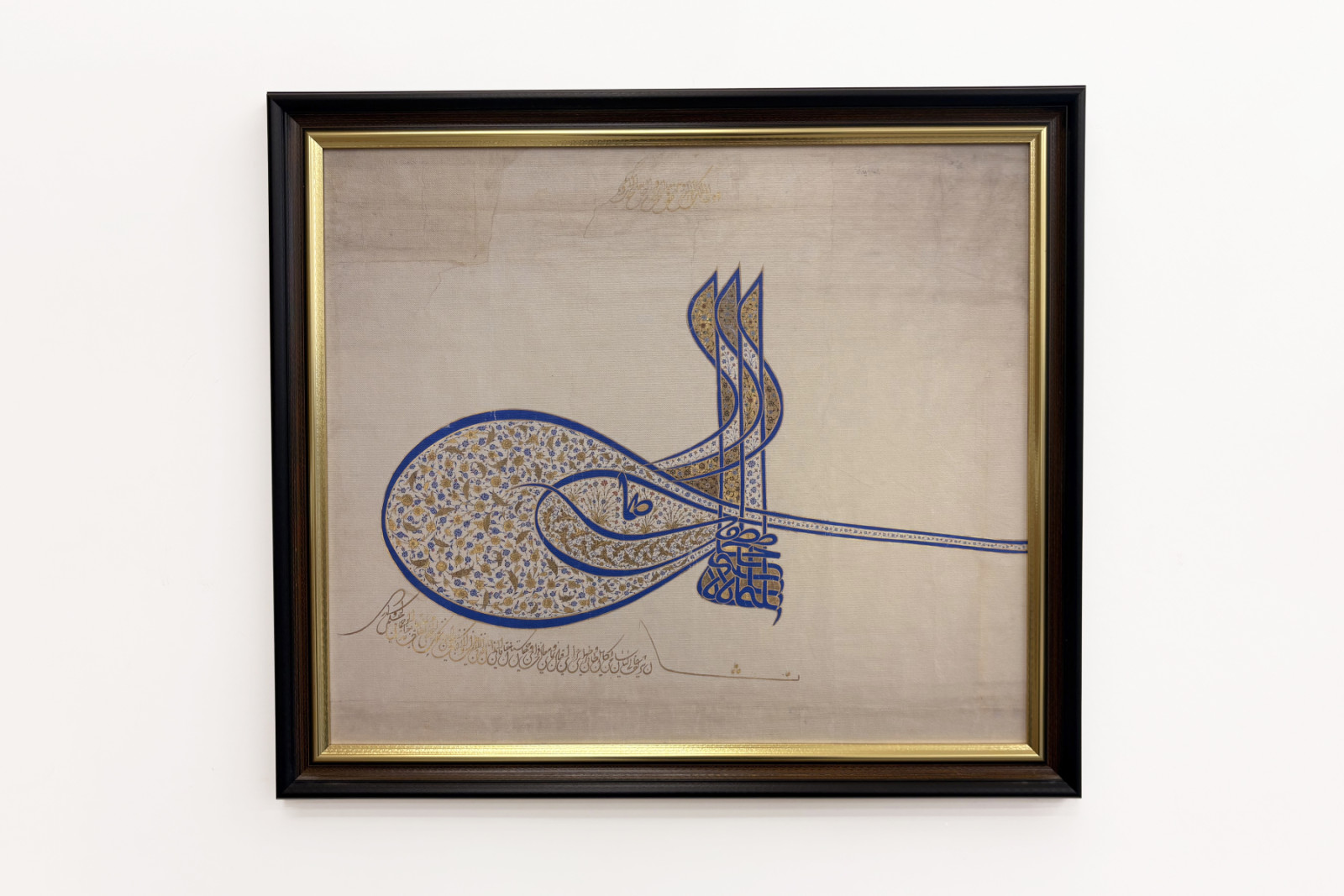
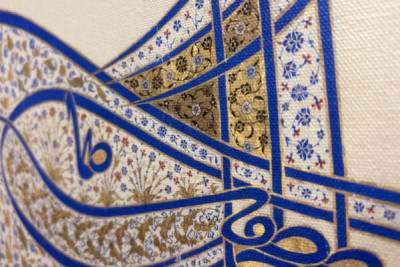
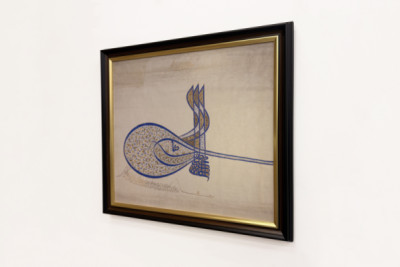
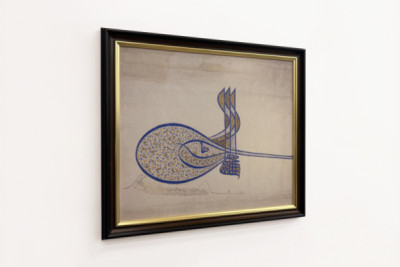
No portrait and no narrative scene commands the viewer’s attention here. At the centre is a symbol of sovereignty comprising script, ornamentation and political power. The tughra bears the name of Sultan Suleiman the Magnificent, along with that of his father, Selim I, and the royal title ‘the Ever-Victorious’. A tughra serves simultaneously as a signature, a seal and a state emblem. Its lines must therefore be legible and make an impression. It achieves both with astonishing calm. Cobalt-blue strokes form loops, arches and three ascending shafts, with golden fields featuring tendrils and small flowers in between. Red and blue appear only sparingly; the beige background leaves plenty of open space - nothing feels cramped. The unknown artist subordinates every ornament to the calligraphic design. Created between 1555 and 1560 in Istanbul, the work belongs to the tradition of Ottoman court art and is now on display at the Metropolitan Museum of Art in New York. I am particularly struck by the decision not to include a portrait of the ruler: Suleiman’s status is evident solely in the controlled movement of the calligraphy.
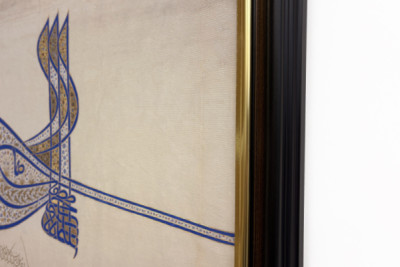
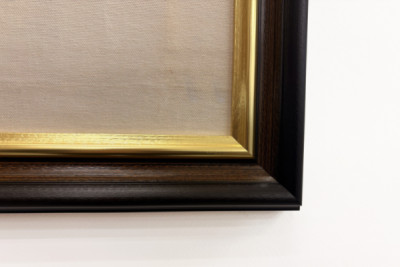
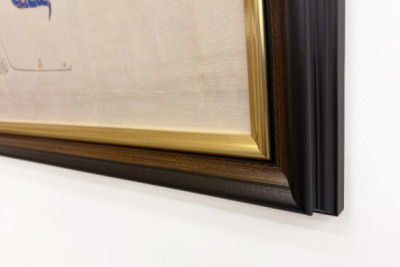
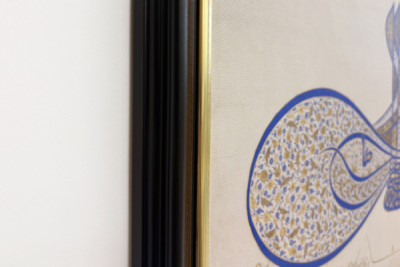
In this piece, the colour coordination is the decisive factor. On the Leonardo canvas with its satin-finished surface, blue and gold sit neatly side by side, and this distinction remains clear, particularly in the narrow bands of the tughra. Lychorida uses a deep black on the outer edge - this makes the cobalt blue in the image appear even more distinct, without becoming darker. Between the two, the light brown hollow bridges the gap to the aged beige tone of the background and prevents a harsh contrast. A narrow strip of gold runs directly along the edge of the image; alongside the golden areas within the design, it looks familiar but does not compete with them, as its line is too narrow for that. My gaze lingers on the lower right-hand corner, as this is where the sequence of colours is most clearly visible: first the beige picture field, then gold, followed by brown, and finally black. Measuring 56 by 48 centimetres, this gradation remains compact. Without a passe-partout, there is no neutral space in between; the image and frame meet directly - which works well here, as the tughra itself consists of clearly defined areas of colour. The long blue inscription extending to the right also gains a definite conclusion thanks to the black outer edge.
 ×
× 





 +43 4257 29415
 support@meisterdrucke.com
 Mo-Do: 7:00 - 16:00 | Fr: 7:00 - 13:00