Amidst glasses, bottles and fruit bowls, a young woman turns her head to one side, whilst the person opposite her leans towards her over the back of his chair. Around the laid table, Renoir depicts a group of rowers, women and men wearing top hats or straw hats. Some figures are engaged in conversation, whilst others observe the goings-on from the background; individual glances cut across the group, linking the staggered sections. The white tablecloth reflects the light in the lower part of the picture. Above it, blue jackets, light-coloured shirts, yellow hats and black suits interplay with the green of the surroundings and the orange of the awning. Renoir organises this abundance not through rigid contours, but through overlapping forms, splashes of colour and shifting lines of sight. This creates the restlessness of a convivial moment without the composition falling apart. The breakfast scene appears both lively and casual at the same time: no one seems to be posing for the painting. Pierre-Auguste Renoir is one of the defining painters of French Impressionism. In this work, created in 1881, he combines the direct observation of modern leisure life with a careful arrangement of figures. Sunlight, clothing and faces are rendered in dynamic brushstrokes; as a result, the scene resembles less a group portrait than a captured afternoon.
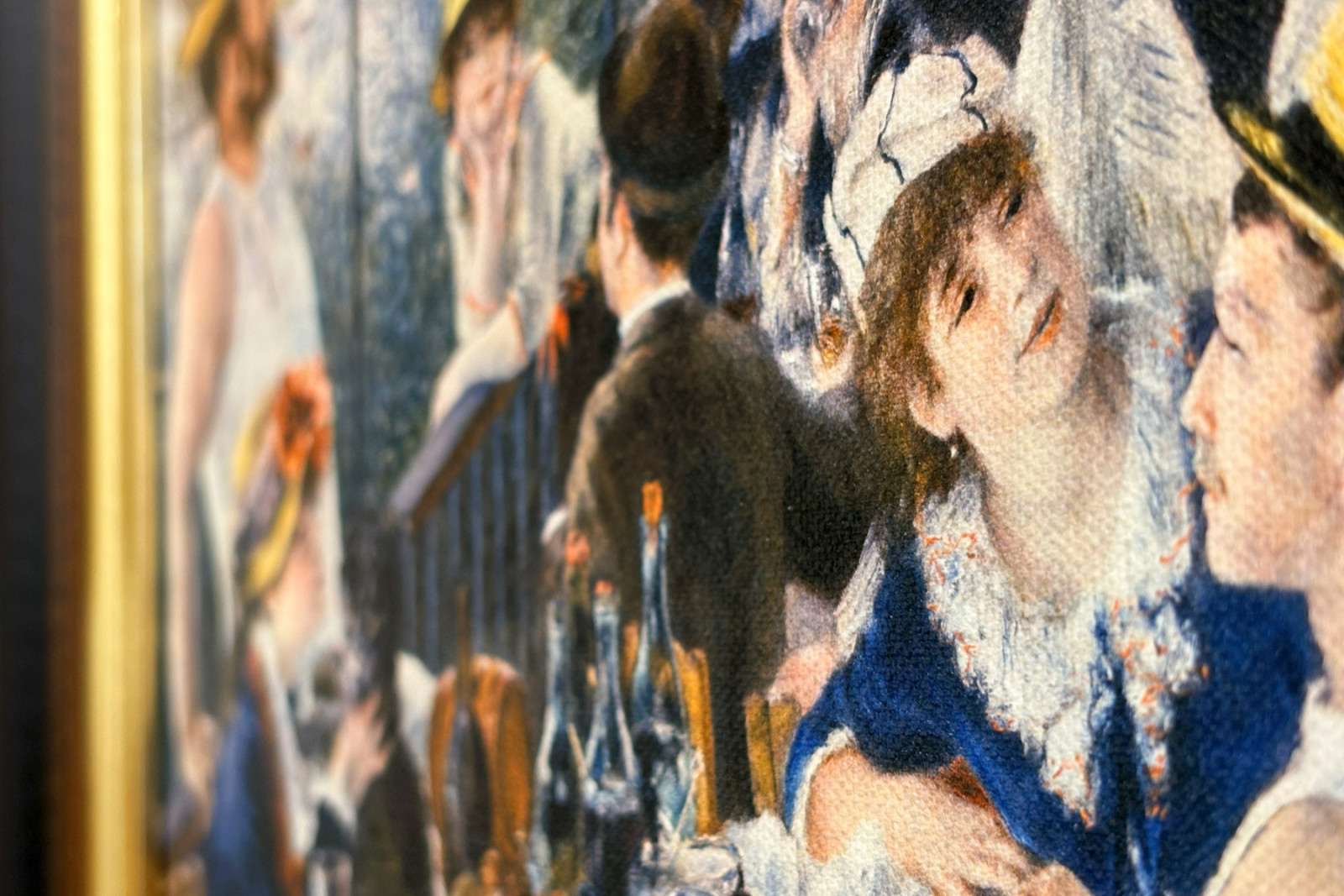
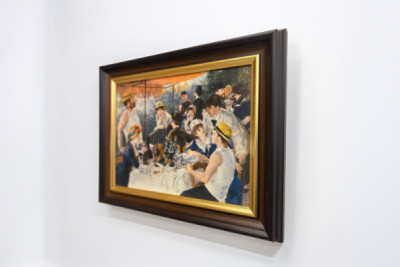
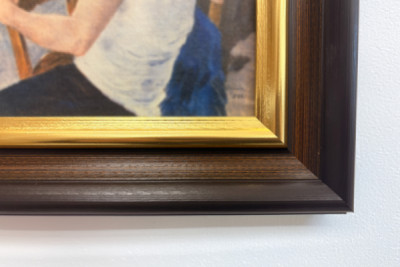
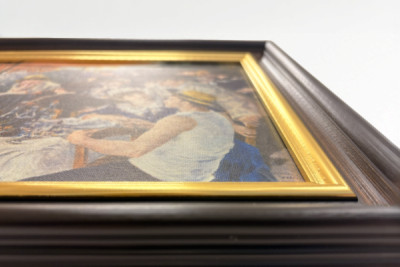
In this version, the Leonardo (satin) canvas features the motif in the format 30 x 22 cm; Lychorida frames it without glass or a passe-partout, using a black outer profile, a light brown moulding and a gold edge. However, the decisive feature of the reproduction is the face of the woman in the blue dress near the centre of the picture. The print clearly reveals her slightly inclined posture: A dark sweep of hair frames her forehead; a few brown and rosy strokes form her eyes, nose and mouth, whilst the light-coloured hat almost blends into the blouse of the standing man. Even from a short distance, it remains evident that Renoir does not model the face smoothly, but rather composes it from small patches of colour. The brushstrokes stand out clearly without breaking the features down into individual grid points. Next to her, the rich blue of the dress and the red accents of the bow stand out against the light-coloured table surface; further in the background, heads and hats gradually dissolve into the green. It is precisely this transition that catches my eye - this is where it is determined whether a reproduction can distinguish between a recognisable figure and an Impressionist dissolution, and this one does. For me, the young woman’s gaze, directed diagonally upwards, carries the whole scene, because it captures a brief moment of undivided attention amidst the babble of voices.
 ×
× 





 +43 4257 29415
 support@meisterdrucke.com
 Mo-Do: 7:00 - 16:00 | Fr: 7:00 - 13:00