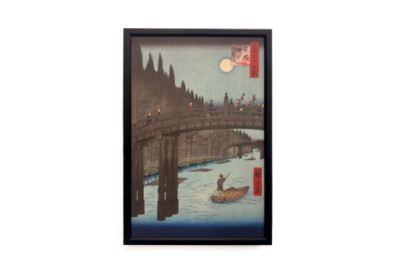
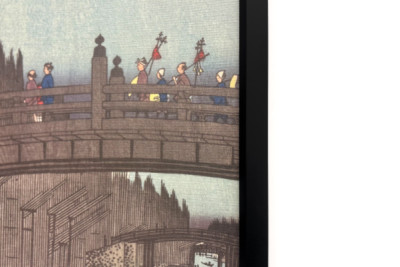
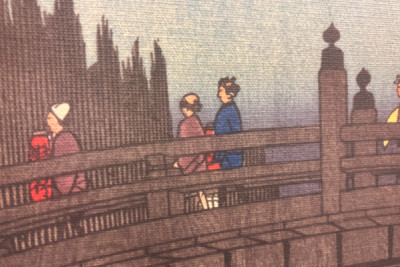
Beneath the full moon, the Capital Bridge stretches across the night-time city, whilst to the left a forest of bundled bamboo poles towers above, and beneath the bridge arch a lone boatmansteers his laden barge across the blue water. On the footbridge, passers-by move along in small groups, some carrying decorated staffs; tiny touches of red, yellow and blue enliven the scene, which is predominantly rendered in brown, black and muted turquoise, without disturbing its evening tranquillity. Ando Hiroshige depicts everyday life in old Edo with the confidence that characterises his late colour woodblock prints: The bridge comes so close to the viewer that its piers and railings almost become the framework of the entire composition, whilst at the same time the watercourse and distant stretches of riverbank open up a long vista into the distance. In 1857, the Japanese ukiyo-e artist did not capture a festive moment in the grand sense, but rather the coexistence of trade, traffic and night; even the bright moon seems less dramatic than matter-of-fact, a calm counterpoint to the dark poles and beams. You can look at it for a long time before you realise just how much is actually happening - and how little of it imposes itself. For me, that is precisely what makes this print so appealing.
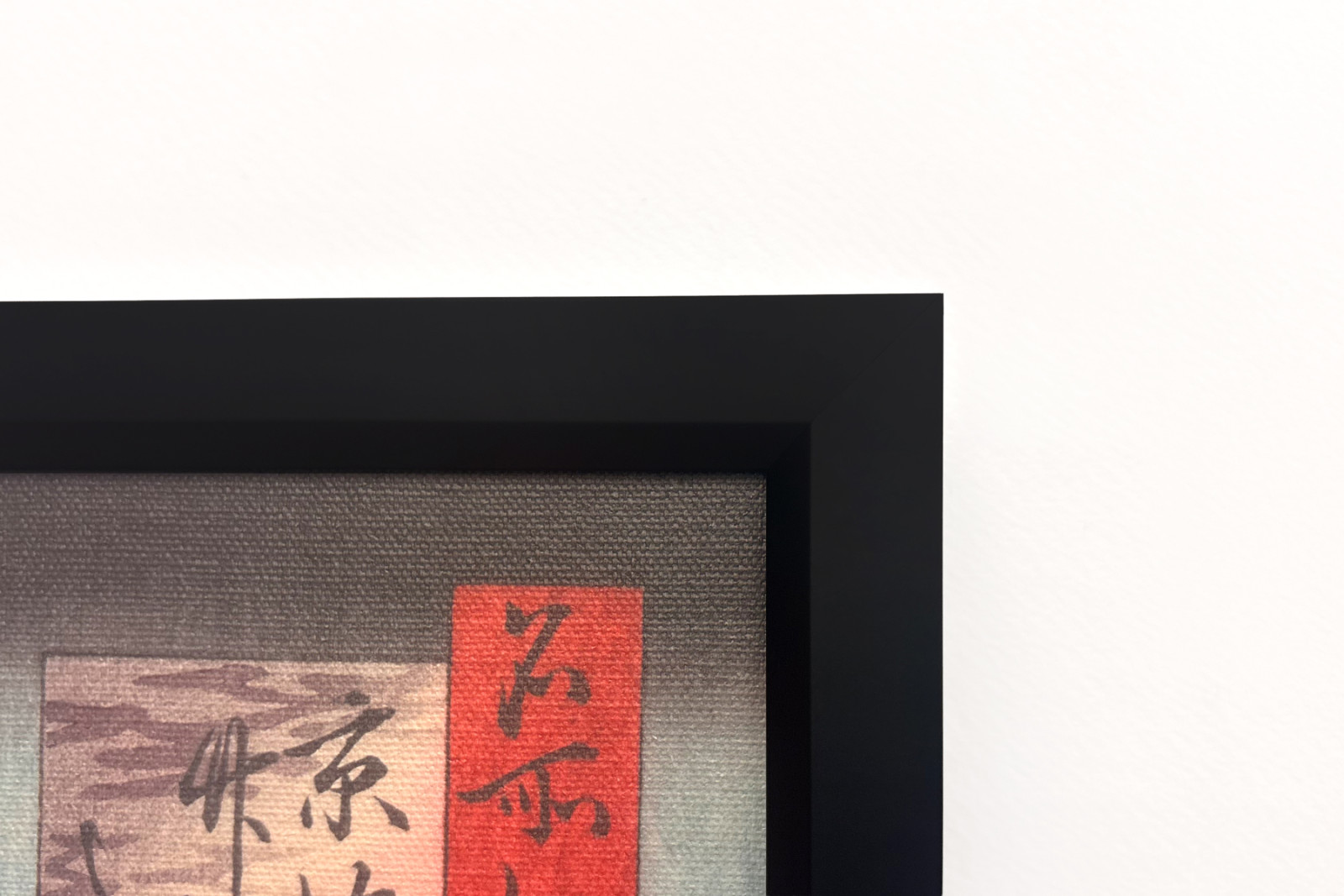
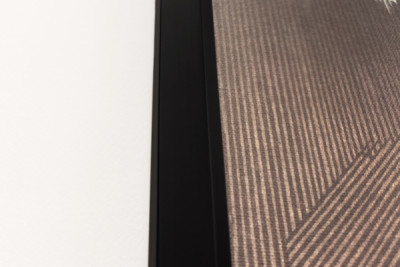
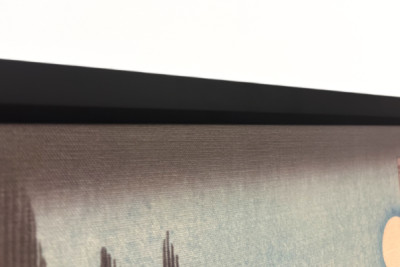
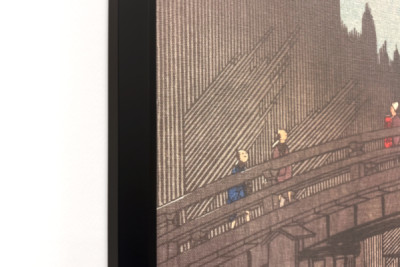
In this piece, Hiroshige’s night scene sits directly within the black ‘Trina’ frame, and the ‘Leonardo’ canvas has exactly the satiny sheen that suits this motif. When light falls from the front, it spreads across the pale blue sky as a flat reflection; the moon retains its creamy roundness, whilst the black characters remain clearly legible. Along the bridge, the same glow breaks up into smaller patches of light; the brown beams largely absorb it, with only a faint sheen lingering on a few individual lines. What I like best is how the surface behaves down in the water: a narrow reflection accompanies the printed waves without turning them into a mirror-like surface. There is no glass here, so there is no harsh secondary reflection on the moon and the figures; Trina draws a matt border around the edge, which barely lightens at the top - simple, almost unobtrusive, which does the print a world of good. Ultimately, it is the individual boatman beneath the bridge arch who determines the effect: whilst the city bustles all around him, on the water he remains entirely at one with himself.
 ×





 +43 4257 29415
 support@meisterdrucke.com
 Mo-Do: 7:00 - 16:00 | Fr: 7:00 - 13:00