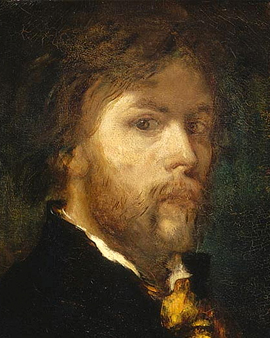
In art, the period between 1880 and 1910 is described as the heyday of symbolism. It is an important current in sculpture and painting, which deals with the access to unconscious processes. This was already relevant before Freud's time. The "Symbolic Manifesto" summarized the movement as follows: "The essential characteristic of Symbolist art is that an idea is never fixed conceptually or expressed directly. The painter, engraver, draftsman and sculptor of this epoch, Gustave Moreau (*1826 in Paris - † 1898 in Paris), who had a decisive influence on Symbolism, concentrated in his works on mystical representations and dream scenes. Gustave Moreau, who had studied at the "École nationale supérieure des Beaux-Arts", undertook numerous trips to Italy to meet artists and see works in the original. Friends who were close to him were the painter Théodore Chassériau and the sculptor and painter Edgar Degas.
His artistic importance is today expressed in a museum in the 9th arrondissement of Paris, the "Musée national Gustave Moreau", where his life's work is documented and his works are made accessible to the public.
Gustave Moreau was of fragile health and did not immediately win prizes for his works. Nevertheless his theme and style prevailed. Above all in painting he made a name for himself. In paintings such as "Oedipus and the Sphinx", the figures and their surroundings are clearly recognizable, but elements are shown that are unreal. He executes the unreal as if it were real. Thus he emphasizes other levels of consciousness as part of our reality(ies). The existence of the psyche, the meaning of the dream and the supernatural find expression in his work. The paintings "Salomé", "Europe and the Bull" or "Hesiod and the Muse" show female and male figures who have wings or are in an unreal environment. Gustave Moreau may not have known this during his lifetime, but dealing with other levels of consciousness was the impetus for the psychoanalysis that developed later. Once again, art was one of the pioneers of significant developments. It stimulates us to think and paves the way for us to walk.
 ×
×







 Passionate Customer Service

.jpg "The Apparition by Gustave Moreau")
.jpg)
 - (MeisterDrucke-195522).jpg "Angel Traveller by Gustave Moreau")
 - (MeisterDrucke-195522).jpg)
.jpg "Jupiter and Semele, 1894-95 by Gustave Moreau")
.jpg)
.jpg "Oedipus and the Sphinx by Gustave Moreau")
.jpg)
.jpg "The Unicorns by Gustave Moreau")
.jpg)
.jpg "Lady Macbeth by Gustave Moreau")
.jpg)
.jpg "The Peri by Gustave Moreau")
.jpg)
 - (MeisterDrucke-221524).jpg "Eve, c. 1880-c. 1885 by Gustave Moreau")
 - (MeisterDrucke-221524).jpg)
.jpg "The Suitors")
.jpg)
.jpg "Dragonfly, c.1884 by Gustave Moreau")
.jpg)
.jpg "St. Sebastian and the Angel, c. 1876 by Gustave Moreau")
.jpg)
.jpg "The Chimera, 1867 by Gustave Moreau")
.jpg)
.jpg "Orpheus, 1865 by Gustave Moreau")
.jpg)
.jpg "Oedipus and the Sphinx by Gustave Moreau")
.jpg)
.jpg "Jason, or Jason and Medea, 1865 by Gustave Moreau")
.jpg)
 - (MeisterDrucke-55748).jpg "The Triumph of Alexander the Great (356-323 BC) by Gustave Moreau")
 - (MeisterDrucke-55748).jpg)
.jpg "The Daughters of Thespius. King Thespios had fifty daughters whom he wanted to unite with Heracles (Hercules), represented at the centre, so that they all had a child by him. Painting by Gustave Moreau (1826-1898). Dimensions 2,5 x 2,5 m. Paris, Musée by Gustave Moreau")
.jpg)
.jpg "Dead Poet Borne by a Centaur by Gustave Moreau")
.jpg)
.jpg "Jacob and the Angel, 1878 by Gustave Moreau")
.jpg)
.jpg "Orpheus, 1865 by Gustave Moreau")
.jpg)
 - (MeisterDrucke-151297).jpg "Ganymede by Gustave Moreau")
 - (MeisterDrucke-151297).jpg)
.jpg "The Fall of Phaethon by Gustave Moreau")
.jpg)
.jpg "The Sacred Elephant Péri by Gustave Moreau")
.jpg)
.jpg "Prometheus by Gustave Moreau")
.jpg)
.jpg "Sketch for Oedipus the Traveler by Gustave Moreau")
.jpg)
.jpg "Salome dances before Herod by Gustave Moreau")
.jpg)
.jpg "The Voices by Gustave Moreau")
.jpg)
.jpg "The Traveling Angels by Gustave Moreau")
.jpg)
.jpg "Arion by Gustave Moreau")
.jpg)
.jpg "The Angels of Sodom by Gustave Moreau")
.jpg)
.jpg "Helen at the Scaean Gate by Gustave Moreau")
.jpg)
_-_(MeisterDrucke-1001852).jpg "Orpheus: A young Thracian girl carrying the head of Orpheus. 1865, 1.54 x 0.99 m, Paris, Musée d")
_-_(MeisterDrucke-1001852).jpg)
.jpg "Christ between the Two Thieves, c. 1870 by Gustave Moreau")
.jpg)
.jpg "The Sphinx Defeated, c. 1878 by Gustave Moreau")
.jpg)
_)_-_(MeisterDrucke-687678).jpg "Sketch (for the two adventurers and the talisman (?)) by Gustave Moreau")
_)_-_(MeisterDrucke-687678).jpg)
.jpg "Hercules and the Lernaean Hydra, 1875-76 by Gustave Moreau")
.jpg)
 - (MeisterDrucke-292256).jpg "Perseus and Andromeda, c. 1867-69 by Gustave Moreau")
 - (MeisterDrucke-292256).jpg)
.jpg "The traveler poet, a meditating thoughtful traveler near the winged horse Pegasus by Gustave Moreau")
.jpg)
.jpg "Salome tattoo. Salome dances in the hall of Herod")
.jpg)
.jpg "Salome dancing before Herod. Salome dances in Herod")
.jpg)
.jpg "The Muses Leaving their Father Apollo to Go Out and Light the World, 1868 by Gustave Moreau")
.jpg)
 - (MeisterDrucke-102342).jpg "Pasiphae and the Bull, c. 1876-80 by Gustave Moreau")
 - (MeisterDrucke-102342).jpg)
.jpg "Salome Dancing before Herod, c. 1876 by Gustave Moreau")
.jpg)
.jpg "Andromeda, chained to a rock, is freed by Perseus. Painting by Gustave Moreau (1826-1898) by Gustave Moreau")
.jpg)
.jpg "Job and the Angels, c. 1890 by Gustave Moreau")
.jpg)
_1861_Paris_-_(MeisterDrucke-948046).jpg "Oedipus and the Sphinx. Painting by Gustave Moreau (1826-1898), 1861. Paris. by Gustave Moreau")
_1861_Paris_-_(MeisterDrucke-948046).jpg)
_-_(MeisterDrucke-1709353).jpg "Dejanira (Autumn) by Gustave Moreau")
_-_(MeisterDrucke-1709353).jpg)
.jpg "Salome Dancing Before Herod, c. 1874 by Gustave Moreau")
.jpg)
_-_(MeisterDrucke-1082082).jpg "Peacock complaining to Juno, by Gustave Moreau (1826-1898) by Gustave Moreau")
_-_(MeisterDrucke-1082082).jpg)
.jpg "The Infant Moses, c.1876-78 by Gustave Moreau")
.jpg)
.jpg "The Rape of Europa, c.1869 by Gustave Moreau")
.jpg)
.jpg "Galatea, 1880-81 by Gustave Moreau")
.jpg)
.jpg "The Appearance. Salome, after dancing in the hall of the feast of Herod, asks for the head of Saint John the Baptist. She points her finger towards the head of the prophet while Herodias stands behind her. Painting by Gustave Moreau by Gustave Moreau")
.jpg)
.jpg "Diomedes Devoured by his Horses, c.1865-1870 by Gustave Moreau")
.jpg)
.jpg "The Traveller or Oedipus the Traveller or Equality before Death: Oedipus before the Sphinx. Painting, 19th century. 0.93 x 1.24 m. Metz, Musée des Beaux-Arts by Gustave Moreau")
.jpg)
_and_the_Muses_-_(MeisterDrucke-71941).jpg "Hesiod (c.700 BC) and the Muses by Gustave Moreau")
_and_the_Muses_-_(MeisterDrucke-71941).jpg)
.jpg "Salome Dancing by Gustave Moreau")
.jpg)
.jpg "Diomedes Being Eaten by his Horses, 1865 by Gustave Moreau")
.jpg)
_Photography_KIM_Y_-_(MeisterDrucke-1419211).jpg "Prometheus. Oil Painting on Canvas by Gustave Moreau (1826-1898). Photography, KIM Youngtae, Paris, Musée Gustave Moreau. by Gustave Moreau")
_Photography_KIM_Y_-_(MeisterDrucke-1419211).jpg)
.jpg "Oedipus and the Sphinx by Gustave Moreau")
.jpg)
_Sun_110_X_-_(MeisterDrucke-1001918).jpg "The Park and the Angel of Death. Oil. 1.10 x 0.37 m. Paris, Musée Gustave Moreau by Gustave Moreau")
_Sun_110_X_-_(MeisterDrucke-1001918).jpg)
.jpg "The Rape of Europa, c.1869 by Gustave Moreau")
.jpg)
.jpg "St. Elisabeth of Hungary, or The Miracle of the Roses, 1879 by Gustave Moreau")
.jpg)
.jpg "Perseus and Andromeda, 1882 by Gustave Moreau")
.jpg)
.jpg "Ulysses and the Mermaids by Gustave Moreau by Gustave Moreau")
.jpg)
.jpg "Saint Cecilia by Gustave Moreau")
.jpg)
.jpg "Oedipus and the Sphinx, 1864 by Gustave Moreau")
.jpg)
_-_(MeisterDrucke-1718228).jpg "Sphinx in a Grotto (Poet, King and Warrior) by Gustave Moreau")
_-_(MeisterDrucke-1718228).jpg)
_-_(MeisterDrucke-965825).jpg "Leda and the Swan. Drawing by Gustave Moreau by Gustave Moreau")
_-_(MeisterDrucke-965825).jpg)
.jpg "Sketch by Gustave Moreau")
.jpg)
.jpg "The Good Samaritan by Gustave Moreau")
.jpg)
_-_(MeisterDrucke-1652410).jpg "Dead Poet Carried by a Centaur by Gustave Moreau")
_-_(MeisterDrucke-1652410).jpg)
_Before_1889_Paris_Arts_Decorat_-_(MeisterDrucke-983390).jpg "The Voices by Gustave Moreau")
_Before_1889_Paris_Arts_Decorat_-_(MeisterDrucke-983390).jpg)
.jpg "Putto after Raphael. Copy of Raphael")
.jpg)
_-_(MeisterDrucke-687583).jpg "Landscape. Sketch (at the Sphinx) by Gustave Moreau")
_-_(MeisterDrucke-687583).jpg)
.jpg "The Tears of Orpheus by Gustave Moreau")
.jpg)
_-_(MeisterDrucke-1340499).jpg "Leda and the Swan by Gustave Moreau")
_-_(MeisterDrucke-1340499).jpg)
.jpg "The appearance. The decapitated head of John the Baptist appears in front of the dancer Salome at the court of Herod I the Great (73-4 BC). Watercolour by Gustave Moreau (1826-1898) 1876 by Gustave Moreau")
.jpg)
_and_Semel_(blasted)_by_Gustave_Moreau_-_(MeisterDrucke-965970).jpg "Jupiter (Zeus) and Semele (blasted) by Gustave Moreau")
_and_Semel_(blasted)_by_Gustave_Moreau_-_(MeisterDrucke-965970).jpg)
.jpg "The Song of Songs by Gustave Moreau")
.jpg)
.jpg "Les Pretendants, 1862-98 by Gustave Moreau")
.jpg)
 - (MeisterDrucke-683552).jpg "Untitled (Color Sketch) by Gustave Moreau")
 - (MeisterDrucke-683552).jpg)
.jpg "Saint George and the Dragon by Gustave Moreau")
.jpg)
_Muse_Gustave_Moreau_-_(MeisterDrucke-992023).jpg "Salome Dancing by Gustave Moreau")
_Muse_Gustave_Moreau_-_(MeisterDrucke-992023).jpg)
.jpg "Humanity: from TtoB, Two Scenes Depicting The Silver Age Represented by Orpheus; Two Scenes Depicting The Iron Age Represented by Cain and Abel (mural) (detail) by Gustave Moreau")
.jpg)
.jpg "Pythéas, conspirator and drunken parasite, character from Opéra de Sapho by Gustave Moreau")
.jpg)
_-_(MeisterDrucke-1576163).jpg "Dejanira (Autumn) by Gustave Moreau")
_-_(MeisterDrucke-1576163).jpg)
 c1872-3 - (MeisterDrucke-119070).jpg "Dejanira (Autumn), c.1872-3 by Gustave Moreau")
 c1872-3 - (MeisterDrucke-119070).jpg)
.jpg "Sketch by Gustave Moreau")
.jpg)
_-_(MeisterDrucke-1652413).jpg "Salome by Gustave Moreau")
_-_(MeisterDrucke-1652413).jpg)
_and_the_Muses_Painting_by_Gustave_Moreau_-_(MeisterDrucke-1002802).jpg "The Greek poet Hesiod (8th century BC) and the Muses by Gustave Moreau")
_and_the_Muses_Painting_by_Gustave_Moreau_-_(MeisterDrucke-1002802).jpg)
.jpg "The Apparition by Gustave Moreau")
.jpg)
_-_(MeisterDrucke-1652397).jpg "Ulysses and the Sirens by Gustave Moreau")
_-_(MeisterDrucke-1652397).jpg)
.jpg "The Chimera, 1866 by Gustave Moreau")
.jpg)
.jpg "The Chimera by Gustave Moreau")
.jpg)
_-_(MeisterDrucke-1654003).jpg "Sappho, falling by Gustave Moreau")
_-_(MeisterDrucke-1654003).jpg)
.jpg "The Vision by Gustave Moreau")
.jpg)
.jpg "Helen on the Ramparts of Troy by Gustave Moreau")
.jpg)
_-_(MeisterDrucke-1652412).jpg "The Sirens by Gustave Moreau")
_-_(MeisterDrucke-1652412).jpg)
_-_(MeisterDrucke-896460).jpg "The Unicorns by Gustave Moreau")
_-_(MeisterDrucke-896460).jpg)

 +43 4257 29415
 support@meisterdrucke.com
 Mo-Do: 7:00 - 16:00 | Fr: 7:00 - 13:00