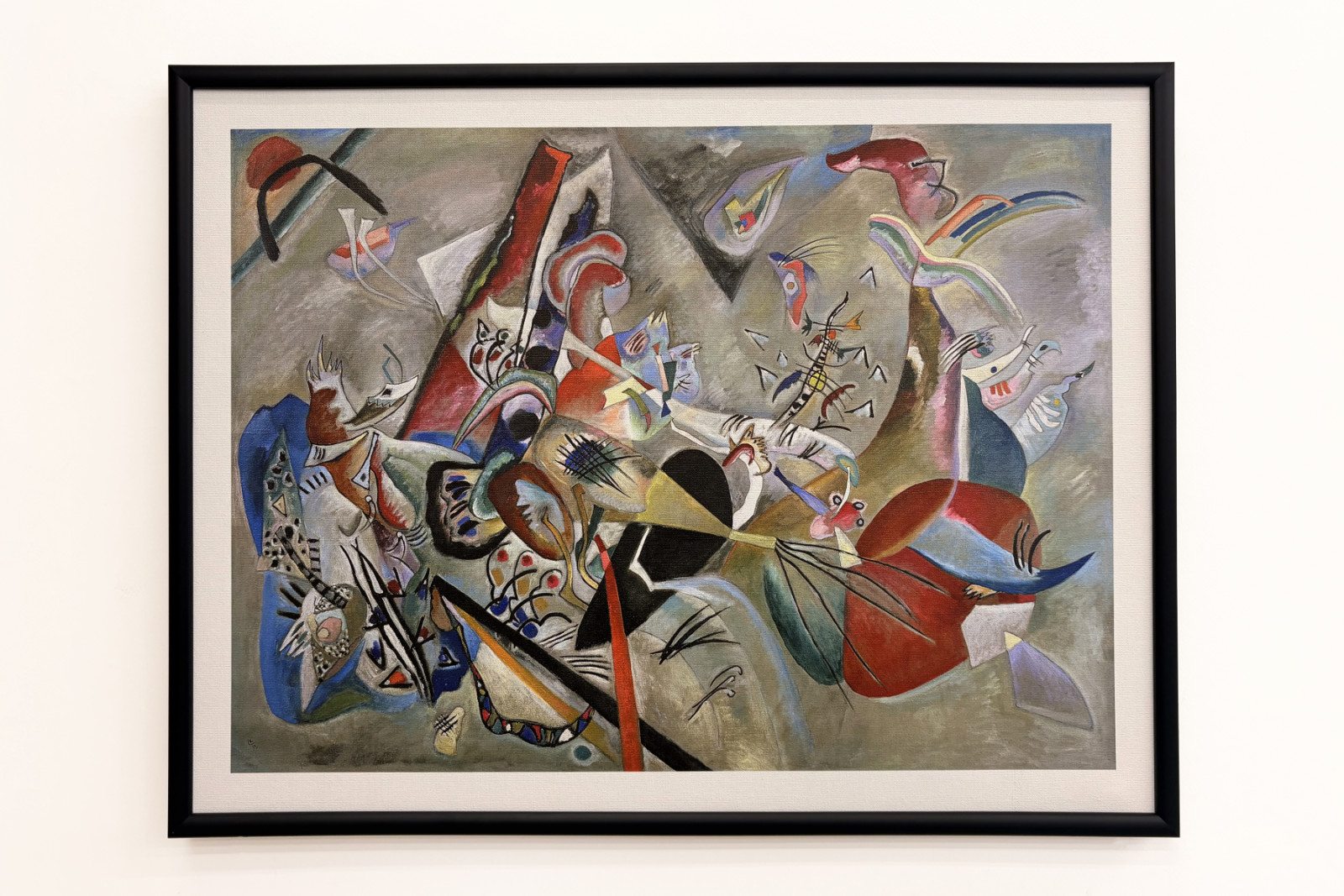
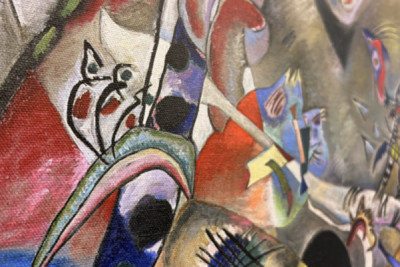
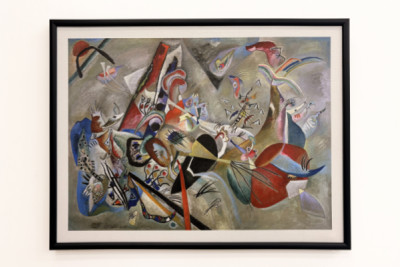
There is no central point holding this composition together - instead, red wedges, blue arches and bundles of black lines drift across a grey-green background that carries them like murky water. If you look for a little longer, you will discover clusters: at the bottom left, a blue field with fine white marks; in the centre, a black shape from which bundles of lines grow like blades of grass; and on the right, a large red curve with a blue arch. Wassily Kandinsky painted ‘In Grey’ in Moscow in 1919, during the turbulent years following the Revolution, and the painting marks a transition: The free, almost musical forms of his Munich period are still present, yet they are already arranged in a stricter, more geometric manner - the path to the Bauhaus, to which he was appointed in 1922, is beginning to take shape. The grey is not merely a silent background, but the tone that mutes and unifies all the colour; as a result, the painting appears less loud than much of Kandinsky’s work, and is instead more contemplative and introspective.
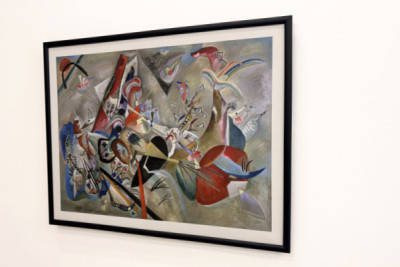
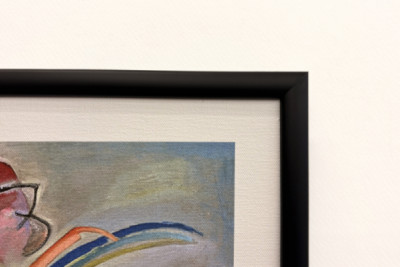
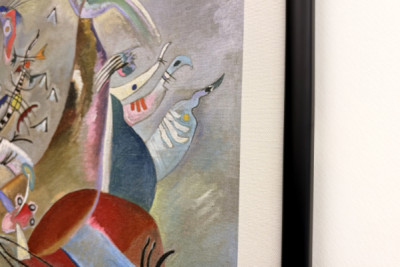
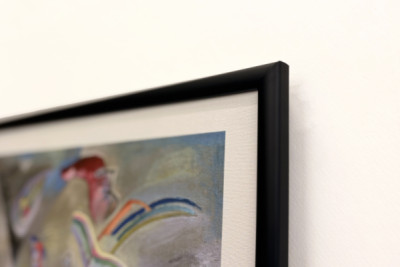
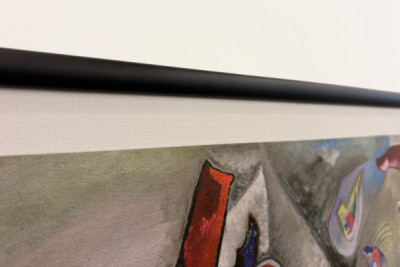
The satin-finished Leonardo canvas bears the motif, measuring 60 x 44 cm, whilst a narrow strip of unprinted white fabric remains around the edges. It is precisely this light border that determines the effect: it separates Kandinsky’s muted grey tones from the deep black, slightly rounded moulding called Friedegarde, so that the black never directly meets the grey of the painting. Without this space, the frame and the background would probably merge into one another; as it is, however, the red and blue forms stand between two distinct poles - white on the inside, black on the outside. I consider it the best decision in this piece that such a narrow black border, of all things, lends the image this clarity amidst the grey.
 ×
× 





 +43 4257 29415
 support@meisterdrucke.com
 Mo-Do: 7:00 - 16:00 | Fr: 7:00 - 13:00