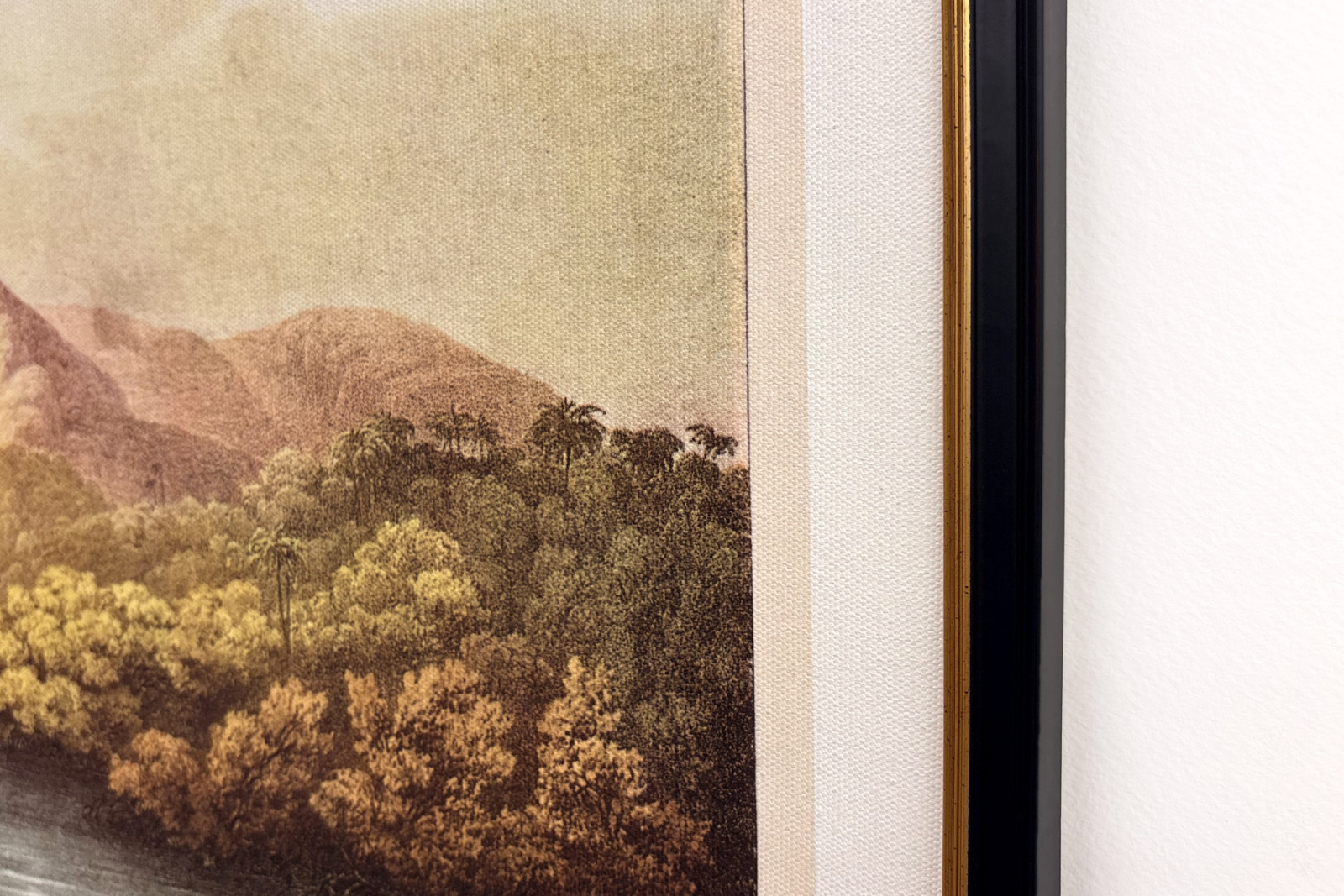
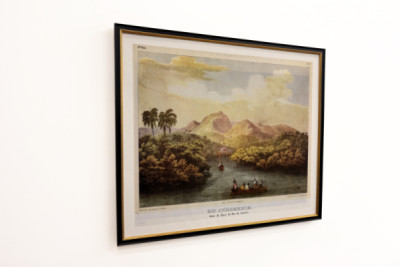
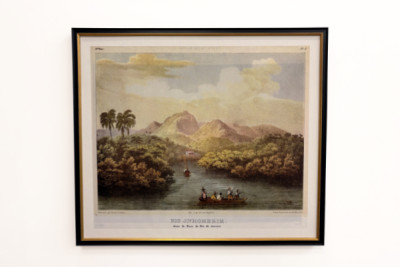
A wide river winds its way between overgrown banks into a mountainous landscape, above which high clouds are gathering. In the foreground, a narrow boat cuts through the calm water; five figures are sitting and standing in it, some holding long poles or oars. Further in the background, a second boat’s orange mast stands out against the green of the banks. Palm trees on the left mark the transition from the river to the forest, whilst the terraced ridges guide the eye towards the horizon. Ochre, olive green and muted blue dominate the colour scheme. The light remains soft and is diffused across the sky, mountain slopes and treetops, without sharply emphasising any single area. In 1835, Johann Moritz Rugendas arranged the landscape in distinct layers of depth: water, vegetation, mountains and sky follow one another, whilst the human figures appear small within the vast natural setting. This combines topographical accuracy with a tranquil, almost contemplative atmosphere.
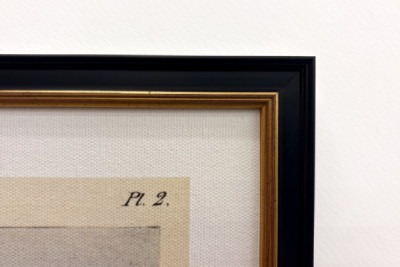
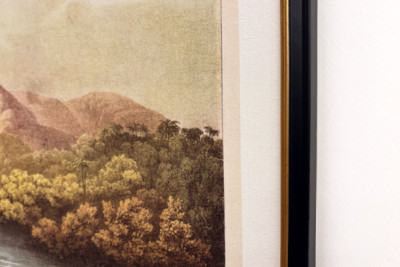
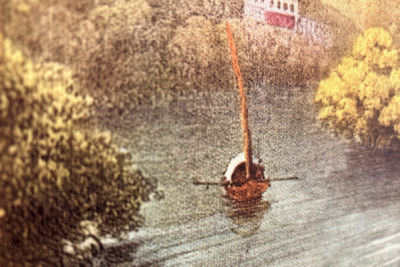
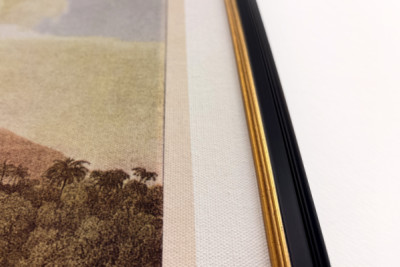
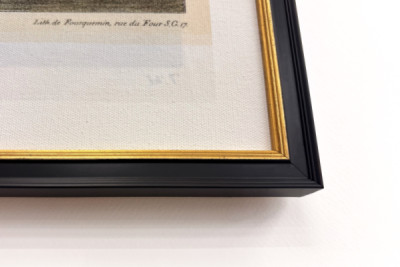
In this version, the matt canvas ‘Salvador’ bears the motif without glass; ‘Amelie’ frames the surface in black with a narrow gold border. What catches the eye when examining the finished work is the small sailing boat in the middle of the river. Its dark hull, the curved remnant of a white sail and the orange mast are clearly distinct from one another in the print, even though they occupy only a few centimetres within the landscape. Even the brief reflection beneath the boat remains discernible and links it to the horizontal lines of the water. In the boat in the foreground, too, the figures retain recognisable postures: an upright torso, bowed heads and poles positioned at an angle form a small sequence of movements. One might object that the details are minuscule - but it is precisely the relationship between the small boats and the wooded hills that makes the spatial expanse of the motif so palpable.
 ×
× 





 +43 4257 29415
 support@meisterdrucke.com
 Mo-Do: 7:00 - 16:00 | Fr: 7:00 - 13:00