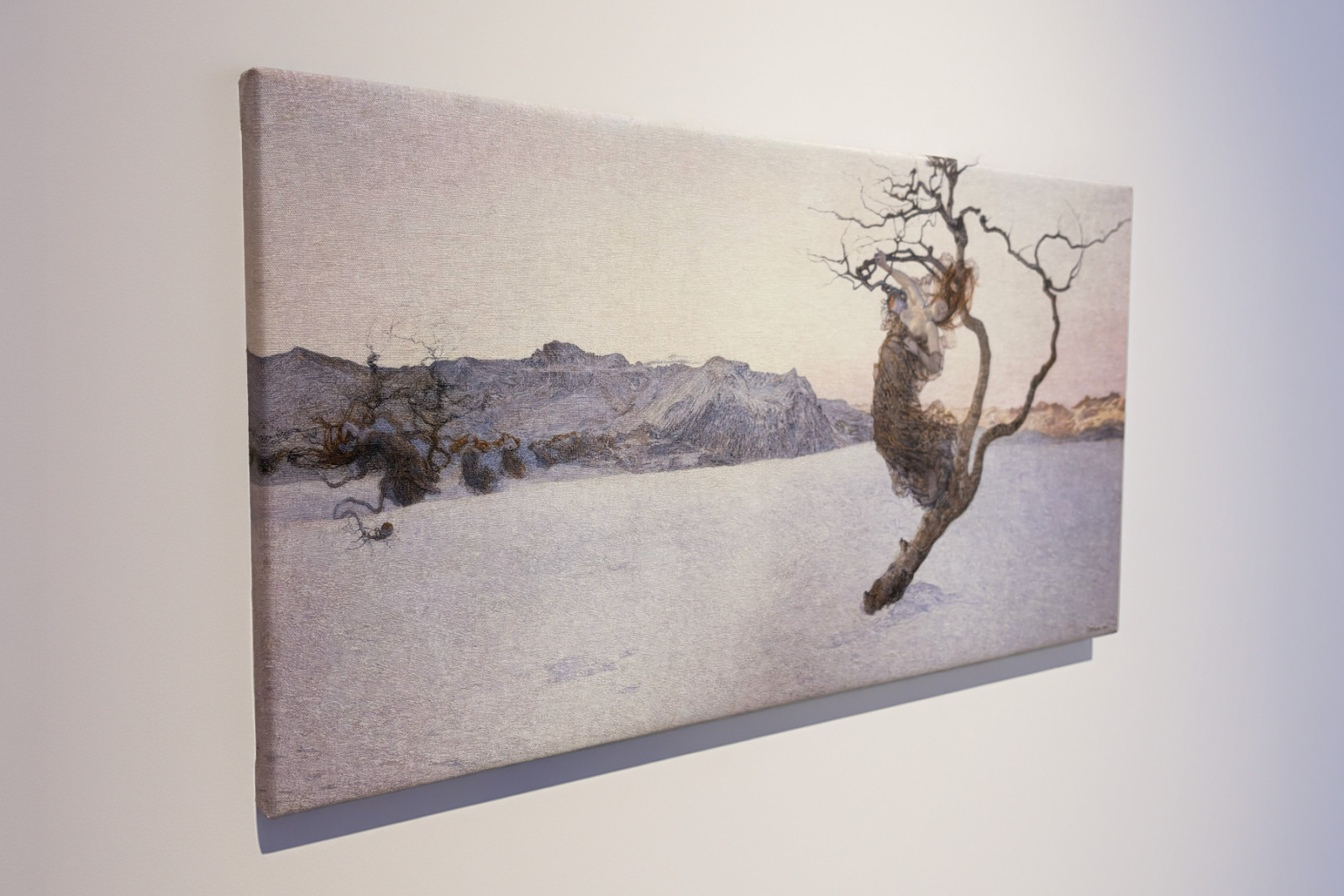
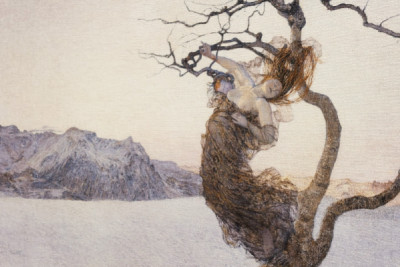
A woman hangs from the bare branches of a gnarled tree, her hair blown into the boughs by the wind, whilst a child’s head presses against her breast - around her, nothing but snow, a high valley shimmering with violet light, and distant peaks bathed in the last light of evening. Giovanni Segantini painted this scene in 1894 as part of his so-called ‘Nirvana’ cycle, inspired by a poem that condemns mothers who have cast their children out: they wander through an icy limbo until reconciliation with their child sets them free. What sounds morally austere comes across in the painting above all as tranquil and ethereal. The Symbolist and Divisionist, who spent his final years in the Engadin mountains, composes the landscape from thousands of fine threads of colour - lilac, ochre, cool blue - so that the snow appears to shimmer and the horizon glows like a thin strip of gold. The figure itself remains semi-transparent, more an apparition than a physical form, and it is precisely this balance between the harshness of the subject matter and the delicacy of the painting that makes the work so compelling.
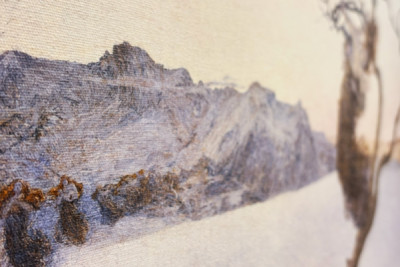
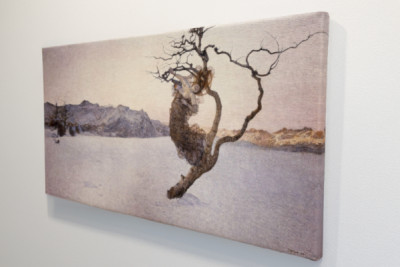
This version translates this into an elongated landscape format measuring 68 x 35 cm, which, on the wall, almost resembles a panoramic window: the landscape stretches out horizontally, whilst the tree with the captive provides the sole vertical accent. Unframed, as a stretched canvas with printed edges all round, the piece hangs freely in front of the wall - the mountain range continues round the left-hand side, lending the flat format additional depth. From a distance of two or three metres, the whole piece appears as a tranquil strip of colour; only upon approaching do Segantini’s woven brushstrokes reveal themselves, and the satin finish of the Leonardo canvas allows the golden hue on the horizon to glow ever so slightly - a detail that holds your gaze longer than expected. Beneath the lower edge, the stretcher frame casts a narrow shadow; this gives the painting a tangible presence in the room, rather than making it appear to stick to the wall.
Precisely because the format is so low, nothing imposes itself - you walk past it, pause, and step closer. Whether above a sideboard or on its own against a quiet wall, this flat strip of winter exerts a pull that larger formats often fail to achieve.
 ×
× 





 +43 4257 29415
 support@meisterdrucke.com
 Mo-Do: 7:00 - 16:00 | Fr: 7:00 - 13:00