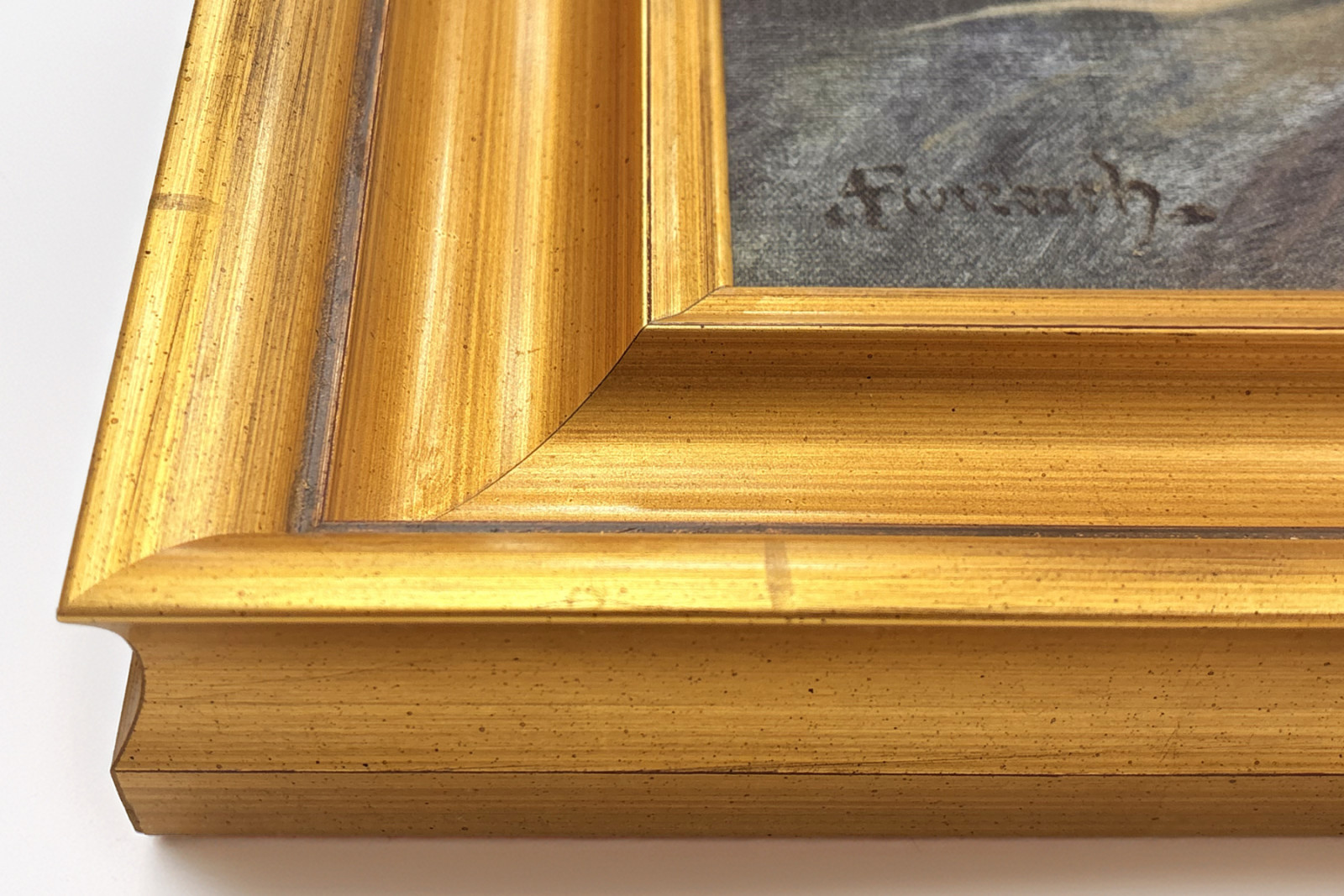
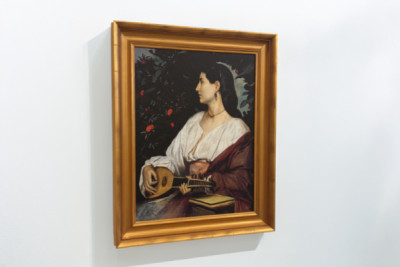
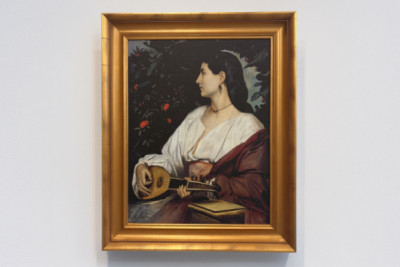
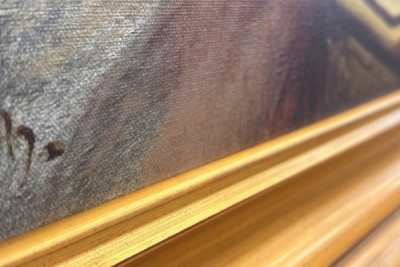
No performance, no audience - just a young woman who, in the shadow of dark branches, picks up her mandolin whilst gazing into the void, as if she were already listening for the next note. Anselm Feuerbach painted this ‘Mandolin Player’ in 1865, and the scene comes alive precisely through this sense of casualness: the white blouse loosely draped over her shoulder, the dark red cloak over it, and behind her, almost black foliage from which a few red blossoms shine. Her profile remains serious, wholly absorbed in the music. Nanna Risi is often cited as the model - the Roman woman whom Feuerbach painted time and again during those years - a story one can readily believe when looking at her face with its classical, serene austerity. The signature sits at the bottom left, drawn thinly and fluidly, directly above the edge of the table.
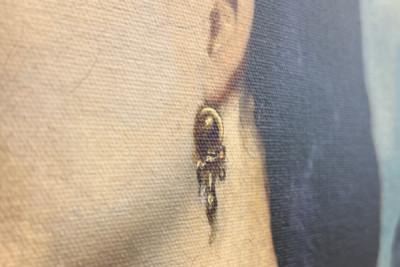
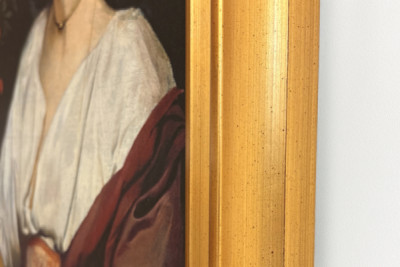
The whole piece is printed on Leonardo, a satin-finished canvas, measuring 48 x 62 cm. If you look closely, for example at the golden earring, you can see the fine grid of the weave running across the cheek and neck: The dark areas almost swallow it up, whilst the light ones reveal it - thus the surface acquires a subtle physicality that comes closer to an oil painting than one might expect. It is only later that the frame comes into its own: Luisa, a gold profile made in Austria, 76 mm wide, whose three staggered lines draw the eye inwards. A substantial frame for such a tranquil subject, yet it is precisely this that carries the composition - weight on the outside, tranquillity on the inside. Here, then, hangs a work from Feuerbach’s years in Rome, during which he painted his most serene pictures.
 ×
×






 +43 4257 29415
 support@meisterdrucke.com
 Mo-Do: 7:00 - 16:00 | Fr: 7:00 - 13:00