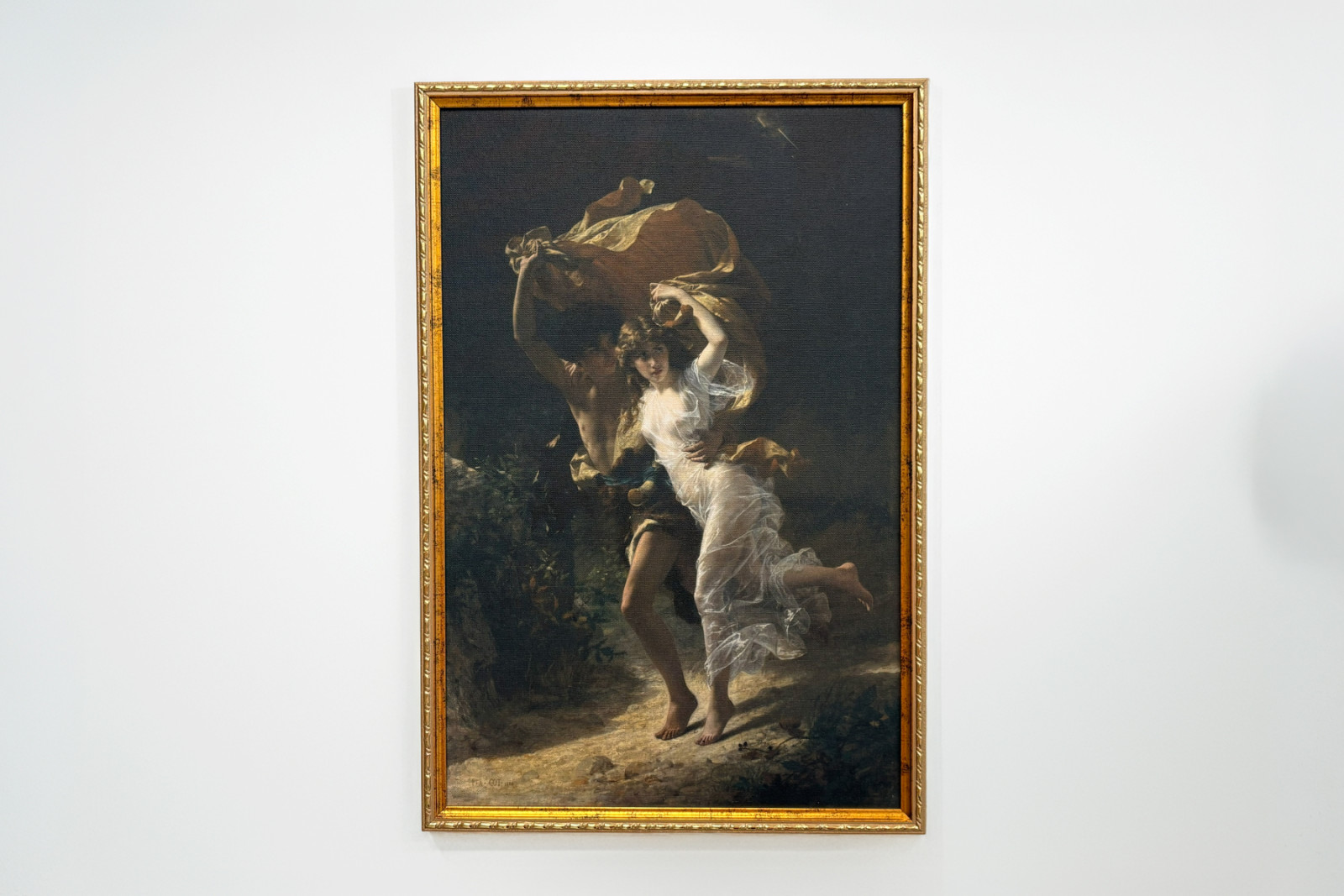
Barefoot, the two of them run through the storm, a shared golden-yellow cloth stretched over their heads, which the wind billows like a sail. He wraps his left arm around her waist; she holds the cloth steady with her arm raised and turns her gaze back - towards the spot where a bolt of lightning has just split the dark sky. Her white gown is so thin that it flutters almost transparently as she runs; his body remains half in shadow, only his shoulder and arm catching the light. Cot builds the entire narrative around this single moment: the race against the rain that has not yet fallen. The path beneath her bare feet glows brightly, as if the sun had found one last window, whilst to the left the bushes are already plunging into darkness. You can almost feel the movement - the young woman’s bent leg, the stones swirled up from the ground, the shawl that could fly away at any moment. And yet there is something playful about their flight, almost a smile: the two are not fleeing from danger, they are fleeing together. It is precisely this duality of drama and lightness that has made the painting famous, and it works astonishingly well even in this small format.
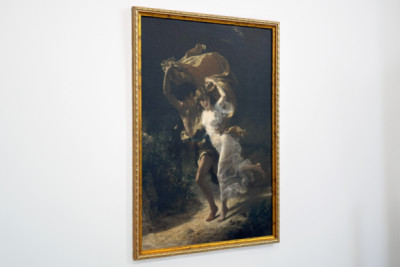
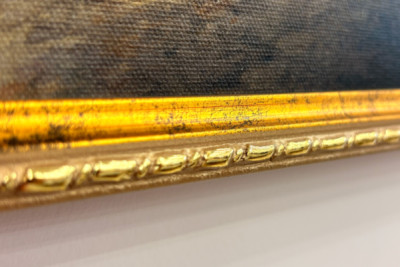
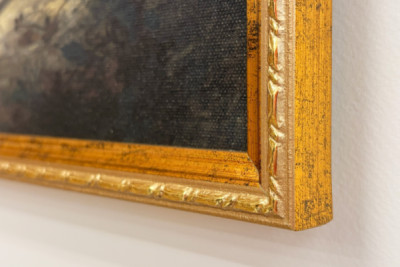
The whole piece is executed as a print on Leonardo canvas, 33 x 50 cm, with a satin finish - and this surface makes all the difference here. The sky, which takes up a good two-thirds of the surface, is deep and dark; on a glossy material it would become a mirror; on matt paper, a dead black hole. The satin finish transforms it into something else entirely: it casts a subtle shimmer over the black, which shifts as you walk past without ever becoming a harsh reflection. Standing directly in front of it, the background remains velvety and opaque; stepping to the side, the diffused light briefly lifts the fabric out of the darkness and allows the night sky almost to breathe. The yellow cloth, by contrast, glows with its own light, as if it had a monopoly on brilliance. The ‘Noemi’ frame encloses the canvas: a narrow gold moulding with a twisted ornament on the outer edge and a dark patina on the profile - it bridges the gap to the era from which the work originates, without overwhelming the small format. I was surprised by how differently the frame and the picture surface react to the same light: the polished ornament casts bright sparks, whilst the canvas right next to it merely glows softly. This alternation between a sharp flash of gold and a matt night-time shimmer mirrors, right at the edge, exactly what is happening in the motif - and that is no small feat for a moulding just a few centimetres wide.
 ×
×








 +43 4257 29415
 support@meisterdrucke.com
 Mo-Do: 7:00 - 16:00 | Fr: 7:00 - 13:00