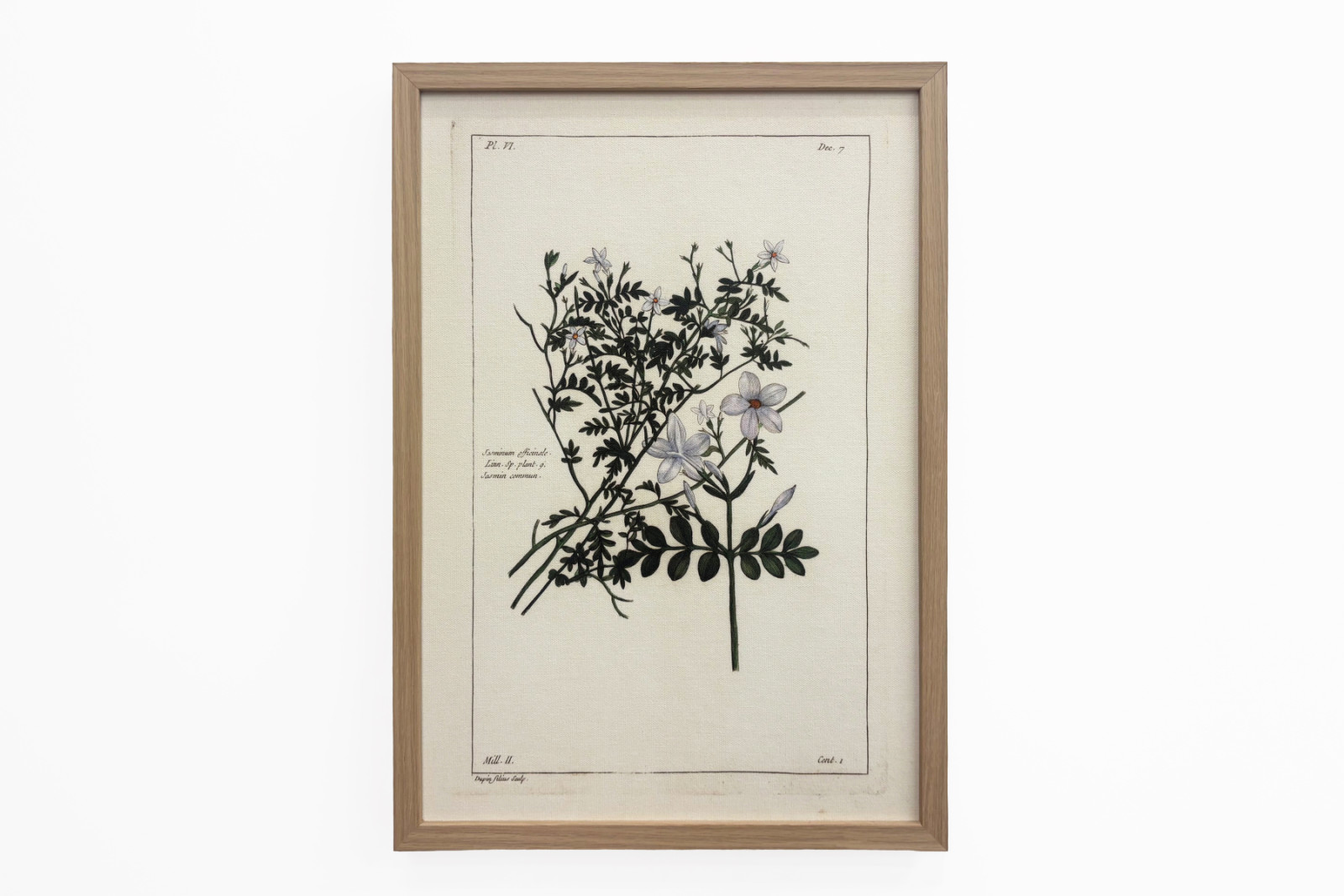
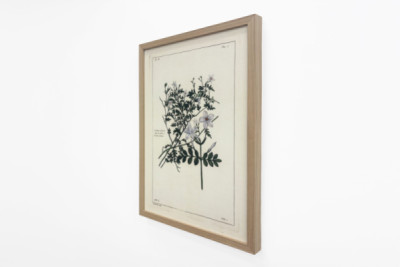
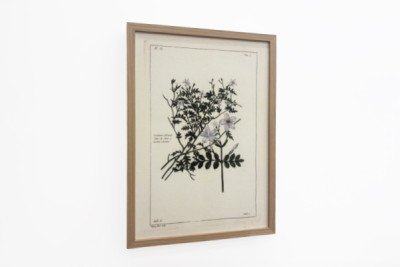
Two borders, not one: on the inside, a black line runs around the sheet - the old plate edge of the engraving - and a few centimetres further out, the oak moulding begins again. In between lies a strip of yellowed ground on which only the numbers remain: ‘Pl. VI.’ and ‘Dec. 7’ at the top, ‘Mill. II.’ and ‘Cent. 1’ at the bottom, along with the small signature ‘Dupin filius sculp.’ Only then does the jasmine itself appear. A twig rises from below, branching into almost black shoots with pinnate leaves, and in the top right-hand corner two whiteflowers with edges tinged with violet and an orange-red dot in the centre. Smaller stars are scattered amongst the branches, and a cluster of buds hangs down on the right. Next to the plant, the botanical name according to Linnaeus, ‘Jasminum officinale’, is written in italics, with the French ‘Jasmin commun’ below it. Dupin the Younger, an 18th-century engraver, created this plate as part of a collection of plants: the numbering in decades and centuries reveals that it was one of many. Nevertheless, it does not look like a catalogue entry. The shoots reach out so haphazardly to the left and upwards, as if someone had only just brought the twig in from the garden, and the dark green of the leaves makes the few flowers shine all the more brightly. No background, no shadow, just the plant and the paper.
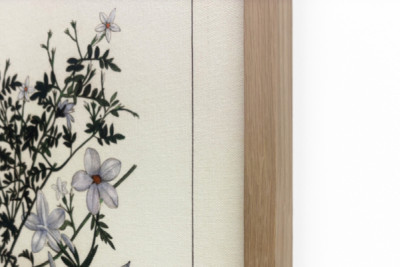
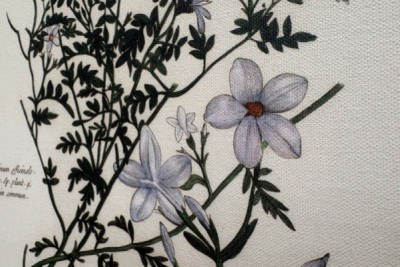
Hanging on the wall, the piece is understated and small. Measuring 30 x 44 cm, it takes up roughly the same space as an open book, and that is exactly how it hangs there: a single sheet, upright, with nothing beside it. The frame, Sinead, consists merely of a narrow oak edge, the grain of which is more clearly visible from the side than from the front. Only when you stand next to it do you realise how far the frame protrudes from the picture surface; the canvas sits set back slightly, and a narrow shadow falls across the background at the left-hand inner edge. No glass, no passe-partout, and therefore no reflection that shifts as you walk past. The sheet remains matt and can be read from any angle, including the tiny signature in the bottom left-hand corner. Satin-the surface used by Leonardo-warms the white slightly, so that the tone of the paper and the wood do not clash; it has no more sheen than that, and that is exactly as it should be for an engraving. What surprises me as I get closer: the hatching in the petals remains as individual strokes, even on the tiniest flowers at the top of the branches, and the orange-red flower centres sit neatly within the outlines. It’s easy to forget that there’s a fabric underneath the paint - the lines of the engraving come through perfectly.
 ×






 +43 4257 29415
 support@meisterdrucke.com
 Mo-Do: 7:00 - 16:00 | Fr: 7:00 - 13:00