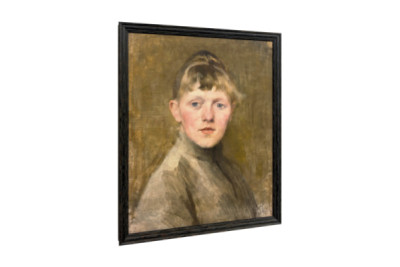
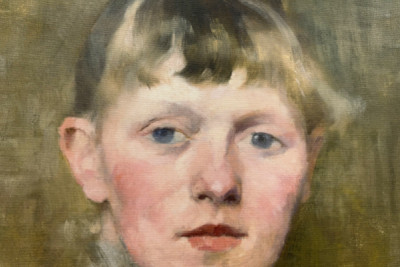
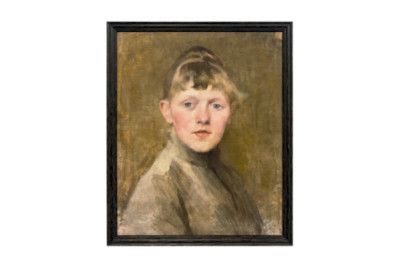
Two eyes, blue-grey and slightly shadowed, hold the viewer’s gaze, whilst everything around them still seems to be in motion: The blouse is little more than a few broad brushstrokes in grey and ochre; the background is a clay-coloured mass in which the canvas shimmers through here and there, and even the hair, combed tightly back with a short fringe, dissolves at the edges into individual strands that blend into the brown of the background. Only the face is finished - the flushed cheek, the small, closed mouth, the straight nose - and it is precisely this contrast between the carefullyconstructed head and the sketch-like rest of the composition is what makes the painting so immediate, as if one were watching the painter as she examines herself in the mirror and decides what is important. Helene Schjerfbeck, born in Helsinki in 1862, paints herself here as a young woman in her early twenties, still very much in theof the naturalist painting of those years, with muted earth tones and light falling obliquely from the left onto her forehead and the bridge of her nose; the radically simplified self-portraits of her later decades, for which she is best known today, are still a long way off. What is already becoming apparent, however, is the unadorned, almost expectant gaze that neither asserts nor conceals anything.
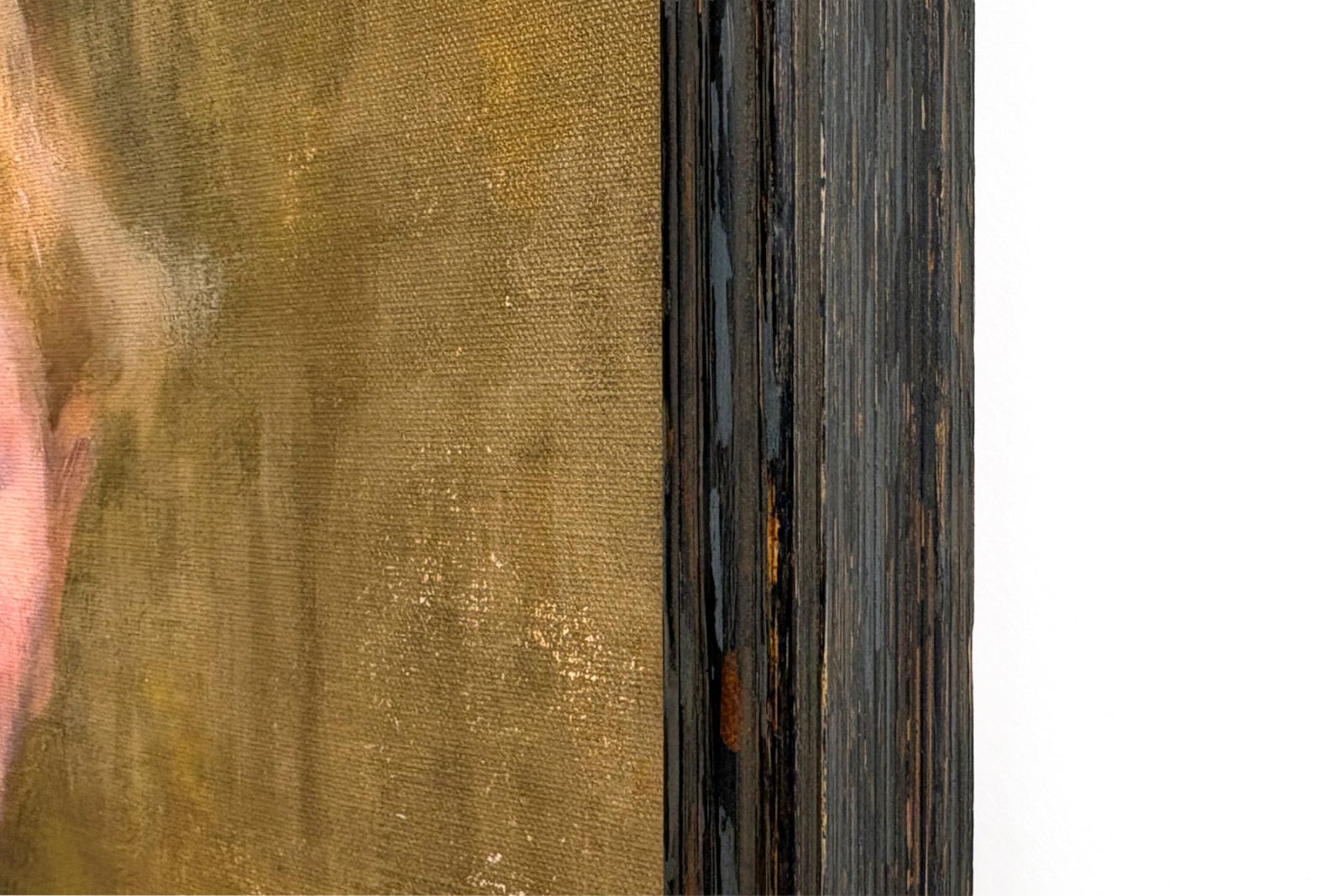
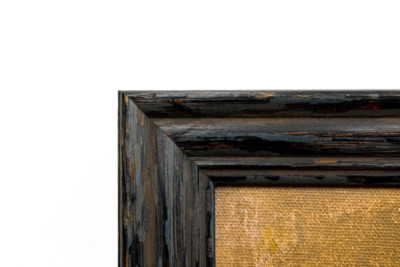
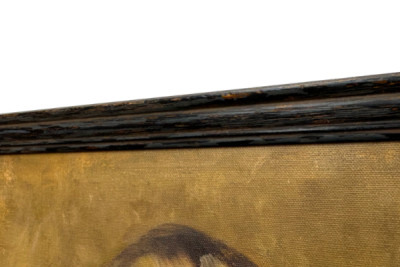
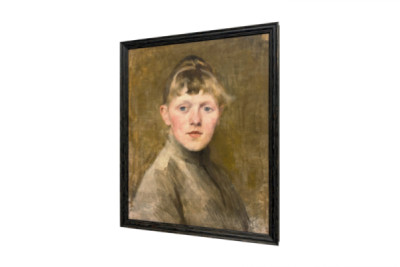
With this piece, the frame is the first thing one encounters, even with the eyes: Erminia, a solid wood profile in black-grey, whose surface looks as though someone had applied several layers of varnish on top of one another and then half-worn them away again, for the brown of the wood breaks through everywhere between the dark stripes, in long streaks along the grain, more pronounced at the edges than on the flat surfaces. The moulding itself is stepped: on the outside, a wide bevel that slopes gently downwards, then a flat groove; on the inside, a narrow curve that abuts the canvas directly, without a passe-partout or glass. In the top corner, the two strips meet at a closed mitre joint, and there are also a couple of holes in the wood, which the manufacturer describes as ‘artistic wormholes’ - a joke that made me hesitate briefly as to whether it might be a bit too much; nevertheless, it suits the peeling appearance. The Leonardo canvas, with its matt satin sheen, allows the grain of the background to show through rather than covering it up. What wins me over is this: the faded black of the frame and the unfinished ochre of the background speak the same language; both look worn, handled, not smooth - and so this early, open-ended portrait sits in a frame that does not deny its workshop character, but rather complements it.
 ×






 +43 4257 29415
 support@meisterdrucke.com
 Mo-Do: 7:00 - 16:00 | Fr: 7:00 - 13:00