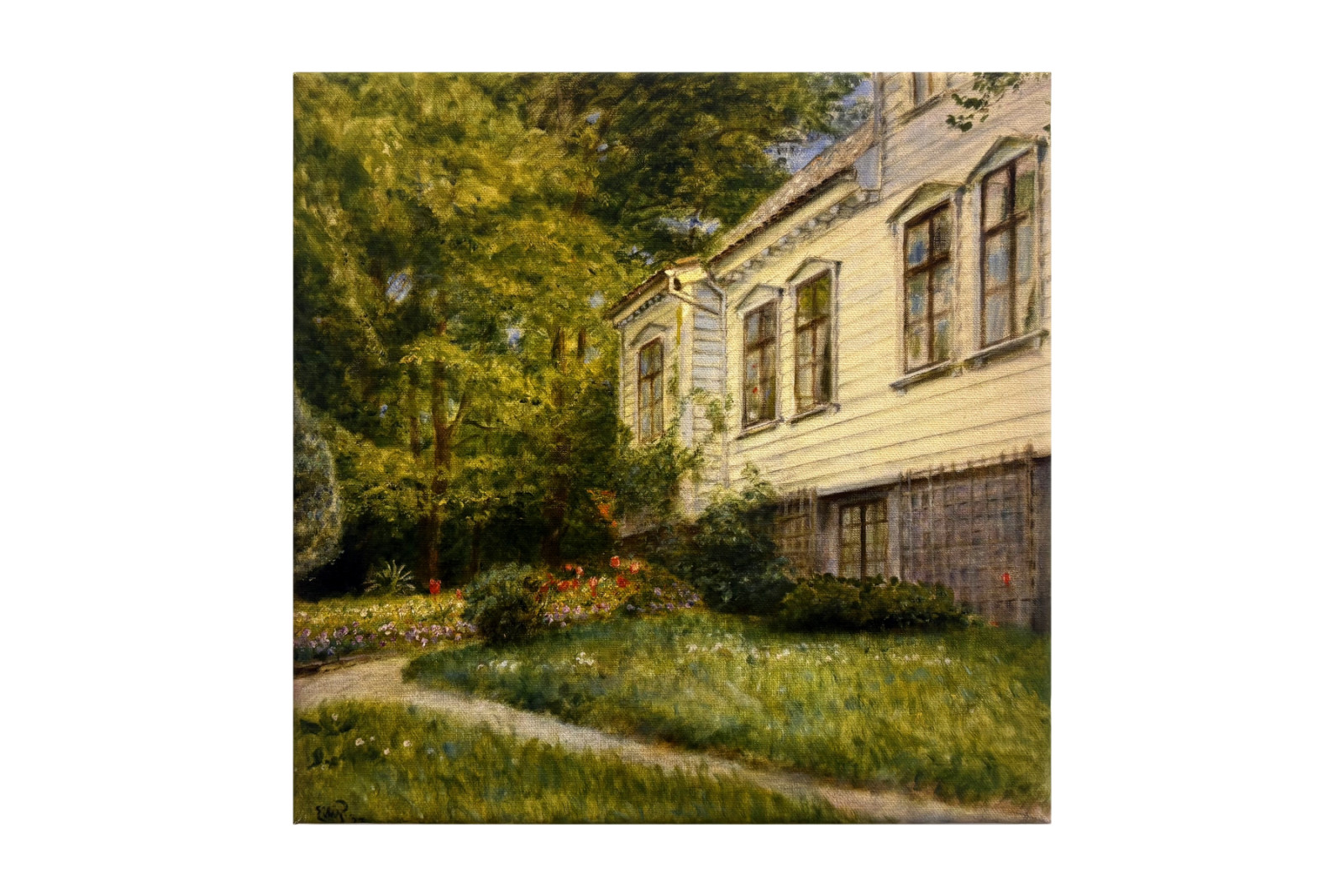
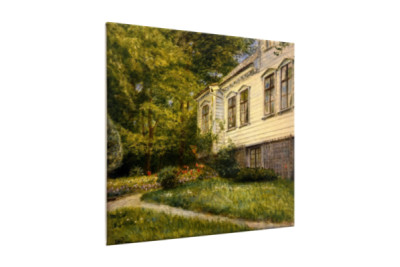
The house stands in the light, the garden in the shade: a white wooden villa with tall lattice windows and a crenellated cornice occupies the right-hand half of the picture, whilst to the left, the foliage of old trees forms a green wall through which only the occasional patch of sky peeks through. Between the two, a light-coloured gravel path winds round a patch of lawn, past a flowerbed of red tulips and a strip of violet-and-white blooms. Summer, probably early afternoon; the sun hits the façade head-on, whilst the grass beneath it is already cast in long shadows. Eilif Peterssen painted this garden in 1927, a year before his death, and one senses from the scene that here is someone who no longer needs to prove how well he can paint windows or trees. The Norwegian, born in 1852, belonged to the generation that brought plein air painting from Paris and Munich to the north, and ‘Soelyst’, sunlight or the joy of the sun, is exactly that: an afternoon in front of a house, nothing dramatic, but warmth in every brushstroke. You do not enter the house; you look at it, and that is enough.
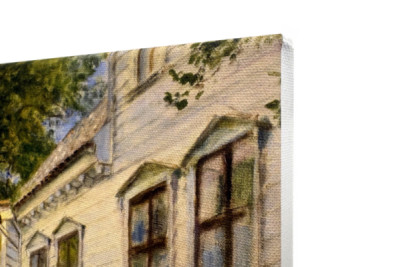
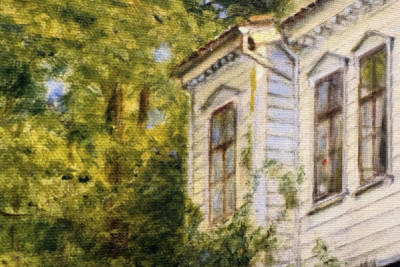
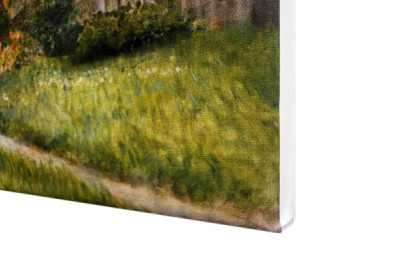
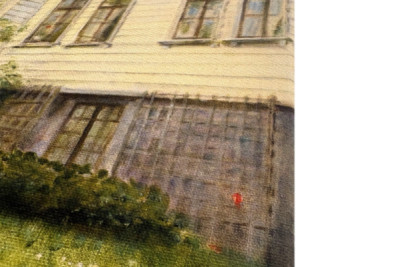
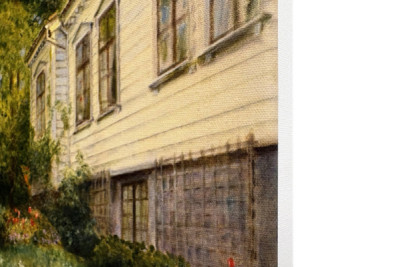
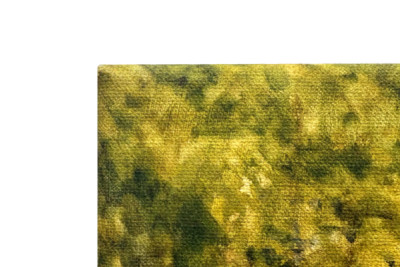
Measuring 30 x 30 cm, this is a small, dense painting, and what caught my eye sits right at the bottom right of the façade: Behind the trellis in front of the basement, in one of the dark windows, there is a single red spot, barely bigger than a fingernail. A flower on the windowsill, a vase, a piece of curtain - Peterssen doesn’t give it away. In print, this spot remains as clear and luminous as the red of the tulips further forward, and it also stays where it belongs, namely behind the delicate latticework that runs across the glass panes in translucent grey-blue strokes. A few windows further up, the red reappears as a tiny speck behind a pane. The first thing I checked when taking the painting off the table was whether the matt canvas would swallow up these minute details or render them, along with the slightly grainy surface of the paint application - and it does. The canvas is stretched without a frame over a narrow stretcher; the sides remain white, and the motif ends precisely at the edge.
One might wonder whether such a subtle painting might not need a frame; it seems to me that the white edge does exactly what the villa in the picture does: it gives the greenery its space. Anyone who absolutely must have a frame will have to imagine it - I would leave it out and hang the picture where even the afternoon sun reaches.
 ×






 +43 4257 29415
 support@meisterdrucke.com
 Mo-Do: 7:00 - 16:00 | Fr: 7:00 - 13:00