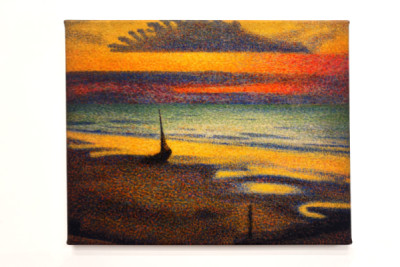
A narrow, dark boat lies abandoned on the beach. Its mast cuts a slender vertical line through the horizontal planes of sand, water and sky. All around, the coastline breaks up into countless splashes of colour: Yellow and orange glow on the shore, a greenish blue stretches across the shallow sea, and above that, red, violet and deep blue lie in broad bands. Dark clouds cap off the sky. The light appears intense, yet the scene remains still. Georges Lemmen painted the beach at Heist in 1891. The Belgian artist was part of the Neo-Impressionist movement - rather than blending colours softly, he placed small dots and strokes side by side. Only when viewed from a distance do they merge to form water, evening light and shadows.
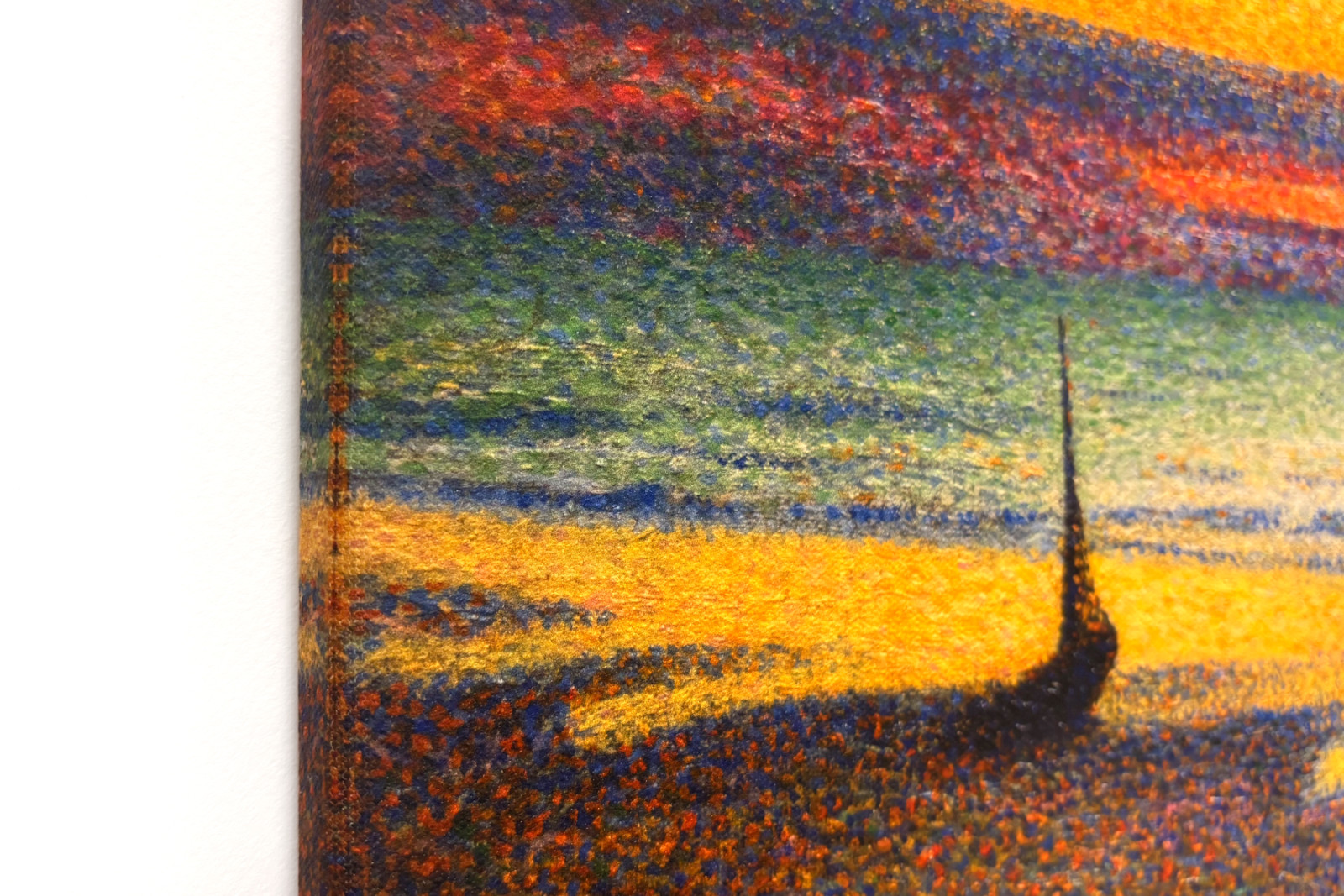
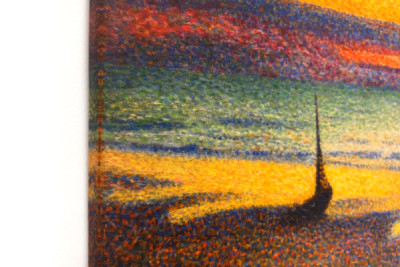
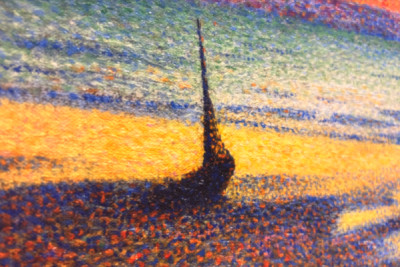
On the Raphael matt canvas, the boat in particular stands out very clearly. The black hull is by no means a solid silhouette: in the print, it contains tiny dots of orange, blue and brown, which allow the last light to continue to work even within the dark form. The slender mast, too, remains cleanly drawn right up to its tip - indeed, it is this line that the eye lingers on the longest. Behind it, light speckles and blue lines alternate, creating the gentle movement of the surf. In the foreground, the individual strokes condense into a heavy shadow; further back, they disperse again. The print is stretched taut on a stretcher frame, with the motif continuing in a mirrored pattern along the sides. In this way, the front loses none of its composition, and the canvas itself appears complete even without an additional frame. The matt surface prevents harsh reflections.
At 38 x 30 cm, this remains a rather small format - it suits the subject well, as it compels the viewer to step closer. And it is precisely on the boat that the precision of the craftsmanship becomes apparent: even the tiniest dots of colour and the sharp line of the mast remain clearly discernible.
 ×
×






 +43 4257 29415
 support@meisterdrucke.com
 Mo-Do: 7:00 - 16:00 | Fr: 7:00 - 13:00