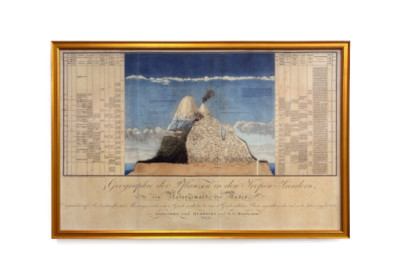
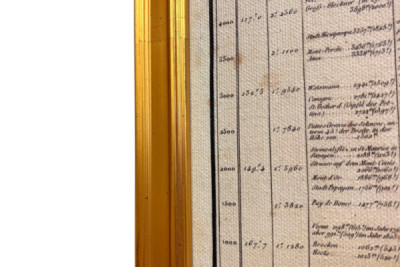
A mountain range unfolds like a scientific diagram: at its centre rises the idealised cross-section of Chimborazo, whose slopes Alexander von Humboldt has labelled with plant names and altitude figures. Behind the bright summit stands a smoking volcano; clouds hang at various altitudes, against a deep blue sky. Tables on the sides list measurements of temperature, air pressure and other natural observations. Published in 1807, the ‘Naturgemälde der Anden’ (Natural Painting of the Andes) visualises an idea that characterised Humboldt’s research: climate, altitude and flora cannot be considered in isolation. Drawn by Schoenberger and Turpin, and printed by Langlois in Paris, the plate combines landscape, statistics and text to form an early form of scientific infographics - and this is precisely where its significance lies, extending far beyond a mere view of the Andes.
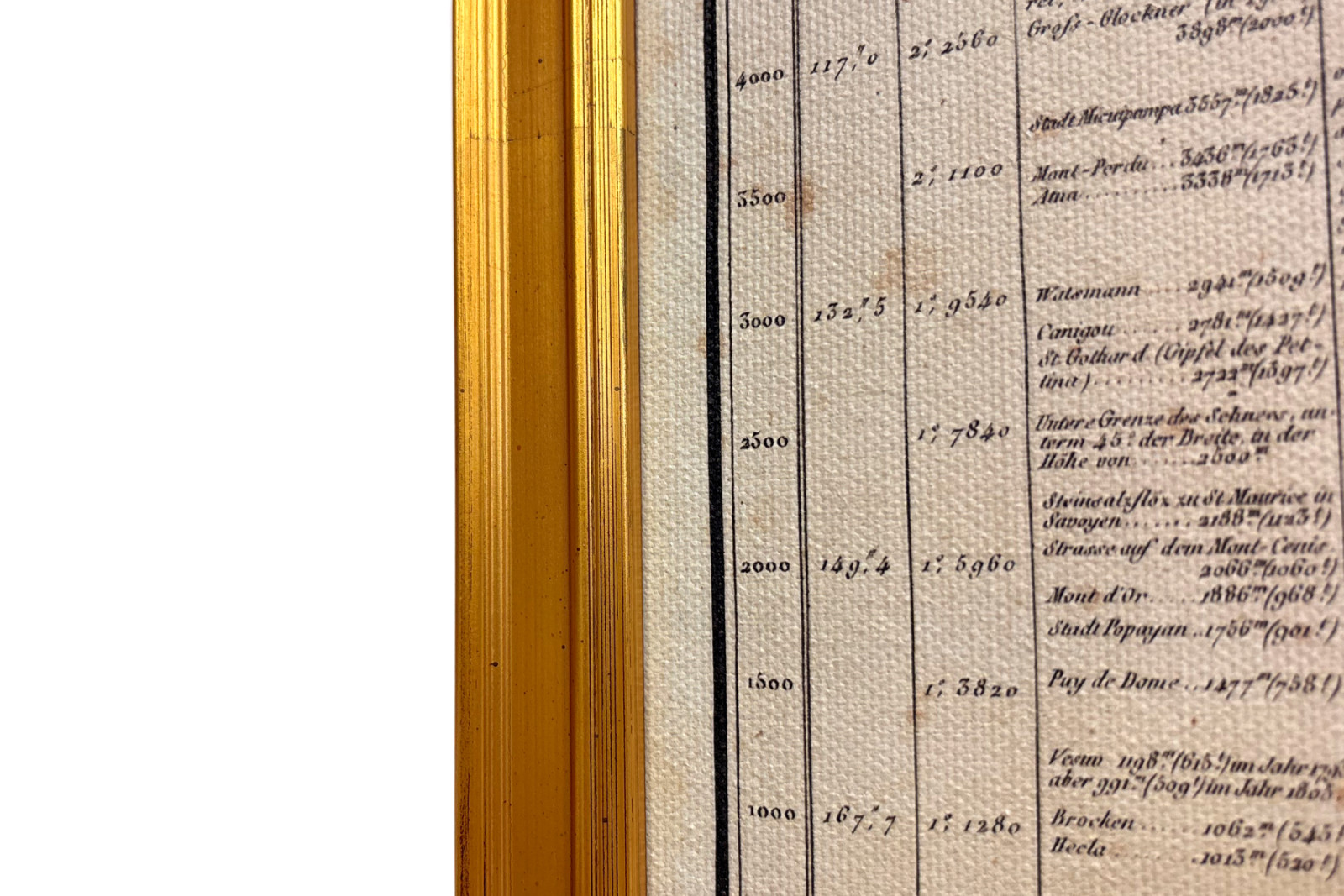
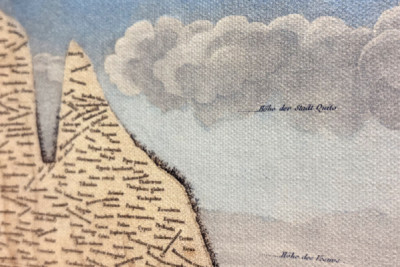
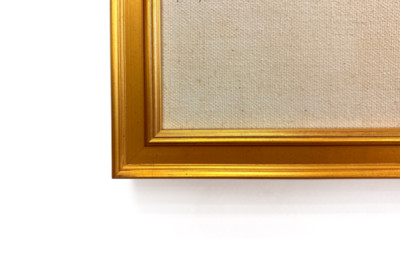
In this 67 x 43-centimetre work, the satin-finished canvas allows Leonardo himself to make even the smallest entries clear and legible. It is on the right-hand mountainside that I linger longest whilst viewing the painting: Densely packed plant names follow its slope; next to them, the delicate inscription ‘Altitude of the city of Quito’ stands out against a bank of grey clouds - still legible. The print clearly separates the black lettering from the sand-coloured mountain; even short horizontal lines, numbers and curving letters retain their shape. Here it becomes apparent that the image places nature within spatial relationships, rather than merely depicting it. Without glass, the surface remains clearly visible. The sheet is framed in ‘Lena’, a narrow gold moulding - a classic frame that our customers often choose for historical charts and which clearly suits this dense sheet well.
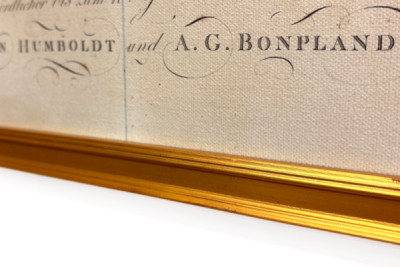
At the bottom edge, the names Alexander von Humboldt and A. G. Bonpland appear in clear capital letters between sweeping lines of text; above them, hundreds of labels converge on the slope to form an almost topographical textual landscape.
 ×
×





 +43 4257 29415
 support@meisterdrucke.com
 Mo-Do: 7:00 - 16:00 | Fr: 7:00 - 13:00