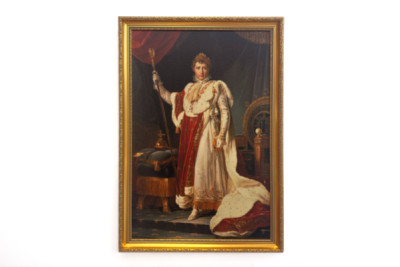
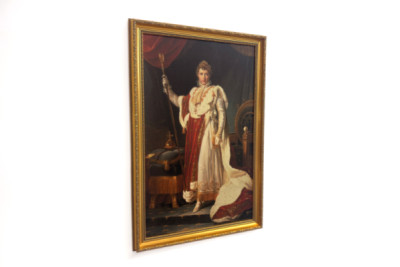
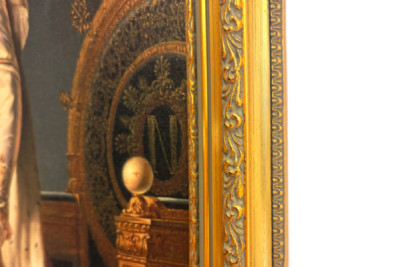
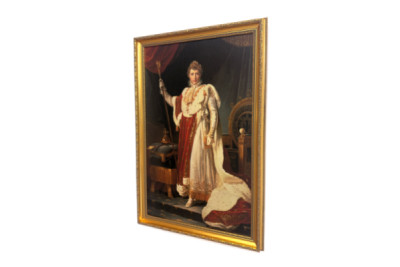
Tiny golden bees crawl across the dark blue carpet at the bottom of the picture. They are minuscule, but the print captures each one individually, with highlights and shadows. The bee was Napoleon’s personal emblem, and it is he who stands here: in full coronation regalia, with a golden laurel wreath, a white underrobe and the heavy, ermine-trimmed purple cloak that cascades down the steps behind him. His right hand holds the sceptre; the imperial orb rests on a cushion to his left; in the background, the back of the throne gleams with the large letter ‘N’. Baron François Gérard painted this portrait in 1804, the year of the imperial coronation. Gérard was a pupil of Jacques-Louis David and became the most sought-after portraitist of the Empire; half of Europe had their portraits painted by him. His Napoleon appears less heroically exaggerated than in the works of some of his colleagues. The face is young, serious, almost sober. All the pomp hangs over him like a claim that has yet to be proven. That is precisely what makes the painting interesting to this day.
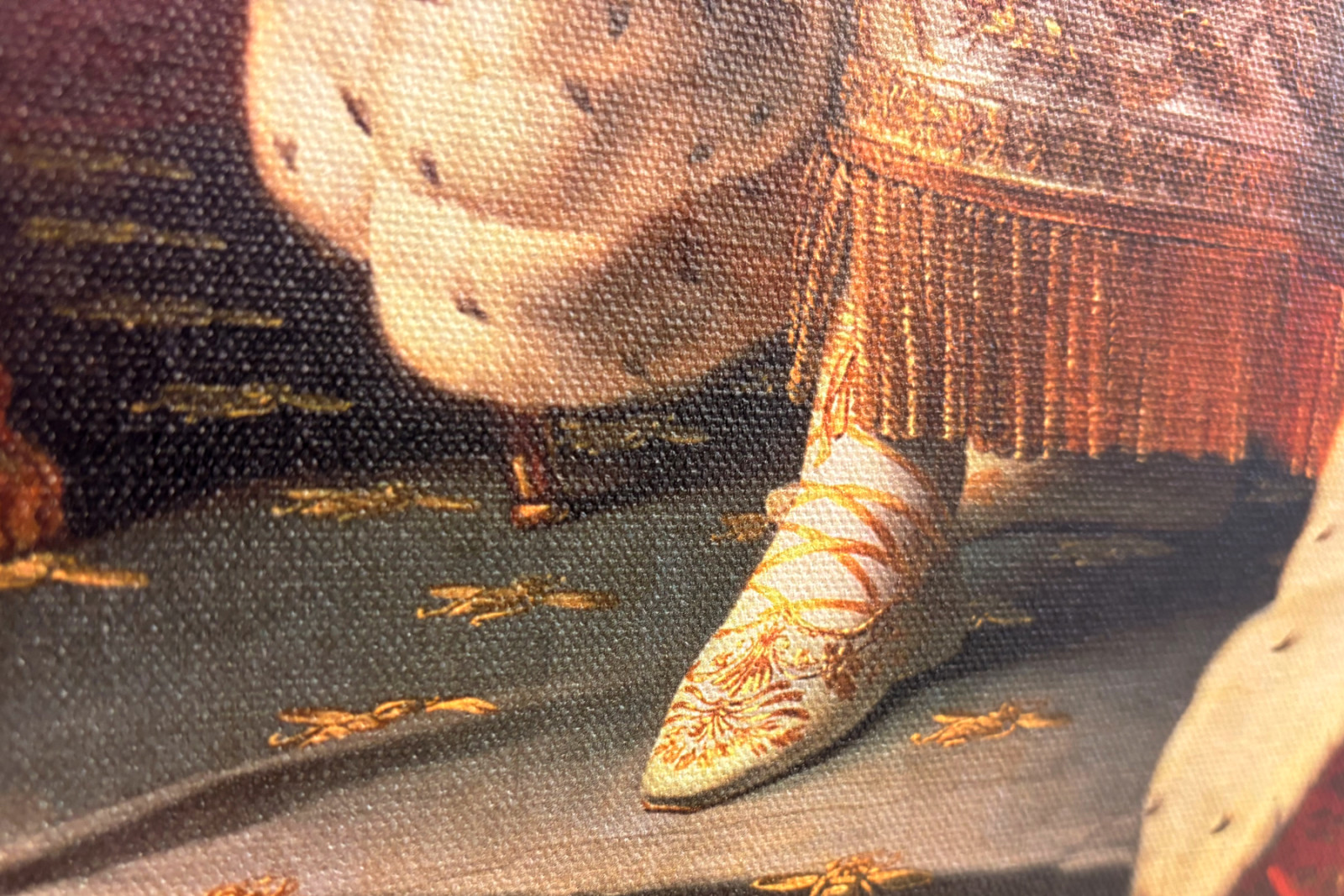
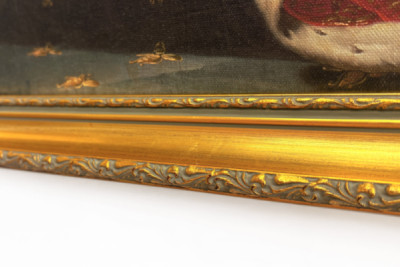
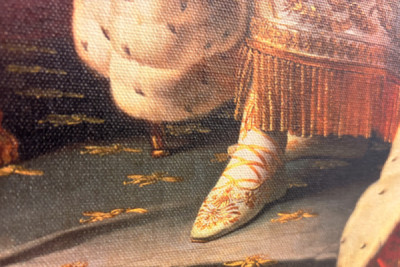
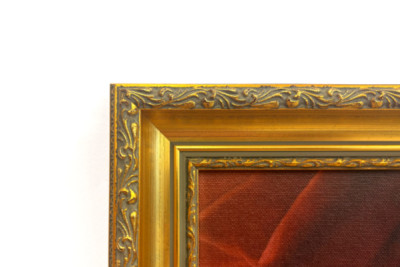
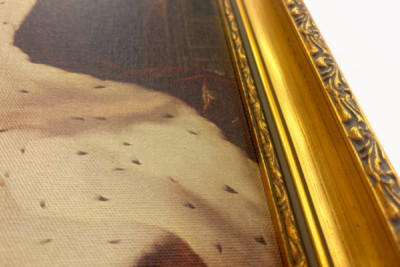
When viewing this painting, it is worth looking down. Napoleon’s left shoe is a small embroidery study in its own right: golden tendrils on a light silk background, behind which lies the dense gold fringe of the cloak’s hem, and the satin-finish print neatly separates the two. Even the ermine tails in the white fur remain discernible as individual dark speckles; nothing blurs together. At 43 x 67 cm, one automatically stands close enough to actually scrutinise these areas - it’s easy to get caught up in them. The canvas is set in a gilded decorative frame with two ornate borders around a smooth, brushed gold edge; in places, a muted base colour shimmers through the ornamentation, making the gilding appear older than it is. A motif with such splendour practically demands it - a plain frame would look out of place here. Taken together, this creates a cohesive Empire-style piece on the wall. You can tell at a glance that it dates from the moment when a general had just proclaimed himself emperor and painting was meant to validate this invention with every ounce of gold at its disposal. Gérard accomplishes this with remarkable composure.
 ×





 +43 4257 29415
 support@meisterdrucke.com
 Mo-Do: 7:00 - 16:00 | Fr: 7:00 - 13:00