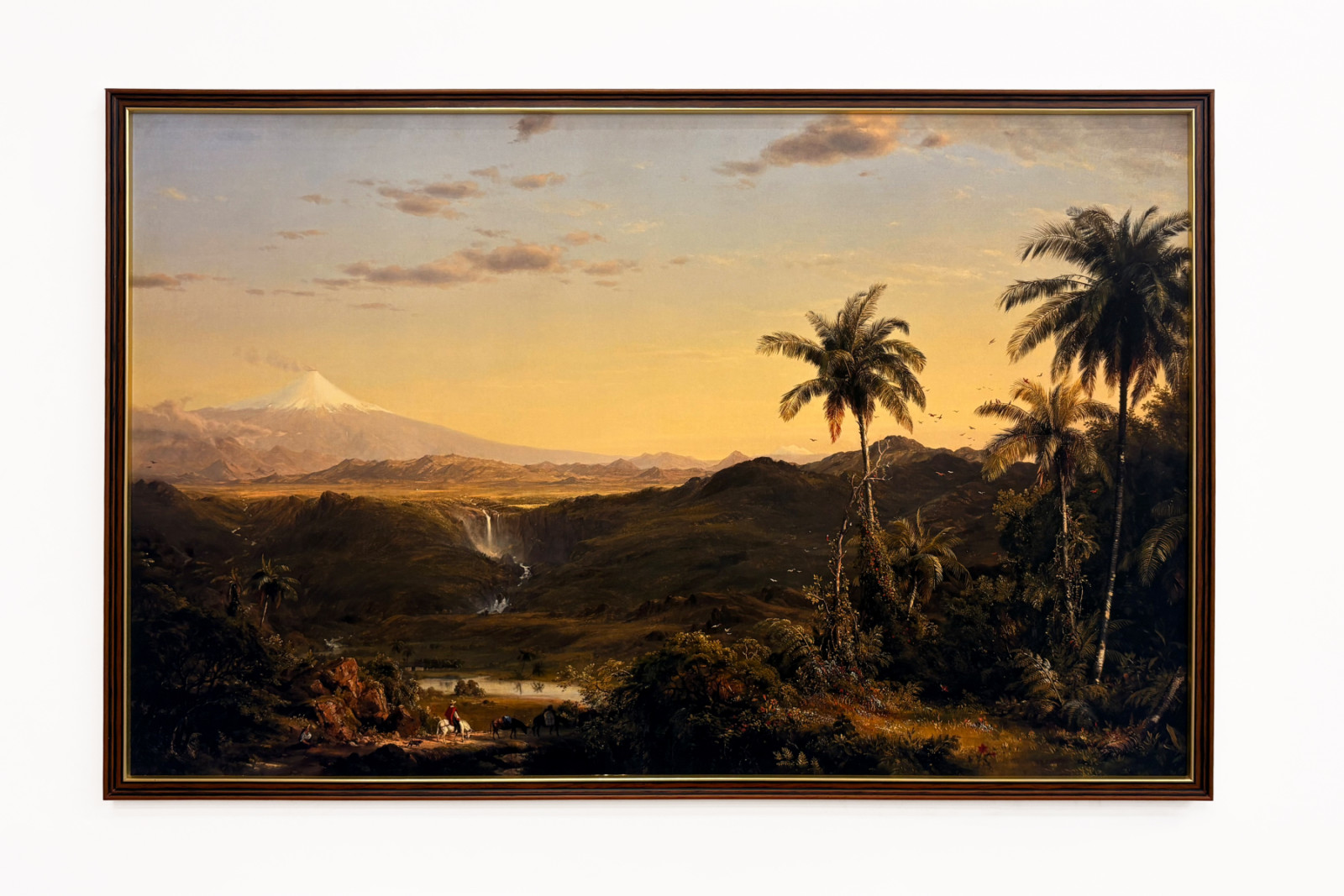
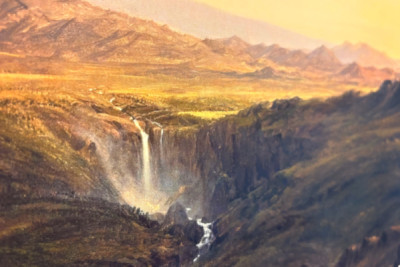
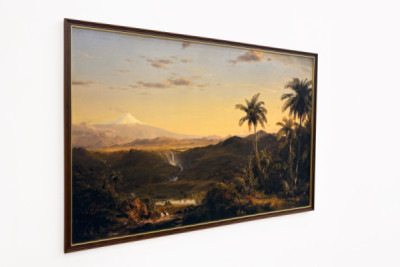
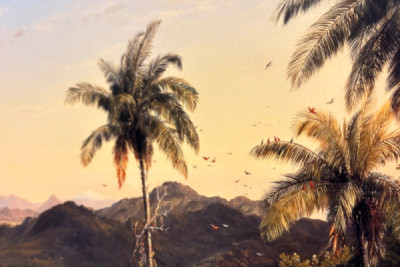
The snow-capped peak of Cotopaxi looms far off in the haze, whilst the tropics glow in the foreground. A waterfall plunges into the gorge; palm trees tower into the evening light; red birds perch on the fronds as if dotted there. At the bottom edge, a horseman with pack animals makes his way, barely larger than a fingernail. Here, in 1855, Frederic Edwin Church painted the culmination of his first journey to South America, which he undertook in the footsteps of Alexander von Humboldt. Church was a pupil of Thomas Cole and went on to become the most prominent representative of the Hudson River School, the group of American painters who depicted landscapes with precision, drama and often allegorical significance. This painting exemplifies that approach: scientific precision in the detail, combined with a light that bathes the entire scene in warm yellow and ochre. A volcano, a waterfall, primeval forest and a human figure in a single panorama - a depiction of the world in landscape format.
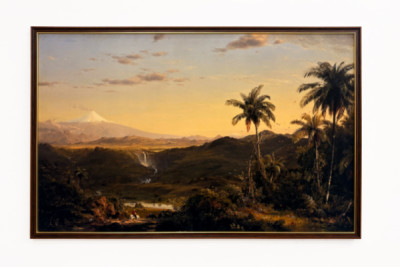
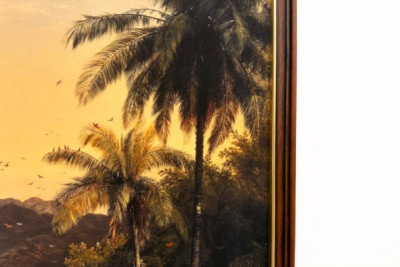
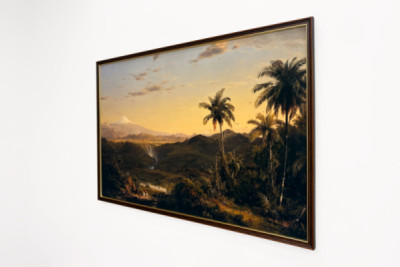
Hanging on the wall, this landscape format unfolds with astonishing breadth. 70 by 45 centimetres may sound manageable, but the elongated proportions draw the eye from left to right across the landscape, from the volcano to the palm trees. The piece hangs flat and unobtrusive against the white surface; nothing stands out, nothing casts heavy shadows. It is only when viewed from the side that it becomes clear just how narrow the frame actually is: barely one and a half centimetres of wood, medium brown with a black grain, with a gleaming gold edge on the inside as its sole embellishment. This restraint suits the subject well. The picture is given a clear boundary, but one that does not compete with it. Nevertheless, despite its narrow width, the frame incorporates several distinct features - a cornice comprising two rounded mouldings, followed by a smooth surface, and on the inside, the golden finishing moulding. If you look closely, you can see on the matt photographic paper just how finely the birds in the sky and the spray from the waterfall are rendered; the paper is non-reflective, so the evening light in the scene remains visible even under room lighting. Without glass or a passe-partout, the landscape comes across as direct and immediate. Church painted the original in his late twenties, on his way to becoming America’s most famous landscape painter - one can see in this painting the ambition to capture the whole world in a single view, and that is precisely what makes it worth seeing to this day.
 ×
× 





 +43 4257 29415
 support@meisterdrucke.com
 Mo-Do: 7:00 - 16:00 | Fr: 7:00 - 13:00