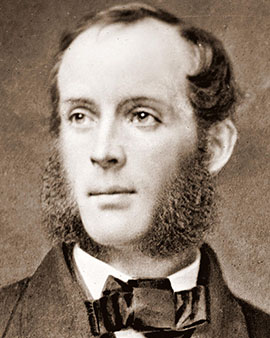
Born into economic independence, Frederic Edwin Church devoted himself to painting. His love for the landscape of his native Connecticut made him create detailed illustrations.
With the connection to his teacher and mentor Thomas Cole, Church moved away from the pure reproduction of what he saw and gave his pictures symbolic character and something parable-like. His talent and precise manner of representation made the artist one of the most important representatives of the Hudson River School.
Inspired by Alexander von Humboldts pictorial travelogues, Church was drawn to distant lands. With his life centered in New York, he traveled during the summer months and the rest of the year he made pictures based on his sketches and memories.
The finished works seem so real that they give the viewer the impression of reality. But they are composed of real fragments with symbols, often of a religious and patriotic nature.
With The Andes of Ecuador and The Heart of the Andes, two large-format compositions were created from sketches. The impressively real character of the landscapes testifies to the great skill of Frederic Edwin Church.
 ×
× 






 Passionate Customer Service

.jpg "The Heart of the Andes by Frederic Edwin Church")
.jpg)
.jpg "Cotopaxi by Frederic Edwin Church")
.jpg)
.jpg "The River of Light by Frederic Edwin Church")
.jpg)
.jpg "Cotopaxi, 1862 by Frederic Edwin Church")
.jpg)
.jpg "Niagara by Frederic Edwin Church")
.jpg)
.jpg "Cayambe, 1858 by Frederic Edwin Church")
.jpg)
.jpg "Pichincha by Frederic Edwin Church")
.jpg)
.jpg "Twilight in the Wilderness, 1860 by Frederic Edwin Church")
.jpg)
.jpg "The Charter Oak at Hartford, c. 1846 by Frederic Edwin Church")
.jpg)
.jpg "Rainy Season in the Tropics by Frederic Edwin Church")
.jpg)
.jpg "Tamaca Palms, 1854 by Frederic Edwin Church")
.jpg)
.jpg "Jamaica by Frederic Edwin Church")
.jpg)
.jpg "Syria by the Sea, 1873 by Frederic Edwin Church")
.jpg)
.jpg "Niagara Falls, from the American Side by Frederic Edwin Church")
.jpg)
.jpg "Cotopaxi Seen from Ambato, Ecuador by Frederic Edwin Church")
.jpg)
 - (MeisterDrucke-224115).jpg "Banana Tree, c. 1865 by Frederic Edwin Church")
 - (MeisterDrucke-224115).jpg)
.jpg "Jerusalem from the Mount of Olives by Frederic Edwin Church")
.jpg)
.jpg "A Donkey, Barranquilla, Colombia by Frederic Edwin Church")
.jpg)
.jpg "Sincholagua, Morning, from the Temple of the Sun, Quito by Frederic Edwin Church")
.jpg)
.jpg "Chimborazo, 1864 by Frederic Edwin Church")
.jpg)
j_-_(MeisterDrucke-695605).jpg "Rainy Season in the Tropics - Google Art Project (crop) by Frederic Edwin Church")
j_-_(MeisterDrucke-695605).jpg)
.jpg "Niagara Falls, from the American Side by Frederic Edwin Church")
.jpg)
.jpg "Tropical Scenery by Frederic Edwin Church")
.jpg)
.jpg "The Chariot of the Sun Fantasy, probably 1868–69 by Frederic Edwin Church")
.jpg)
.jpg "Apple by Frederic Edwin Church")
.jpg)
.jpg "The Aegean Sea by Frederic Edwin Church")
.jpg)
.jpg "Tamaca Palms, 1854 by Frederic Edwin Church")
.jpg)
.jpg "Great Basin, Mt. Katahdin by Frederic Edwin Church")
.jpg)
.jpg "Cotopaxi by Frederic Edwin Church")
.jpg)
.jpg "Botanical Study, Jamaica by Frederic Edwin Church")
.jpg)
.jpg "Tamaca Palms by Frederic Edwin Church")
.jpg)
.jpg "Plant Studies by Frederic Edwin Church")
.jpg)
.jpg "Cotopaxi, 1855 by Frederic Edwin Church")
.jpg)
.jpg "Mountain over Hintersee by Frederic Edwin Church")
.jpg)
.jpg "Volcano Puresé and the Rio de Vinagre, Purese, Colombia, August 1853 by Frederic Edwin Church")
.jpg)
.jpg "Sketches of Plants and of Part of the Balustrade Bordering the Terrace at the Inn at Guaranda, Ecuador by Frederic Edwin Church")
.jpg)
.jpg "Looking Across the Hudson Valley, New York by Frederic Edwin Church")
.jpg)
.jpg "Hudson Valley, New York with Sun Setting Behind the Catskill Mountains by Frederic Edwin Church")
.jpg)
.jpg "Landscape at Sunset, Jamaica by Frederic Edwin Church")
.jpg)
.jpg "Hilly Landscape, Early Autumn by Frederic Edwin Church")
.jpg)
.jpg "Sketches. Landscape,")
.jpg)
.jpg "Ecuador?, Mountain Plateau with Hut by Frederic Edwin Church")
.jpg)
.jpg "Cloudy Sunset, Jamaica by Frederic Edwin Church")
.jpg)
.jpg "Looking across the Hudson Valley, August 14, 1867 by Frederic Edwin Church")
.jpg)
.jpg "Cloud Study by Frederic Edwin Church")
.jpg)
_186570_-_(MeisterDrucke-1566311).jpg "Autumn Landscape (North Carolina?), 1865–70 by Frederic Edwin Church")
_186570_-_(MeisterDrucke-1566311).jpg)
.jpg "Shore and Sea, \"Bloxburgh\", August 1865 by Frederic Edwin Church")
.jpg)
.jpg "In the New England Woods, 1855–65 by Frederic Edwin Church")
.jpg)
_-_(MeisterDrucke-1245929).jpg "Ecuador, Mountain (Possibly Chimborazo) by Frederic Edwin Church")
_-_(MeisterDrucke-1245929).jpg)
.jpg "View of Mount Pichincha from Chillo, Ecuador, June 26, 1857 by Frederic Edwin Church")
.jpg)
_-_(MeisterDrucke-1257385).jpg "Mt. Katahdin from the South West (?) by Frederic Edwin Church")
_-_(MeisterDrucke-1257385).jpg)
.jpg "Hudson Valley at Sunset by Frederic Edwin Church")
.jpg)
_186070_-_(MeisterDrucke-1560123).jpg "Woodland Scene in Autumn (Hudson, New York or Maine), 1860–70 by Frederic Edwin Church")
_186070_-_(MeisterDrucke-1560123).jpg)
_1853_-_(MeisterDrucke-1566610).jpg "Ecuador, Mountain (possibly Chimborazo), 1853 by Frederic Edwin Church")
_1853_-_(MeisterDrucke-1566610).jpg)
.jpg "Rooftops near Sant")
.jpg)
![Tower at Lydda, and Ramleh seen from Ramleh Tower, Palestine [Ramleh, Israel] by Frederic Edwin Church](/kunstwerke/300px/Frederic_Edwin_Church_-_Tower_at_Lydda_and_Ramleh_seen_from_Ramleh_Tower_Palestine_Ramleh_Israel_-_(MeisterDrucke-1289434).jpg "Tower at Lydda, and Ramleh seen from Ramleh Tower, Palestine [Ramleh, Israel] by Frederic Edwin Church")
![Tower at Lydda, and Ramleh seen from Ramleh Tower, Palestine [Ramleh, Israel] by Frederic Edwin Church](/kunstwerke/400w/Frederic_Edwin_Church_-_Tower_at_Lydda_and_Ramleh_seen_from_Ramleh_Tower_Palestine_Ramleh_Israel_-_(MeisterDrucke-1289434).jpg)
_Pond_two_people_in_canoe_1845_-_(MeisterDrucke-1566949).jpg "Htakie (?) Pond, Two People in Canoe, 1845 by Frederic Edwin Church")
_Pond_two_people_in_canoe_1845_-_(MeisterDrucke-1566949).jpg)
.jpg "Costume Design of a Jewish Boy Described as a Pharisee, a Fig Tree, and Heads, Palestine by Frederic Edwin Church")
.jpg)
.jpg "Mt. Katahdin from Lake Katahdin, 1855–65 by Frederic Edwin Church")
.jpg)
.jpg "Andian Mountain Valley with Winding Stream, Colombia or Ecuador, 1857 by Frederic Edwin Church")
.jpg)
.jpg "Trees, July 1844 by Frederic Edwin Church")
.jpg)
_187080_-_(MeisterDrucke-1567496).jpg "Mt. Katahdin from the South West, 1870-80 by Frederic Edwin Church")
_187080_-_(MeisterDrucke-1567496).jpg)
_186570_-_(MeisterDrucke-1566314).jpg "Autumn Landscape (Vermont), 1865–70 by Frederic Edwin Church")
_186570_-_(MeisterDrucke-1566314).jpg)
.jpg "Valley \"near Golling,\" Austria, August 5, 1868 by Frederic Edwin Church")
.jpg)
_1868_-_(MeisterDrucke-1567772).jpg "Roof Studies, Austria (?), 1868 by Frederic Edwin Church")
_1868_-_(MeisterDrucke-1567772).jpg)
.jpg "Hudson Valley at Sunset, 1870–80 by Frederic Edwin Church")
.jpg)
.jpg "Botanical Sketches, \"near Jorje\", July 23, 1857 by Frederic Edwin Church")
.jpg)
.jpg "Looking Across the Hudson Valley, New York, ca. 1867 by Frederic Edwin Church")
.jpg)
.jpg "A Group of Trees with the Upper Part of a Dead Tree, 1866 by Frederic Edwin Church")
.jpg)
_ca_1850_-_(MeisterDrucke-1555922).jpg "Coast at Mount Desert Island (Sand Beach), ca. 1850 by Frederic Edwin Church")
_ca_1850_-_(MeisterDrucke-1555922).jpg)
.jpg "Sky Study, Mountain Ridges, Rainbow, 1860s by Frederic Edwin Church")
.jpg)
.jpg "Tropical Scenery: South American Landscape by Frederic Edwin Church")
.jpg)
.jpg "Rooftops near Sant")
.jpg)
.jpg "Landscape, May 1865 by Frederic Edwin Church")
.jpg)
_Pond_Bordered_by_Trees_1845_-_(MeisterDrucke-1566948).jpg "Htakie (?) Pond Bordered by Trees, 1845 by Frederic Edwin Church")
_Pond_Bordered_by_Trees_1845_-_(MeisterDrucke-1566948).jpg)
.jpg "Mount Pichincha from Chillo, Ecuador by Frederic Edwin Church")
.jpg)
.jpg "Obersee, near Berchtesgarden, Bavaria, July 17, 1868 by Frederic Edwin Church")
.jpg)
.jpg "Trees, Tree Tops, and a Wooded Bank, Saddleback, Maine by Frederic Edwin Church")
.jpg)
.jpg "Rocky Coast, Grand Manan, Canada by Frederic Edwin Church")
.jpg)
.jpg "Landscape with Trees and a Stream, Grand Manan Island, Canada by Frederic Edwin Church")
.jpg)
_1868_-_(MeisterDrucke-1567026).jpg "Jerusalem, general view, April (?), 1868 by Frederic Edwin Church")
_1868_-_(MeisterDrucke-1567026).jpg)
.jpg "Camel Studies, Tree Bush, and Valley, Possibly 1868 by Frederic Edwin Church")
.jpg)
.jpg "Woodland Scene, 1870–80 by Frederic Edwin Church")
.jpg)
_possibly_1860_-_(MeisterDrucke-1555786).jpg "Cloudy Sky Over Valley (Maine?), Possibly 1860 by Frederic Edwin Church")
_possibly_1860_-_(MeisterDrucke-1555786).jpg)
.jpg "Mt. Katahdin, Showing Pomola and the Great Basin from Sandy Bottom Pond by Frederic Edwin Church")
.jpg)
.jpg "Landscape Near Guaranda, Ecuador by Frederic Edwin Church")
.jpg)
.jpg "Siloam and Jerusalem, Southeastern Corner of the Walls Seen from the Mount of Olives by Frederic Edwin Church")
.jpg)
.jpg "The Andes of Ecuador by Frederic Edwin Church")
.jpg)
.jpg "Mt. Katahdin, from Lake Katahdin by Frederic Edwin Church")
.jpg)
.jpg "Mountain Range, Toluca; Verso: Mountain Range, Toluca, January 7, 1885 by Frederic Edwin Church")
.jpg)
.jpg "The Goell and Watzmann, near Berchtesgaden by Frederic Edwin Church")
.jpg)
.jpg "Mountain Landscape; Verso: Landscape, 1883 by Frederic Edwin Church")
.jpg)
.jpg "A Corner of a Pond, ca. 1860 by Frederic Edwin Church")
.jpg)
.jpg "Drawing, Woodland Scene, 1870–80 by Frederic Edwin Church")
.jpg)
.jpg "Bamboo Grove, Jamaica by Frederic Edwin Church")
.jpg)
_-_(MeisterDrucke-1258579).jpg "Sketch of a Catskill Landscape (View of the Kaanterkill) by Frederic Edwin Church")
_-_(MeisterDrucke-1258579).jpg)
.jpg "Cloud Study, July 28, 1871 by Frederic Edwin Church")
.jpg)
.jpg "Drawing, Cloud Study, 1844 by Frederic Edwin Church")
.jpg)
.jpg "Study of the Great Basin, Mt. Katahdin by Frederic Edwin Church")
.jpg)
.jpg "Hillside, 1870-80 by Frederic Edwin Church")
.jpg)

 +43 4257 29415
 support@meisterdrucke.com
 Mo-Do: 7:00 - 16:00 | Fr: 7:00 - 13:00