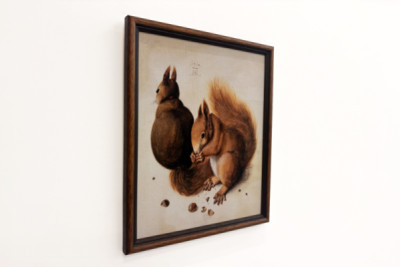
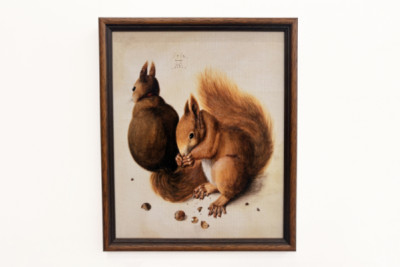
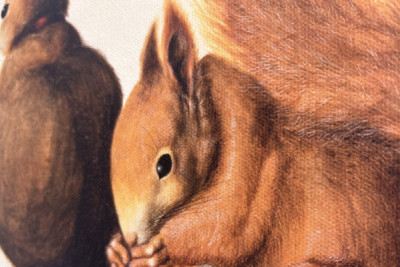
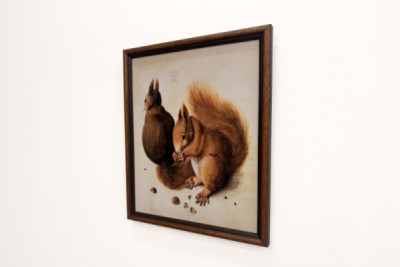
A hazelnut disappears between the front paws of the animal on the right - it is precisely there that the fine strokes of fur converge to form a small dark centre that catches the eye. From this point, the composition unfolds: two squirrels sit close together, one facing the viewer, entirely absorbed in cracking the nut, the other turning its rounded back towards them. Around them, shells and nut fragments lie scattered across the light, unadorned background. Albrecht Dürer dates the study to 1512 and places his monogram above the scene - a time when the Nuremberg master captured animals and plants with a precision far ahead of his era. The drawing explains nothing; it merely observes: individual tufts of hair on the bushy tail, the splayed claws, the alert black eye. It is precisely this sobriety that has made the motif so compelling for five centuries.
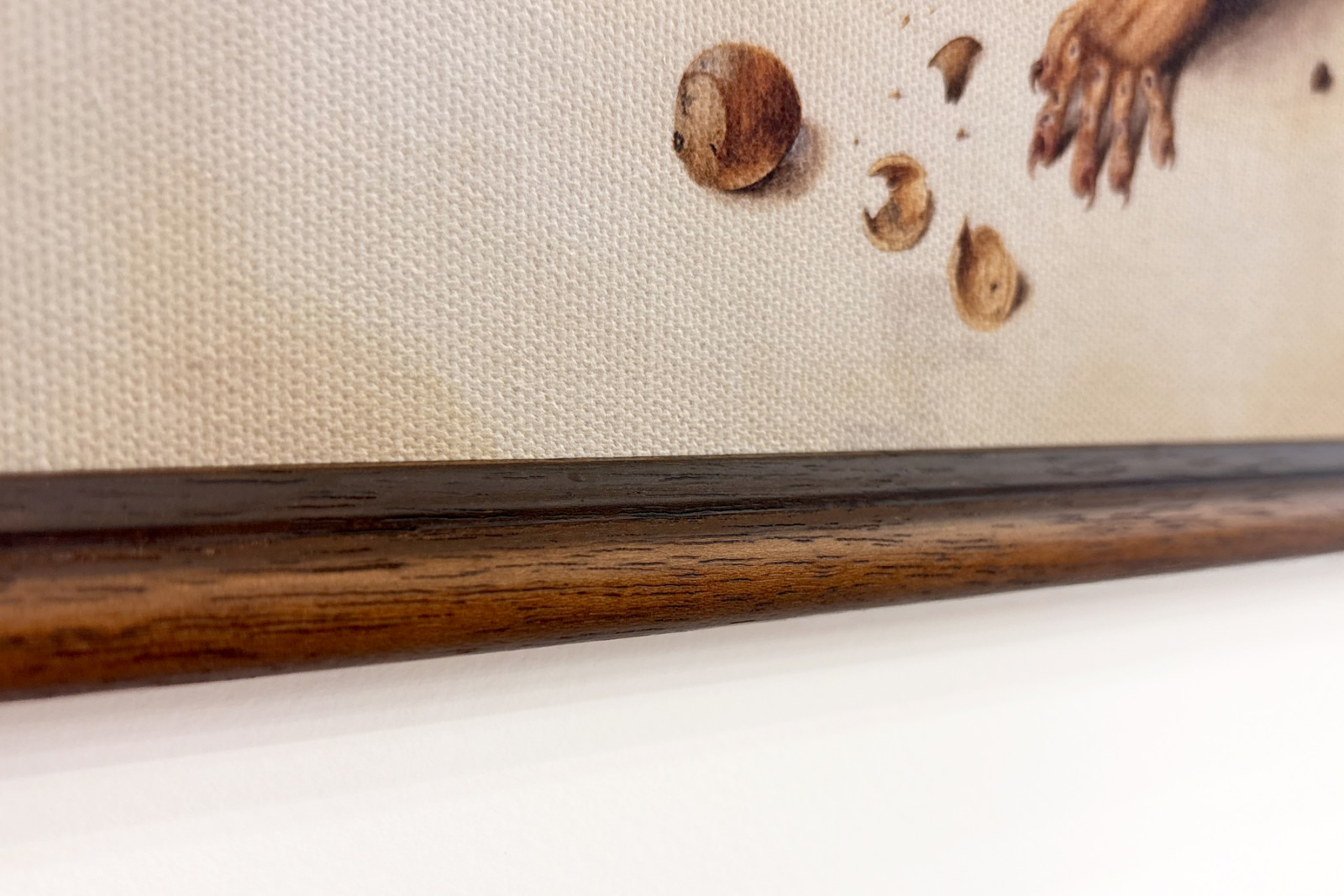
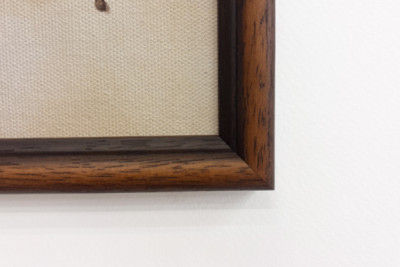
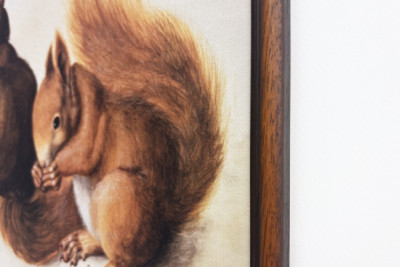
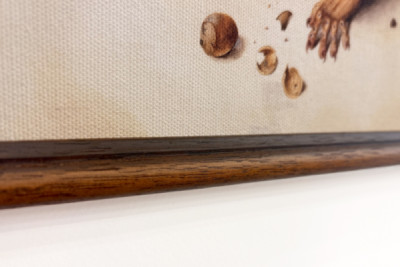
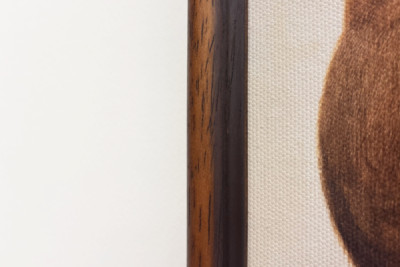
Here, the canvas serves as a backing for the drawing, its matt surface evenly absorbing the ambient light rather than reflecting it - even when viewed at an angle, no glare appears across the fur, and the reddish-brown tones remain consistent from every angle. For a motif consisting entirely of fine hairline strokes, this is exactly right, as nothing outshines the drawing. Riana, a slender wooden frame in reddish-brown, frames the 25 x 30-centimetre format with a rounded profile and visible grain, in which short, dark pores bring the wood to life. As the eye moves from the matt picture surface across the slightly glossy curve of the strip, one senses the change in material - a textile background against oiled wood. In such a compact piece, this could easily have appeared fragmented; in fact, the two elements blend seamlessly together.
 ×
× 





 +43 4257 29415
 support@meisterdrucke.com
 Mo-Do: 7:00 - 16:00 | Fr: 7:00 - 13:00