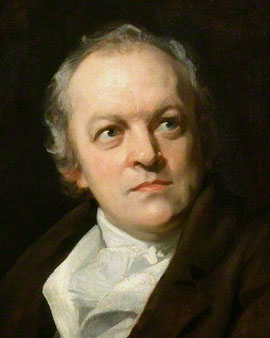
Notorious among his contemporaries as an eccentric nutcase, the genius of William Blake, born in London in 1757, was only recognized and honored after his death. Already haunted by visions of angels, demons and ghosts in his childhood, mysticism served the trained engraver throughout his life as inspiration for his artistic and poetic career. After quarrelling with the President of the Royal Academy of Arts, he founded a printing house and published his works himself, together with his wife Catherine, by inventing a special printing technique, relief etching. Typical for Blake was the novel combination of image and writing.
Also because of the visualization of his visions in his works, which were so different from contemporary art, Blake was regarded by his fellow men as a crazy, yet unusually happy person who stood up for equality of the sexes, races and classes. These views, which were dangerous in the politics of the time, were particularly influenced by a liberal interpretation of the Bible, unlike the Church, and the ideas and ideals of the French Revolution, and were far ahead of their time. In his paintings Blake often used religious motifs, such as the Fall of Man in Satan Exulting over Eve and The Temptation and Fall of Eve.
William Blake died in 1827 largely unnoticed and penniless, but is today considered an important artist whose works still influence pop culture.
 ×
×







 Passionate Customer Service

.jpg "Jacob")
.jpg)
.jpg "The Great Red Dragon and the Woman Clothed with the Sun by William Blake")
.jpg)
.jpg "The Ancient of Days by William Blake")
.jpg)
.jpg "The Great Red Dragon and the Beast from the Sea by William Blake")
.jpg)
.jpg "Jacob")
.jpg)
.jpg "The Red Dragon and the Woman Clothed in Sun, ca. 1802-1805 by William Blake")
.jpg)
.jpg "Copy of the Laocoön, for Rees")
.jpg)
.jpg "Behemoth and Leviathan by William Blake")
.jpg)
.jpg "The Ghost of a Flea by William Blake")
.jpg)
.jpg "The Number of the Beast is 666 by William Blake")
.jpg)
.jpg "The River of Life by William Blake")
.jpg)
_c1803-05_(b_-_(MeisterDrucke-636435).jpg "The Great Red Dragon and the Woman Clothed with the Sun (Rev. 12: 1-4), c. 1803-05 by William Blake")
_c1803-05_(b_-_(MeisterDrucke-636435).jpg)
.jpg "I Want! I Want!, from")
.jpg)
.jpg "Satan Calling up his Legions by William Blake")
.jpg)
.jpg "Dante running from the three beasts by William Blake")
.jpg)
.jpg "Antaeus setting down Dante and Virgil in the Last Circle of Hell by William Blake")
.jpg)
.jpg "Newton by William Blake")
.jpg)
.jpg "The Angel Michael Binding Satan («He Cast Him into the Bottomless Pit, and Shut Him Up»), c. 1805 by William Blake")
.jpg)
 - (MeisterDrucke-55380).jpg "The First Book of Urizen; Man floating upside down, 1794 by William Blake")
 - (MeisterDrucke-55380).jpg)
 - (MeisterDrucke-62372).jpg "A naked man with a long, white beard, plate 3 from “The First Book of Urizen”, 1794 by William Blake")
 - (MeisterDrucke-62372).jpg)
.jpg "The circle of the lustful or The lovers")
.jpg)
.jpg "Satan Arousing the Rebel Angels, 1808 by William Blake")
.jpg)
 - (MeisterDrucke-2132).jpg "The First Book of Urizen, Plate 21 (Bentley 16) by William Blake")
 - (MeisterDrucke-2132).jpg)
 - (MeisterDrucke-58294).jpg "Book of Urizen; Blake")
 - (MeisterDrucke-58294).jpg)
.jpg "Europe a Prophecy by William Blake")
.jpg)
.jpg "Penseroso and L")
.jpg)
.jpg "Satan Smiting Job with Boils by William Blake")
.jpg)
.jpg "Satan Exulting over Eve by William Blake")
.jpg)
.jpg "Title Page for")
.jpg)
_-_(MeisterDrucke-314413).jpg "Nebuchadnezzar, 1795 by William Blake")
_-_(MeisterDrucke-314413).jpg)
.jpg "The Descent of Man into the Vale of Death, plate 8, illustration from “The Grave, A Poem” by William Blake (1757-1827), engraved by Luigi Schiavonetti (1765-1810), 1808 by William Blake")
.jpg)
.jpg "Adam and Eve Sleeping by William Blake")
.jpg)
.jpg "God judging Adam by William Blake")
.jpg)
.jpg "The Great Red Dragon and the Woman Clothed with the Sun, c. 1805 by William Blake")
.jpg)
.jpg "Illustration 2 to Milton")
.jpg)
.jpg "Number of monkeys, baboons..., illustration and text from The Marriage of Heaven and Hell, c. 1790-3 by William Blake")
.jpg)
.jpg "Death")
.jpg)
.jpg "To reconcile them seeks to destroy existence..., text from The Marriage of Heaven and Hell by William Blake")
.jpg)
.jpg "The Circle of the Thieves: Agnolo Brunelleschi Attacked by a Six-Footed Serpent, Illustration to the")
.jpg)
.jpg "The Wandering Moon by William Blake")
.jpg)
.jpg)
.jpg)
.jpg "Job")
.jpg)
.jpg "I am Young and ye are very Old wherefore I was afraid by William Blake")
.jpg)
.jpg "A naked man with a long white beard is seated on the ground with his knees up and his eyes closed, plate 12 from The First Book of Urizen, 1794 by William Blake")
.jpg)
.jpg "Us with all the fury of a spiritual existence..., text from The Marriage of Heaven and Hell by William Blake")
.jpg)
.jpg "Tornado-Zeus Battling Typhon Erasmus Darwin, The Botanic Garden by William Blake")
.jpg)
.jpg "Infant Joy, from Songs of Innocence by William Blake")
.jpg)
.jpg "Illustrations to Dante")
.jpg)
.jpg "Root of an oak, he was suspended in a fungus..., text from The Marriage of Heaven and Hell by William Blake")
.jpg)
.jpg "Visions of the Daughters of Albion, 1793 by William Blake")
.jpg)
.jpg "Jerusalem, Plate 37, And One stood forth.... by William Blake")
.jpg)
.jpg "Young")
.jpg)
_-_(MeisterDrucke-1436726).jpg "The First Book of Urizen, Plate 10, \"7. From the caverns of his jointed spine . . . .\" (Bentley 11) by William Blake")
_-_(MeisterDrucke-1436726).jpg)
.jpg "Young")
.jpg)
_-_(MeisterDrucke-1442213).jpg "Songs of Innocence and of Experience, Plate 46, \"The Human Abstract\" (Bentley 47) by William Blake")
_-_(MeisterDrucke-1442213).jpg)
.jpg "Jerusalem His Western Heaven..., pl. 31, from Jerusalem the Emanation of the Giant Albion by William Blake (1757-1827), 1804-1820 by William Blake")
.jpg)
.jpg "Visions of the Daughters of Albion:")
.jpg)
.jpg "Young")
.jpg)
.jpg "Young")
.jpg)
_-_(MeisterDrucke-1436789).jpg "The First Book of Urizen, Plate 20, \"Of Life Forsaken Mountains . . . .\" (Bentley 23) by William Blake")
_-_(MeisterDrucke-1436789).jpg)
.jpg "And Saul Said unto David, Go, and the Lord be with Thee by William Blake")
.jpg)
 - (MeisterDrucke-75352).jpg "A naked man with a floating white beard, plate 5 from")
 - (MeisterDrucke-75352).jpg)
_-_(MeisterDrucke-1442445).jpg "Songs of Innocence and of Experience, Plate 4, \"The Shepherd\" (Bentley 5) by William Blake")
_-_(MeisterDrucke-1442445).jpg)
.jpg "Jerusalem The Emanation of the Giant Albion; plate 76 Albion before Christ crucified on the Tree of Knowledge of Good and Evil, 1804-20 by William Blake")
.jpg)
.jpg "Young")
.jpg)
_-_(MeisterDrucke-1441826).jpg "Songs of Innocence and of Experience, Plate 6, \"The Little Black Boy\" (Bentley 10) by William Blake")
_-_(MeisterDrucke-1441826).jpg)
.jpg "Jerusalem, Plate 41 by William Blake")
.jpg)
_-_(MeisterDrucke-1442652).jpg "Songs of Innocence and of Experience, Plate 18,")
_-_(MeisterDrucke-1442652).jpg)
 - (MeisterDrucke-148229).jpg "Preludium, plate 1 from")
 - (MeisterDrucke-148229).jpg)
_plate_37_from_Songs_of_Innocence_and_-_(MeisterDrucke-1111039).jpg "The Little Girl Found (cont.): plate 37 from")
_plate_37_from_Songs_of_Innocence_and_-_(MeisterDrucke-1111039).jpg)
.jpg "He promulgates his ten commands..., text from")
.jpg)
.jpg "Visions of the Daughters of Albion, Plate 10 by William Blake")
.jpg)
.jpg "Illustration to Milton")
.jpg)
.jpg "Young")
.jpg)
 - (MeisterDrucke-53729).jpg "Jerusalem The Emanation of the Giant Albion: And One stood forth, top to bottom, Los supported by Christ; Albion")
 - (MeisterDrucke-53729).jpg)
.jpg "Jerusalem, Plate 46 by William Blake")
.jpg)
_plate_10_from_Songs_of_Innocence_and_o_-_(MeisterDrucke-414460).jpg "P.125-1950.pt10 The Little Black Boy (cont.): plate 10 from Songs of Innocence and of Experience (copy AA), c. 1815-26 by William Blake")
_plate_10_from_Songs_of_Innocence_and_o_-_(MeisterDrucke-414460).jpg)
.jpg "Songs of Experience: The Fly by William Blake")
.jpg)
_-_(MeisterDrucke-1755294).jpg "The Little Black Boy (Plate 30) by William Blake")
_-_(MeisterDrucke-1755294).jpg)
.jpg "Young")
.jpg)
_-_(MeisterDrucke-1443621).jpg "Songs of Innocence and of Experience, Plate 12, \"Spring\" (Bentley 23) by William Blake")
_-_(MeisterDrucke-1443621).jpg)
.jpg "The First Book of Urizen, Plate 9, \"Chap: IV | 1 Ages on ages roll")
.jpg)
 from Songs of Innocence and of Experience (Bentley Copy L) 1789-94 (relief etching with pen and wc) - (MeisterDrucke-73015).jpg)
 from Songs of Innocence and of Experience (Bentley Copy L) 1789-94 (relief etching with pen and wc) - (MeisterDrucke-73015).jpg)
.jpg "Europe. A Prophecy, Plate 11 by William Blake")
.jpg)
.jpg "Young")
.jpg)
.jpg "Young")
.jpg)
_-_(MeisterDrucke-1755142).jpg "The Lamb (Plate 8) by William Blake")
_-_(MeisterDrucke-1755142).jpg)
.jpg "Young")
.jpg)
.jpg "Orc springs up, enveloped in the flames of revolution, plate 10 from")
.jpg)
_from_Songs_of_Innocence_and_of_Experie_-_(MeisterDrucke-897994).jpg "‘The Little Black Boy’, plate 9 (Bentley 10) from ‘Songs of Innocence and of Experience’ (Bentley Copy L), 1789-94 by William Blake")
_from_Songs_of_Innocence_and_of_Experie_-_(MeisterDrucke-897994).jpg)
_-_(MeisterDrucke-1441719).jpg "Songs of Innocence and of Experience, Plate 30, \"Night\" (Bentley 20) by William Blake")
_-_(MeisterDrucke-1441719).jpg)
_-_(MeisterDrucke-1757356).jpg "Shot from the heights of Enitharmon (Plate 17) by William Blake")
_-_(MeisterDrucke-1757356).jpg)
.jpg "The First Book of Urizen, Plate 23: \"The Ox in the Slaughter House Moans . . . .\" (Bentley 25) by William Blake")
.jpg)
.jpg "Cain Fleeing from the Wrath of God by William Blake")
.jpg)
.jpg "The Ancient of Days - Urizen measuring the material world (Illustration of the frontispiece of the book")
.jpg)
.jpg "Young")
.jpg)
.jpg "The Poems of Thomas Gray, Design 93 by William Blake")
.jpg)
 - (MeisterDrucke-2142).jpg "The First Book of Urizen, Plate 4 (Bentley 24) by William Blake")
 - (MeisterDrucke-2142).jpg)
.jpg "Satan Addressing his Potentates, Illustration from")
.jpg)
.jpg "Songs of Innocence and of Experience: Combined Title-page by William Blake")
.jpg)

 +43 4257 29415
 support@meisterdrucke.com
 Mo-Do: 7:00 - 16:00 | Fr: 7:00 - 13:00