Matthias Grünewald is one of the artists whose life and career is largely unknown. He became famous only after his death. He was probably born in Würzburg around the year 1480. Albrecht Dürer and Hans Fyoll, whose journeyman he is even said to have been, are regarded as his teachers and inspiration. Grünewald's first surviving works were created in 1504 and he apparently painted exclusively biblical and Christian motifs on canvas. Like many of his contemporaries, he worked for various patrons, such as the Archbishops of Mainz Jakob von Liebenstein and Ulrich von Gemmingen. He was also not only employed as a painter. It is handed down that Matthias Grünewald was also a talented and sought-after fountain builder.
He became known to posterity primarily for his triptych, the Isenheim Altarpiece. Completed in 1516, it leaves the viewer to this day full of wonder about the realistic and above all apocryphal representation of various stations of the Passion of Jesus Christ and consequently offers diverse scope for interpretation. Particularly noteworthy is Grünewald's haptic balancing of the light and dark contrasts. This ensures, above all, that the attention to detail of this work can demonstrate an almost unparalleled depth for the time.
Only about a dozen of his paintings and some drawings have survived. Also Grünewald left no theoretical treatises or other records. However, even this fragmentary work shows that he was one of the great masters of his guild, who during his lifetime probably hardly reaped the fame that his famous contemporaries Albrecht Dürer and Lucas Cranach dem Älteren. Towards the end of his life, Grünewald even seemed to have taken leave of painting altogether. It is speculated that in the end he devoted himself to soap making. He finally died in Halle an der Saale on August 31, 1528.
 ×
× 






 Passionate Customer Service

.jpg "The Resurrection of Christ, from the right wing of the Isenheim Altarpiece, c.1512-16, detail of 17677 by Matthias Grünewald")
.jpg)
.jpg "The Resurrection by Matthias Grünewald")
.jpg)
.jpg "The Crucifixion, from the Isenheim Altarpiece, c.1512-15 by Matthias Grünewald")
.jpg)
.jpg "The Resurrection of Christ, from the right wing of the Isenheim Altarpiece, c.1512-16, detail of 17677 by Matthias Grünewald")
.jpg)
 c1512-16 - (MeisterDrucke-212737).jpg "The Resurrection of Christ, from the Isenheim Altarpiece (right wing), c. 1512-16 by Matthias Grünewald")
 c1512-16 - (MeisterDrucke-212737).jpg)
.jpg "The Nativity, from the Isenheim Altarpiece, c. 1512-16 by Matthias Grünewald")
.jpg)
.jpg "The Isenheim Altarpiece. Left wing: Meeting of Saint Anthony and Saint Paul the Anchorite in the Desert by Matthias Grünewald")
.jpg)
.jpg "Temptation of St. Anthony, from the Isenheim Altarpiece, c. 1512-16 by Matthias Grünewald")
.jpg)
.jpg "The Stuppach Madonna, 1518 by Matthias Grünewald")
.jpg)
.jpg "Detail of Saint Anthony from the Isenheim Altarpiece, c. 1512-16 by Matthias Grünewald")
.jpg)
.jpg "The Face of Christ, detail from the Crucifixion from the Isenheim Altarpiece, c.1512-16 by Matthias Grünewald")
.jpg)
.jpg "Christ on the Cross between Mary and John by Matthias Grünewald")
.jpg)
.jpg "Angel attacking the devils, detail of the Temptation of St. Anthony from the Isenheim Altarpiece, c.1512-16 by Matthias Grünewald")
.jpg)
.jpg "Detail of a Chamber Pot from the Nativity Scene of the Isenheim Altarpiece, Outer Wing, c. 1512-1516 by Matthias Grünewald")
.jpg)
.jpg "Angel Musicians, from the Concert of Angels from the Isenheim Altarpiece, c. 1512-16 by Matthias Grünewald")
.jpg)
.jpg "Christ on the Cross with Mourning Mary Magdalene by Matthias Grünewald")
.jpg)
.jpg "God the Father from the Isenheim Altarpiece, detail from The Virgin and Child with Angels, c.1512-16 by Matthias Grünewald")
.jpg)
.jpg "Christ carrying the Cross by Matthias Grünewald")
.jpg)
 - (MeisterDrucke-177204).jpg "Demons Armed with Sticks from the Isenheim Altarpiece, c.1512-16 by Matthias Grünewald")
 - (MeisterDrucke-177204).jpg)
.jpg "Virgin at the Entombment by Matthias Grünewald")
.jpg)
.jpg "The Entombment by Matthias Grünewald")
.jpg)
.jpg "Annunciation to the Shepherds by Matthias Grünewald")
.jpg)
 (grisaille) - (MeisterDrucke-60169).jpg "St. Lucy (c.283-c.304) by Matthias Grünewald")
 (grisaille) - (MeisterDrucke-60169).jpg)
.jpg "Mary Magdalene from the Predella Panel of the Isenheim Altarpiece by Matthias Grünewald")
.jpg)
.jpg "Concert of Angels from the Isenheim Altarpiece, c.1512-16 by Matthias Grünewald")
.jpg)
.jpg "The Virgin and Child, from the Isenheim Altarpiece, c.1512-16 by Matthias Grünewald")
.jpg)
.jpg "The Concert of Angels, from the Isenheim Altarpiece, c.1512-16 (detail of 17670) by Matthias Grünewald")
.jpg)
.jpg "The Isenheim Altarpiece, closed, detail of the left hand of Christ, c.1512-16 by Matthias Grünewald")
.jpg)
.jpg "The Isenheim Altarpiece. Central panel: Concert of Angels and Nativity, 1506-1515 by Matthias Grünewald")
.jpg)
.jpg "Detail of the Crucifixion from the Isenheim Altarpiece: Detail of a Lamb, c. 1512-16 by Matthias Grünewald")
.jpg)
 - (MeisterDrucke-153144).jpg "Visit of Saint Anthony to Saint Paul the Hermit, detail from the Isenheim Altarpiece, c. 1512-16 by Matthias Grünewald")
 - (MeisterDrucke-153144).jpg)
.jpg "St. Sebastian, from the Isenheim Altarpiece, c.1512-16 by Matthias Grünewald")
.jpg)
.jpg "The Crucifixion from the Isenheim Altarpiece, detail of Christ")
.jpg)
.jpg "Detail of the temptation of Saint Anthony from the Isenheim Altarpiece, c. 1512-16 by Matthias Grünewald")
.jpg)
.jpg "Mary Magdalene, detail from the Crucifixion from the Isenheim Altarpiece, c. 1512-16 by Matthias Grünewald")
.jpg)
.jpg "Christ on the Cross, detail from the central Crucifixion panel of the Isenheim Altarpiece, c. 1512-15 by Matthias Grünewald")
.jpg)
.jpg "Isenheim Altarpiece by Matthias Grünewald")
.jpg)
 - (MeisterDrucke-136721).jpg "Saint Mary Magdalene, c.1479 by Matthias Grünewald")
 - (MeisterDrucke-136721).jpg)
.jpg "Archangel Gabriel (detail) by Matthias Grünewald")
.jpg)
.jpg "The Devil attacking the window, detail from St. Anthony the Hermit from the Isenheim Altarpiece, c. 1512-16 by Matthias Grünewald")
.jpg)
.jpg "Demons Armed with Sticks, detail from the reverse of the Isenheim Altarpiece by Matthias Grünewald")
.jpg)
.jpg "The Isenheim Altarpiece. Left wing: Annunciation by Matthias Grünewald")
.jpg)
.jpg "The Isenheim Altarpiece. Right wing: The Temptation of Saint Anthony by Matthias Grünewald")
.jpg)
.jpg "Detail of Christ")
.jpg)
.jpg "Demons pulling St. Anthony")
.jpg)
.jpg "Christ on the Cross between Mary and John (Tauberbischofsheim Altarpiece) by Matthias Grünewald")
.jpg)
.jpg "The Isenheim Altarpiece by Matthias Grünewald")
.jpg)
.jpg "The Mocking of Christ by Matthias Grünewald")
.jpg)
.jpg "St. Anthony the Hermit, from the Isenheim Altarpiece, c.1512-1516 by Matthias Grünewald")
.jpg)
.jpg "Soldiers Guarding Christ")
.jpg)
 - (MeisterDrucke-639731).jpg "Crucifixion, c.1515 by Matthias Grünewald")
 - (MeisterDrucke-639731).jpg)
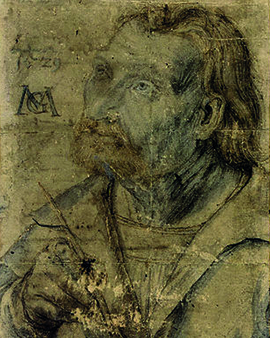
.jpg "Bearded Saint with walking stick, c. 1516 by Matthias Grünewald")
.jpg)
.jpg "The Crucifixion from the Isenheim Altarpiece, detail of Christ")
.jpg)
.jpg "The Crucifixion by Matthias Grünewald")
.jpg)
.jpg "Saint Sebastian and Landscape (detail from the Isenheim Altarpiece, inner wing) by Matthias Grünewald")
.jpg)
.jpg "Altarpiece of Our Lady of the Snows, c.1519 (detail) by Matthias Grünewald")
.jpg)
.jpg "St. Catherine by Matthias Grünewald")
.jpg)
.jpg "Detail of the Nativity scene from the Isenheim Altarpiece (the announcement to the shepherds) by Matthias Grünewald")
.jpg)
.jpg "Crucifixion by Matthias Grünewald")
.jpg)
.jpg "The Virgin")
.jpg)
.jpg "Angels Under the Dais (detail) by Matthias Grünewald")
.jpg)
.jpg "The Small Crucifixion by Matthias Grünewald")
.jpg)
.jpg "Visit of St Anthony to St Paul and Temptation of St Anthony by Matthias Grünewald")
.jpg)
.jpg "St. John the Evangelist and the Virgin (detail) by Matthias Grünewald")
.jpg)
.jpg "Visit of Saint Anthony to Saint Paul the Hermit (detail of the crest of Guido Gersi from the Isenheim Altarpiece) by Matthias Grünewald")
.jpg)
.jpg "Saint Maurice by Matthias Grünewald")
.jpg)
.jpg "Panel of the Heller Altar Depicting St. Laurence by Matthias Grünewald")
.jpg)
.jpg "Detail of a falling soldier from the scene of the resurrection of Christ from the Isenheim Altarpiece by Matthias Grünewald")
.jpg)
.jpg "Detail of the Annunciation of the Virgin Mary from the Isenheim Altarpiece (outer wing) by Matthias Grünewald")
.jpg)
.jpg "A Glass Jug (detail) by Matthias Grünewald")
.jpg)
_-_(MeisterDrucke-164944).jpg "St. Maurice (detail) by Matthias Grünewald")
_-_(MeisterDrucke-164944).jpg)
_-_(MeisterDrucke-315245).jpg "An Elderly Woman with Clasped Hands by Matthias Grünewald")
_-_(MeisterDrucke-315245).jpg)
.jpg "Portrait of an Old Woman in Profile to the Left by Hans Schäufelein")
.jpg)
.jpg "The Visit of Saint Anthony to Saint Paul the Hermit (detail of a crow carrying a piece of bread from the Isenheim Altarpiece) by Matthias Grünewald")
.jpg)
.jpg "Crucifixion by Matthias Grünewald")
.jpg)
.jpg "Concert of Angels and Nativity (detail) by Matthias Grünewald")
.jpg)
.jpg "The Virgin Illuminated (detail) by Matthias Grünewald")
.jpg)
.jpg "The Small Crucifixion by Matthias Grünewald")
.jpg)
.jpg "Aschaffenburg Altar by Matthias Grünewald")
.jpg)
.jpg "The Mocking of Christ (detail) by Matthias Grünewald")
.jpg)
.jpg "Stuppacher Madonna by Matthias Grünewald")
.jpg)
 - (MeisterDrucke-132846).jpg "Portrait of a Patron by Matthias Grünewald")
 - (MeisterDrucke-132846).jpg)
.jpg "The Small Crucifixion by Matthias Grünewald")
.jpg)
.jpg "The Visit of Saint Anthony to Saint Paul the Hermit (detail from the Isenheim Altarpiece) by Matthias Grünewald")
.jpg)
.jpg "The Visit of Saint Anthony to Saint Paul the Hermit (detail of Saint Paul")
.jpg)
.jpg "Suffering Man (detail) by Matthias Grünewald")
.jpg)
.jpg "St. Anthony and St. Paul (detail from the Isenheim Altarpiece) by Matthias Grünewald")
.jpg)
.jpg "Virgin and Child in the Clouds by Matthias Grünewald")
.jpg)
.jpg "Coburg Panel by Matthias Grünewald")
.jpg)
.jpg "St. Anthony and St. Paul (detail) by Matthias Grünewald")
.jpg)
.jpg "Meeting of St Erasm and St Maurice by Matthias Grünewald")
.jpg)
.jpg "Panel of the Heller Altar depicting St. Cyriacus by Matthias Grünewald")
.jpg)
.jpg "Detail of the arm of John the Baptist from the Isenheim Altarpiece. Altarpiece closed. c.1512-16 by Matthias Grünewald")
.jpg)
.jpg "God the Father (detail) by Matthias Grünewald")
.jpg)
.jpg "Virgin and Child in the Clouds by Matthias Grünewald")
.jpg)
.jpg "St. Joseph by Matthias Grünewald")
.jpg)
.jpg "Detail from the Isenheim altarpiece, outer wing, concert of angels, c.1512-16 by Matthias Grünewald")
.jpg)
.jpg "The Prophet Isaiah, from the Isenheim Altarpiece by Matthias Grünewald")
.jpg)
.jpg "Crucifixion from the Isenheim Altarpiece (detail of Christ")
.jpg)
.jpg "The Small Crucifixion by Matthias Grünewald")
.jpg)

 +43 4257 29415
 support@meisterdrucke.com
 Mo-Do: 7:00 - 16:00 | Fr: 7:00 - 13:00