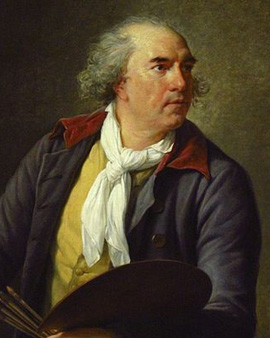
The Frenchman Hubert Robert was a painter who was born in May 1733 in Paris. Unfortunately little is known about his childhood. His father is said to have been a high official in Paris. At the age of 12 he began his school education at the university, the Jesuit Collège de Navarre, which was founded in 1304 by Joan of Navarre, wife of the French king. Here the young Hubert was not only taught painting, but also logic, grammar and theology. The French sculptor René-Michel Slodtz became Hubert's favourite lecturer. He followed with great interest his explanations about the different perspectives and constantly improved his drawings a little bit further. It is said that it was only thanks to Slodtz' instructive teaching that Hubert Robert made the decision to pursue a career as a painter.
After six years at the University of Paris he went to Rome. Here he lived for eleven years and built up a large circle of friends and acquaintances. This included some of the most important artists, painters and writers of the time. Giovanni Battista Piranesi and Giovanni Paolo Pannini, who also lived in Rome, probably had a special influence on his further development. Piranesi began his career as an engraver before working as an archaeologist and architect. Pannini, on the other hand, was a well-known Roman veduta painter.
After his stay in Rome, Hubert Robert returned to his home town Paris. It was the year 1793 and Hubert celebrated his 60th birthday in troubled times. The great terror of the French Revolution was approaching. At the beginning of the year, members of the Party of the Jacobins beheaded the French King Louis XVI with the guillotine in front of the public. Throughout the country, people who the Jacobins believed to be opponents of the revolution fell victim to the bloody terror. Also Robert was imprisoned in the same year. He was held in the Paris prisons Saint-Pélagie and Saint-Lazare. Only after the overthrow of Robespierre was he freed, that was in the summer of 1794, but the French Revolution was to last another five years. Robert joined the Jacobins and became a member of the National Convention. The "Convention nationale" was the revolutionary representation of the people. The Convention was replaced by the National Assembly, which was the first national parliament in Europe. The French Revolution ended with the adoption of the Declaration of Human and Civil Rights in 1799. From then on, the monarchy was history and the citizens could in future have a say in the development of their country in free elections. The French Revolution was one of the most momentous events in the long history of Europe. Hubert Robert still experiences the first, peaceful years after the revolution and the beginning of the 19th century. He died in 1808, at the age of 75 in his native Paris.
 ×
×







 Passionate Customer Service

.jpg "The Bathing Pool by Hubert Robert")
.jpg)
.jpg "The Fountains, 1787-88 by Hubert Robert")
.jpg)
.jpg "The Old Temple, 178788 by Hubert Robert")
.jpg)
_-_(MeisterDrucke-903803).jpg "The Bathing Pool, c. 1780 by Hubert Robert")
_-_(MeisterDrucke-903803).jpg)
.jpg "The Falls of Tivoli, 1768 by Hubert Robert")
.jpg)
.jpg "The Fire of Rome, 18 July 64 AD by Hubert Robert")
.jpg)
.jpg "View of the Park of Méréville, c. 1790 by Hubert Robert")
.jpg)
.jpg "Roman Ruins, 1759 by Hubert Robert")
.jpg)
.jpg "The Hall of the Seasons at the Louvre by Hubert Robert")
.jpg)
.jpg "Egyptian Fantasy, 1760 by Hubert Robert")
.jpg)
.jpg "Architectural capriccio by Hubert Robert")
.jpg)
.jpg "Ruined Landscape by Hubert Robert")
.jpg)
.jpg "The Gardens of Versailles by Hubert Robert")
.jpg)
.jpg "The Obelisk, 1787-88 by Hubert Robert")
.jpg)
.jpg "Dance and concert in a park by Hubert Robert")
.jpg)
.jpg "Imaginary View of the Grand Gallery of the Louvre in Ruins, 1796 by Hubert Robert")
.jpg)
 in the Tuileries Paris 1794 - (MeisterDrucke-97011).jpg "The Cenotaph of Jean-Jacques Rousseau (1712-78) in the Tuileries, Paris, 1794 by Hubert Robert")
 in the Tuileries Paris 1794 - (MeisterDrucke-97011).jpg)
.jpg "Porto di Ripetta in Rome, with the Pantheon, architectural tableau, 1766 by Hubert Robert")
.jpg)
_1776_Sun_076x104_m_M_-_(MeisterDrucke-1022870).jpg "Landscape with Bridge, 1776, 0.76 x 1.04 m, Musée Fabre, Montpellier by Hubert Robert")
_1776_Sun_076x104_m_M_-_(MeisterDrucke-1022870).jpg)
.jpg "The Tomb of Jean-Jacques Rousseau at Ermenonville, 1802 by Hubert Robert")
.jpg)
.jpg "The Old Temple, 1787-88 by Hubert Robert")
.jpg)
.jpg "The Ruins of Nîmes, Orange, and Saint-Rémy-de-Provence by Hubert Robert")
.jpg)
.jpg "Roman Ruins, the Forum with the Colosseum and the Obelisk by Hubert Robert")
.jpg)
.jpg "The Old Bridge, c.1760 by Hubert Robert")
.jpg)
.jpg "Arches in Ruins by Hubert Robert")
.jpg)
.jpg "Fire at the Opera of the Palais-Royal, View from the Louvre, 1781 by Hubert Robert")
.jpg)
.jpg "Ruins at the Sea Near Naples: the \"Scola di Virgilio\" by Hubert Robert")
.jpg)
.jpg "Project for the Arrangement of the Grand Gallery of the Louvre, c. 1789 by Hubert Robert")
.jpg)
.jpg "Imaginary View of the Grand Galerie du Louvre in Ruins, painting by Hubert Robert (1733-1808), sun, 1.14 x 1.46 m by Hubert Robert")
.jpg)
.jpg "Washerwomen beneath a Bridge Arch by Hubert Robert")
.jpg)
.jpg "Park Landscape by Hubert Robert")
.jpg)
.jpg "The Grand Gallery of the Louvre between 1801 and 1805. Painting by Hubert Robert (1733-1808), 0.37 x 0.46, Louvre Museum, Paris by Hubert Robert")
.jpg)
_Seen_from_the_Side_verso_-_(MeisterDrucke-1222895).jpg "Statue of a Roman Woman (Female Deity?) Seen from the Side (verso) by Hubert Robert")
_Seen_from_the_Side_verso_-_(MeisterDrucke-1222895).jpg)
.jpg "View through the atrium of the casino towards the garden parterre of the Villa Albani by Hubert Robert")
.jpg)
.jpg "Imaginary View of Rome with Equestrian Statue of Marcus Aurelius, the Column of Trajan and a Temple by Hubert Robert")
.jpg)
.jpg "Christ Drives the Money Changers from the Temple by Hubert Robert")
.jpg)
.jpg "Interior of the Villa Giulia with Haymakers by Hubert Robert")
.jpg)
.jpg "View of the Campidoglio with the Statue of Marcus Aurelius by Hubert Robert")
.jpg)
.jpg "The Ponte Salario, c.1775 by Hubert Robert")
.jpg)
.jpg "Landscape with an Arch and the Dome of St Peter")
.jpg)
.jpg "The Church of Santi Giovanni e Paolo in Rome, seen from the apse by Hubert Robert")
.jpg)
.jpg "Heroic landscape by Hubert Robert")
.jpg)
.jpg "The Demolition of the Houses on the Pont Notre-Dame in Paris by Hubert Robert")
.jpg)
.jpg "The Fire of the Hôtel-Dieu in Paris 1772 by Hubert Robert")
.jpg)
.jpg "The Oval Fountain in the Gardens of the Villa d")
.jpg)
.jpg "A Hermit Praying in the Ruins of a Roman Temple, ca 1760 by Hubert Robert")
.jpg)
.jpg "The Burning of Rome by Hubert Robert")
.jpg)
.jpg "The Portico of a Country Mansion by Hubert Robert")
.jpg)
.jpg "Wandering Minstrels by Hubert Robert")
.jpg)
.jpg "Landscape by Hubert Robert")
.jpg)
.jpg "The Oval Fountain in the Gardens of the Villa d")
.jpg)
.jpg "Colonnade and Gardens at the Villa Mancini by Hubert Robert")
.jpg)
_-_(MeisterDrucke-1657255).jpg "A Picturesque View of the Capitol in Rome by Hubert Robert")
_-_(MeisterDrucke-1657255).jpg)
_-_(MeisterDrucke-1658175).jpg "The Square House in Nimes by Hubert Robert")
_-_(MeisterDrucke-1658175).jpg)
.jpg "Alexander the Great Before the Tomb of Achilles by Hubert Robert")
.jpg)
.jpg "The Rustic Bridge, Château de Méréville, France by Hubert Robert")
.jpg)
_huile_sur_toile_-_(MeisterDrucke-1313791).jpg "Sarcophagus by Hubert Robert")
_huile_sur_toile_-_(MeisterDrucke-1313791).jpg)
.jpg "Capriccio with Washerwomen at a Canal by Hubert Robert")
.jpg)
.jpg "Demolition of the Church of the Feuillants by Hubert Robert")
.jpg)
.jpg "Demolition of the Houses of the Notre Dame Bridge in Paris in 1786 by Hubert Robert")
.jpg)
.jpg "Demolition of the church of the Feuillants in the Rue Saint Honore, c.1804 by Hubert Robert")
.jpg)
.jpg "Pyramid with a Broken Tip in an Ancient Ruin Landscape by Hubert Robert")
.jpg)
.jpg "The Statue before the Ruins, plate three from Les Soirées de Rome by Hubert Robert")
.jpg)
_-_(MeisterDrucke-1657455).jpg "The Demolition of the Houses on Pont au Change, Paris by Hubert Robert")
_-_(MeisterDrucke-1657455).jpg)
_-_(MeisterDrucke-1260804).jpg "A Roman Fountain (Counterproof) by Hubert Robert")
_-_(MeisterDrucke-1260804).jpg)
_Painting_by_Hubert_Robert_(173_-_(MeisterDrucke-1029629).jpg "The Fire of the Opera at the Palais Royal by Hubert Robert")
_Painting_by_Hubert_Robert_(173_-_(MeisterDrucke-1029629).jpg)
.jpg "Architectural Fantasy, 1760 by Hubert Robert")
.jpg)
.jpg "A Colonnaded Thermal Building with Girls Washing Clothes by Hubert Robert")
.jpg)
 and Marie-Antoinette (1755-1793) at the entry of the Tapis Vert in the Gardens of Versailles 1775 (colour engraving) (detail) - (MeisterDrucke-146781).jpg "Louis XVI (1754-1793) and Marie-Antoinette (1755-1793) at the entry of the Tapis Vert in the Gardens of Versailles, 1775 (detail) by Hubert Robert")
 and Marie-Antoinette (1755-1793) at the entry of the Tapis Vert in the Gardens of Versailles 1775 (colour engraving) (detail) - (MeisterDrucke-146781).jpg)
.jpg "From Study Volume 37, Page 39 by Hubert Robert")
.jpg)
_-_(MeisterDrucke-1311117).jpg "A Palace with an Arched Bridge (A Roman Villa) by Hubert Robert")
_-_(MeisterDrucke-1311117).jpg)
_-_(MeisterDrucke-1133044).jpg "Man sketching the ruins of a classical temple by Hubert Robert")
_-_(MeisterDrucke-1133044).jpg)
.jpg "View of the Grotto and the Rustic Bridge in the Landscape Garden at Méréville by Hubert Robert")
.jpg)
.jpg "Roman Ruins with Laundresses by Hubert Robert")
.jpg)
_huile_sur_toile_vers_1770-178_-_(MeisterDrucke-1325969).jpg "In a Park by Hubert Robert")
_huile_sur_toile_vers_1770-178_-_(MeisterDrucke-1325969).jpg)
_-_(MeisterDrucke-592633).jpg "Le Musée des Antiques, c.1800 by Hubert Robert")
_-_(MeisterDrucke-592633).jpg)
.jpg "Figures around a Fire by Hubert Robert")
.jpg)
.jpg "Statue of Abundance (recto) by Hubert Robert")
.jpg)
.jpg "Architectural Scene with Women Washing Clothes at a Pool by Hubert Robert")
.jpg)
.jpg "View of the Villa Medici by Hubert Robert")
.jpg)
.jpg "The Dance by Hubert Robert")
.jpg)
.jpg "Seated Male Nude with Arm over Head, Seen from the Side by Hubert Robert")
.jpg)
.jpg "Landscape with the Ruins of the Temple of the Sibyl in Tivoli by Hubert Robert")
.jpg)
.jpg "Roman capriccio with a street singer by Hubert Robert")
.jpg)
.jpg "Ascent to the Farnese Gardens on the Palatine by Hubert Robert")
.jpg)
.jpg "Washerwomen in the Ruins of the Colosseum by Hubert Robert")
.jpg)
_-_(MeisterDrucke-898117).jpg "Terrace Ruins in a Park, c.1780 by Hubert Robert")
_-_(MeisterDrucke-898117).jpg)
.jpg "Ruined Farm by Hubert Robert")
.jpg)
.jpg "Architectural Capriccio with Temple and Obelisk, 1798 by Hubert Robert")
.jpg)
.jpg "The Bathing Pool by Hubert Robert")
.jpg)
.jpg "Landscape with Roman Temple Ruin by Hubert Robert")
.jpg)
.jpg "The demolition of the Bastille, July 14, 1789 by Hubert Robert")
.jpg)
.jpg "Pavilion in a Park by Hubert Robert")
.jpg)
.jpg "View of the Arc de Triomphe and the Theatre of Orange by Hubert Robert")
.jpg)
.jpg "Imaginary View of Rome with the Colossi of Monte Cavallo and a Church by Hubert Robert")
.jpg)
_-_(MeisterDrucke-1658310).jpg "Fountain on a Terrace by Hubert Robert")
_-_(MeisterDrucke-1658310).jpg)
.jpg "Three Ladies Chatting by Hubert Robert")
.jpg)
.jpg "Temple of Minerva, Athens, Greece by Hubert Robert")
.jpg)
.jpg "The Grande Galerie of the Louvre by Hubert Robert")
.jpg)
.jpg "Landscape, The Waterfall by Hubert Robert")
.jpg)

 +43 4257 29415
 support@meisterdrucke.com
 Mo-Do: 7:00 - 16:00 | Fr: 7:00 - 13:00