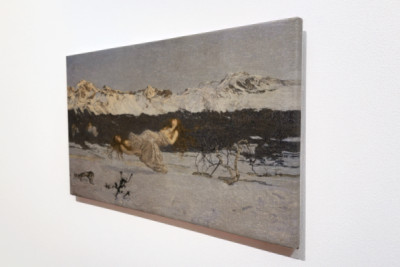
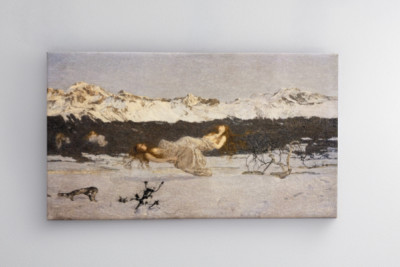
The landscape is layered horizontally: at the bottom, a snowfield; above it, an almost black strip of bare scrub; behind that, the snow-capped mountain range; and at the top, a pale sky. And floating across these rigid bands are two women, supported by nothing - their loose, reddish-brown hair trails behind them like smoke and becomes entangled in the dark branches. Here, Segantini is not painting a narrative with a beginning and an end, but rather a state of being: cold, weightlessness, a limbo between sleep and punishment. The light remains subdued; the colours are kept to greys, beiges and off-white, with only the hair and the flesh tones providing a contrast of warm hues. If you look for a little longer, you will discover a third, half-disintegrated figure in the darkness on the left - the painting reveals its figures only hesitantly.
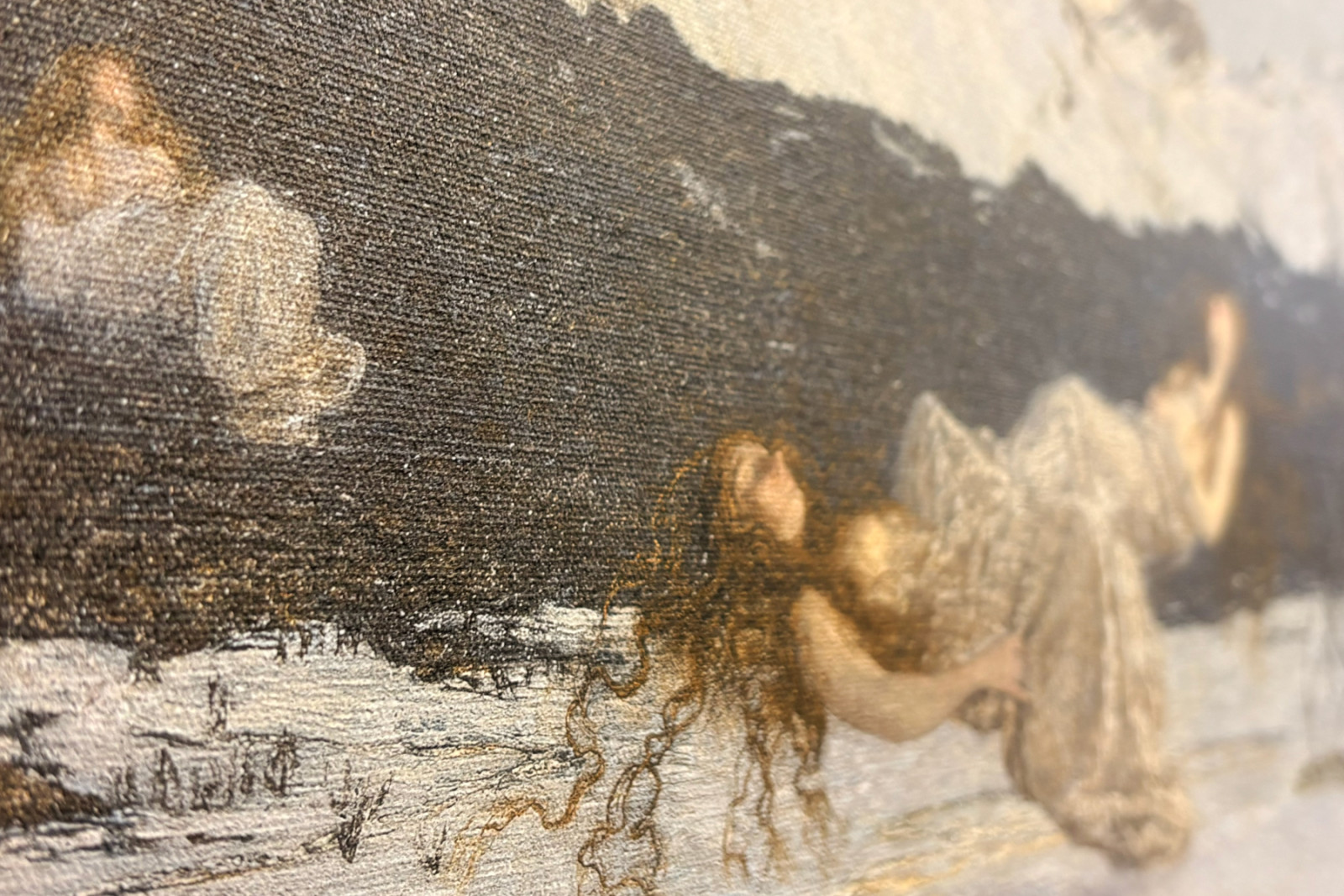
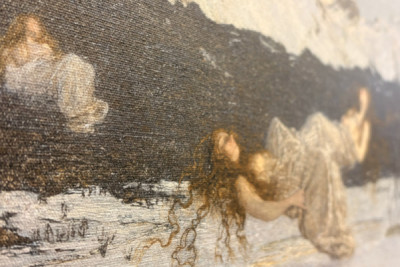
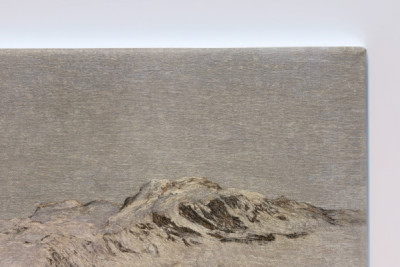
On the satin-finished ‘Leonardo’ canvas, stretched to a size of 68 x 39 cm without a frame, it is precisely this state that takes on a tangible quality. As the eye travels over the dark strip of undergrowth, a fine-grained relief emerges: the many short strokes with which Segantini has rendered the branches sit as slightly raised dots and threads on the fabric, whilst the sky above remains flat and still. At the top edge of the picture, the structure of the canvas lies exposed beneath the light grey, and the etched mountain ridges appear almost as if scratched rather than printed. The motif continues cleanly around the edges of the stretcher frame, whilst the snowfield extends to the sides.
Thus, the painting hangs on the wall as a flat surface, without glass or a passe-partout - and this suits it perfectly, because nothing comes between the eye and the canvas. What catches the eye are the hair-thin, winding strands: they remain legible right down to the very last loop, and one follows them almost involuntarily from the warm reddish-brown of the figures across to the black branches.
 ×






 +43 4257 29415
 support@meisterdrucke.com
 Mo-Do: 7:00 - 16:00 | Fr: 7:00 - 13:00