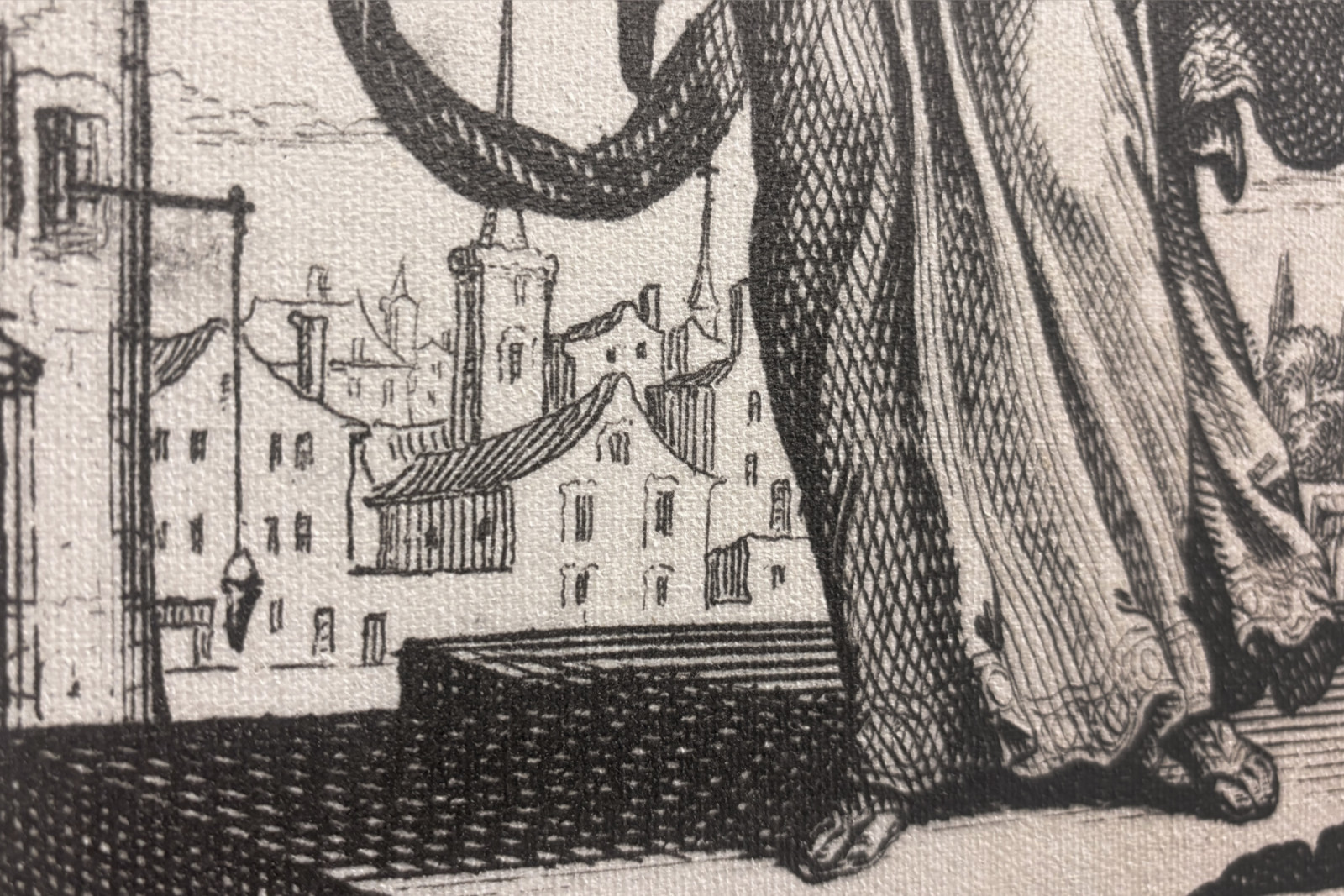
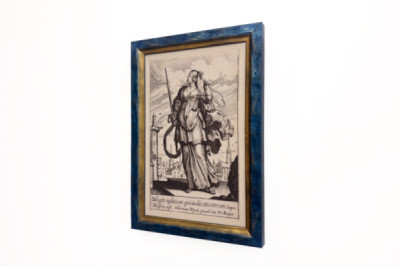
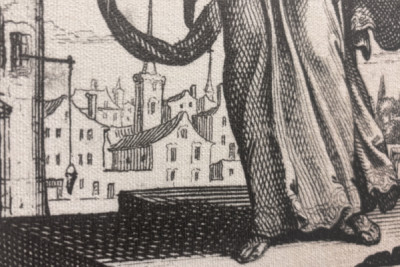
Above the rooftops of a densely built city stands Justice as a towering, almost striding figure. In her raised hand she holds the scales, whilst at her other side the long sword rises vertically: here, weighing up and deciding do not appear as opposites, but as two parts of the same task. Her head is turned upwards, her robe falls in heavy folds down to her bare feet, and behind the figure a cloth billows in wide loops. Abraham Bosse places this personification against a deep urban landscape featuring towers, gables and tiny windows. It is precisely here that his precision is evident. A few short strokes suffice for a roof; closely spaced cross-hatching condenses the skirt into shadows; parallel lines form the sky and the ground. This print from 1636 is part of Bosse’s series on the virtues. The Parisian engraver therefore does not present the abstract idea in a distant and solemn manner, but places it right at the heart of a recognisable world. Black and the warm white of the paper dominate the image; brightness arises solely from the spacing between the lines. If you look more closely, you can even see from the feet, the edges of the walls and the dark plinth just how deliberately Bosse applies each hatch.
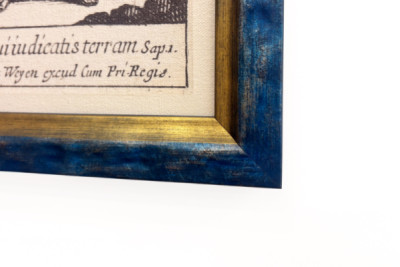
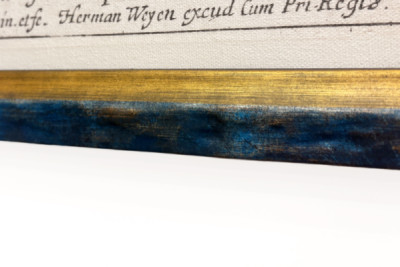
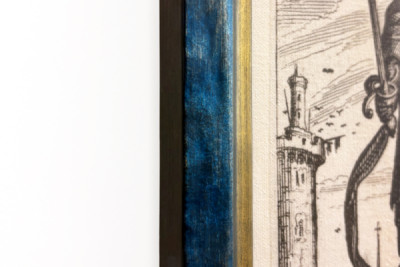
In this reproduction, the Leonardo (satin) canvas carries the old line drawing in 22 × 34 centimetres; its surface remains visible without obscuring the thin outlines of the houses or the inscription beneath the scene. However, it is Heidrun that sets the decisive tone. The profile, approximately three centimetres wide, is edged on the outside with a deep blue that does not appear to have been applied evenly: Brushstrokes run across the surface, interspersed with lighter patches and small darkened areas. This makes the colour appear to have developed naturally rather than having been applied. Towards the centre, the profile rises over a narrow edge into a gold zone. This gold, too, does not form a smooth surface; fine longitudinal lines break up its sheen and allow a brownish base to show through in places. It is particularly worth taking a close look at the lower right-hand mitre joint. There, the aligned marks from both strips meet cleanly; the line of intersection remains clear and runs right to the outer tip. Between the blue and gold, a narrow, worn edge traces the change in profile; right at the edge of the picture, the gold ends in a dark line that converges razor-sharp at the corner.
 ×





 +43 4257 29415
 support@meisterdrucke.com
 Mo-Do: 7:00 - 16:00 | Fr: 7:00 - 13:00