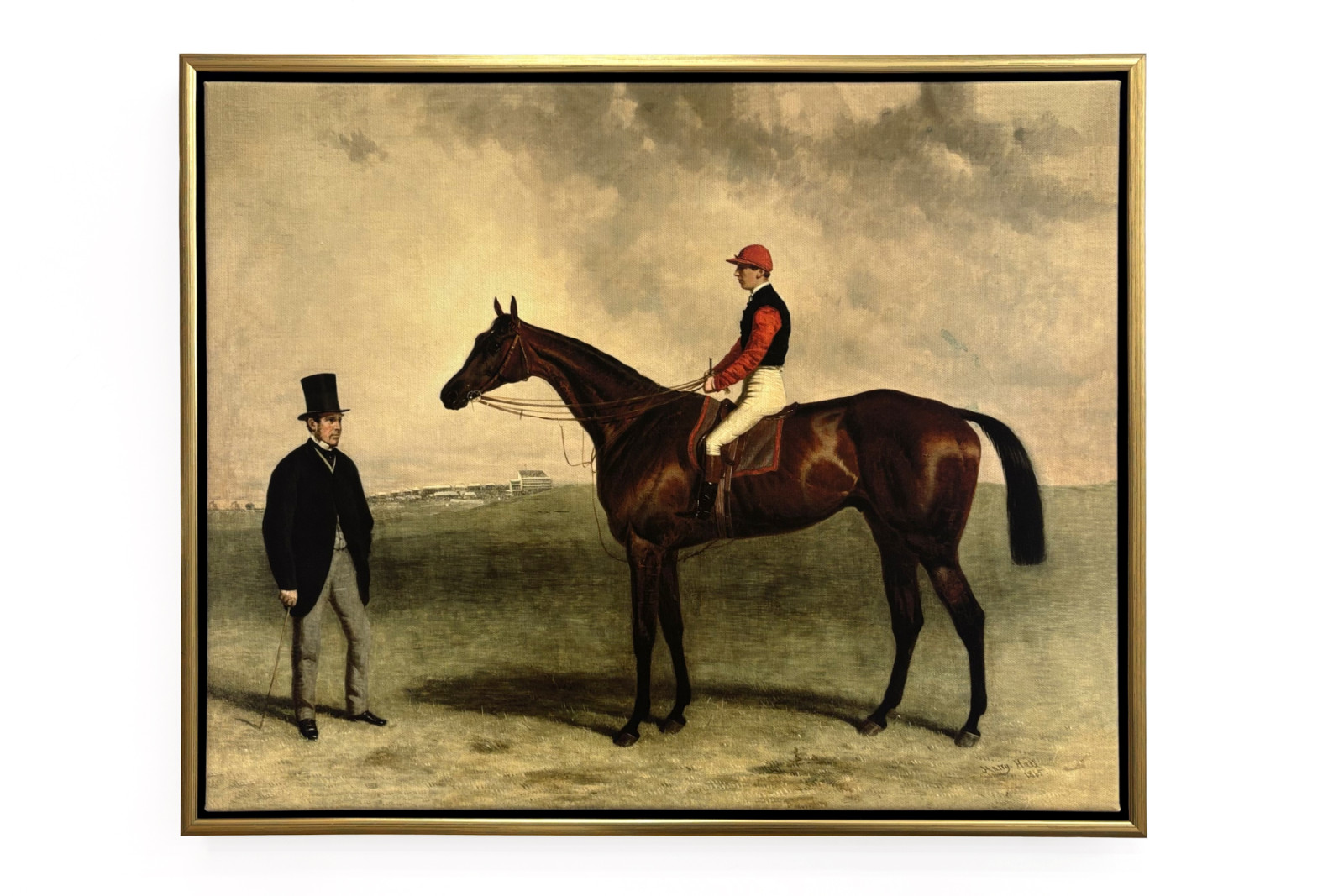
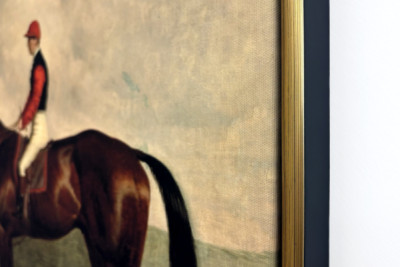
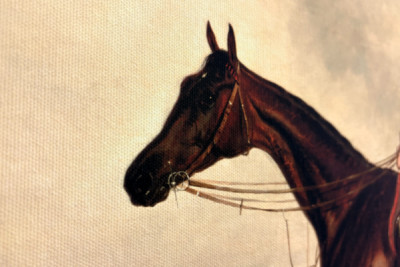
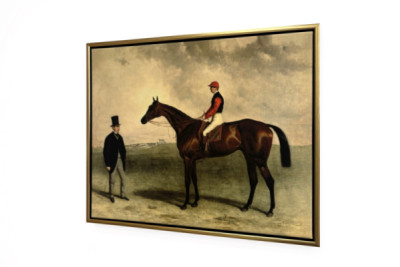
A red riding helmet stands out as the sole bold splash of colour against a sky that shifts between sandy yellow and smoky grey. Beneath it stands Gladiateur in profile, a dark brown thoroughbred&with a gleaming hindquarters, bridled, with a skimpy saddlecloth, carrying the jockey Harry Grimshaw in a red jacket and black waistcoat. On the left, wearing a top hat and carrying a walking stick, the owner, Count Frederic de Lagrange, waits, his gaze fixed on his horse without touching it. Flat grandstand structures loom on the horizon, serving more as a backdrop than a venue. The scene is frozen in time: no movement, no race, just the arrangement of horse, rider and owner, as if taking stock. Harry Hall (1816-1882) painted it in 1865 in the tradition of the English equine portrait, which in the Victorian era served primarily to document breeding and success. A background of muted green and ochre forms the backdrop to the whole scene, with almost no shadows; the light falls evenly from the front. A painting for calm walls, then, for hallways or a study where muted tones set the tone anyway.
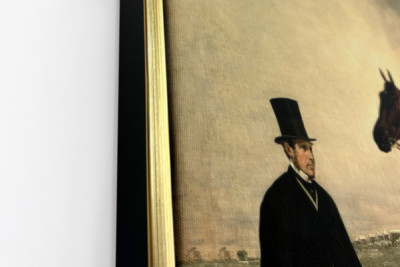
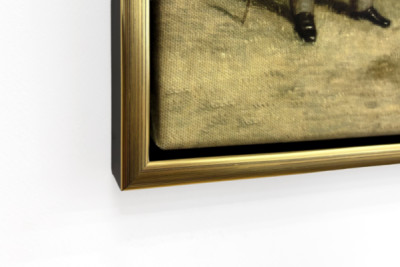
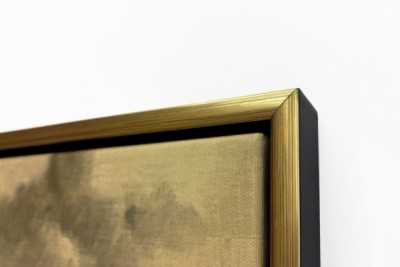
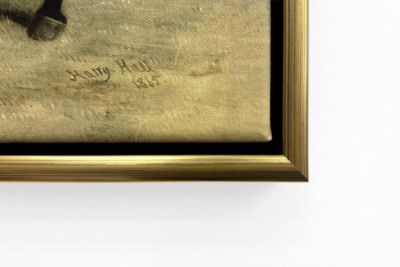
The Corlett frame, a black wooden moulding accented with gold, encases the Salvador canvas with its matt surface - and it is precisely at this junction that the piece comes into its own. On the inside, the golden profile rises diagonally outwards; its surface features dark longitudinal streaks that make the gold look less like gold leaf and more like brushed brass. Whether one interprets this as a patina or as texture is a matter of taste; I like it because it takes the gloss out of the shine. On the outside, the strip slopes down vertically from the wall as a black side panel. A narrow gap remains between the stretcher frame and the moulding, uniform on all four sides, dark enough that the canvas does not appear to touch the frame but seems to stand freely within it. The printed edge of the stretcher frame continues in the same sky-blue tone, reinforcing this impression. At the top corner, the two mitre cuts meet without a visible gap; the striped pattern changes direction cleanly at this point. If you look at the profile from the side, you can see that the frame is about a finger’s width deeper than the canvas - hence the shadow effect created by the joint. At 60 x 48 cm, this remains a manageable size that the frame’s height does not overwhelm. For a sports picture of this kind, I would be hard-pressed to recommend any other combination: the gold and the sandy sky are closely matched, as are the black and the Count’s tailcoat, and the gap keeps both at a distance.
Framed in this way, the composition in the picture appears even more static than it already is. The Count is looking on, the horse stands still, the jockey waits - and nobody in this scene is in any hurry.
 ×





 +43 4257 29415
 support@meisterdrucke.com
 Mo-Do: 7:00 - 16:00 | Fr: 7:00 - 13:00