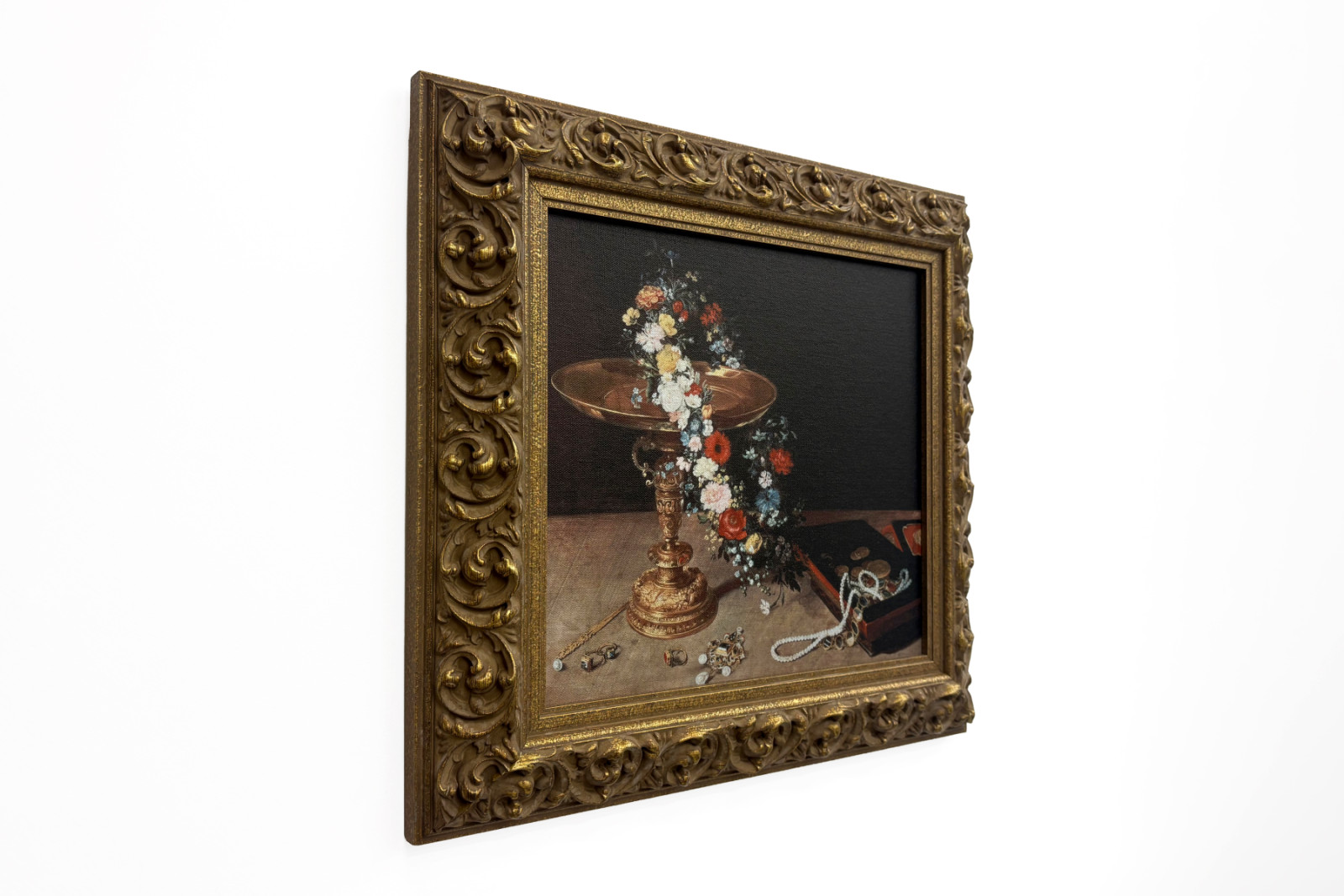
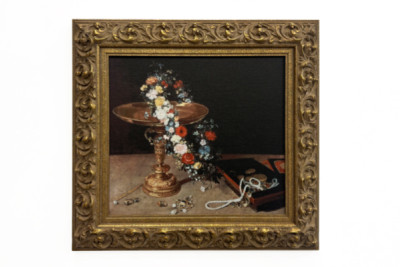
Nobody has placed the flowers in the bowl; they are lying on top of it: A garland of roses, carnations, forget-me-nots and white umbels hangs diagonally over the golden tazza, as if someone had just tossed it there and then walked away, whilst the shallow bowl itself remains empty, merely gathering the light that falls onto the table from the left. Against the almost black background, the colours shine all the more brightly: the red of the roses, the pale yellow, the blue between the leaves; and down on the tabletop, a second narrative begins, quieter and more precious: a red twigwith coins, a string of pearls sliding over the edge onto the wood, scattered rings, a brooch with a dark stone, a gold chain running aimlessly across the tabletop. It is a picture of possession, without anyone holding it in their hands. The flowers will wither, the pearls will not, and it is precisely in this juxtaposition that the unease one feels when looking at the still life lies, even though nothing in it is moving.
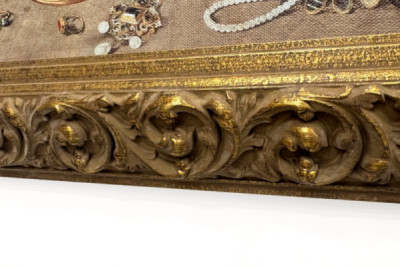
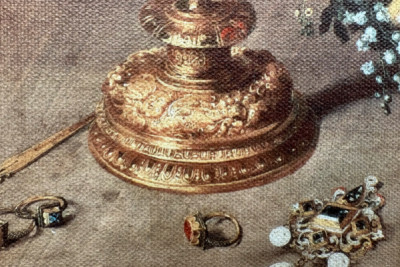
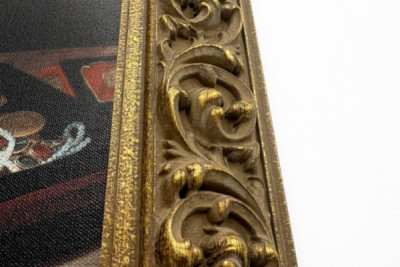
This still life was created on a Leonardo canvas with a satin finish, Liya has framed it in a wide gold frame, and without glass or a passe-partout, it now hangs on the wall in such a way that the surface lies directly before the eye. The fabric is clearly under tension here, particularly at the base of the tazza, where the embossed ornamentation of the painted goldsmith’s work runs across the warp and weftand breaks slightly at every intersection, so that the paint does not lie on top like a film, but appears to be interwoven with the fabric. Nevertheless, the beads remain sharply defined dots; my gaze lingers on them every time, because I would have expected them, of all things, to fray on the fabric. Liya, on the other hand, creates a deep relief: acanthus tendrils twisting round themselves, gold on the ridges, a dull brown in the hollows, plus a narrow strip with a grainy pattern along the inner edge, which frames the picture. For a picture measuring 30 x 27 cm, that’s a lot of frame - more than I would have thought possible for such a small format - but the Tazza stands up to it.
Both surfaces - the carved tendrils and the coarse weave - speak of the material before they speak of the subject. As the light falls across the satin, it merely lifts the ridges of the threads, whilst the dark ground behind remains matt, lending the painted gold of the bowl a lustre that seems to come not from the paper but from the paint itself. One really could not ask for more from a print of this picture.
 ×






 +43 4257 29415
 support@meisterdrucke.com
 Mo-Do: 7:00 - 16:00 | Fr: 7:00 - 13:00