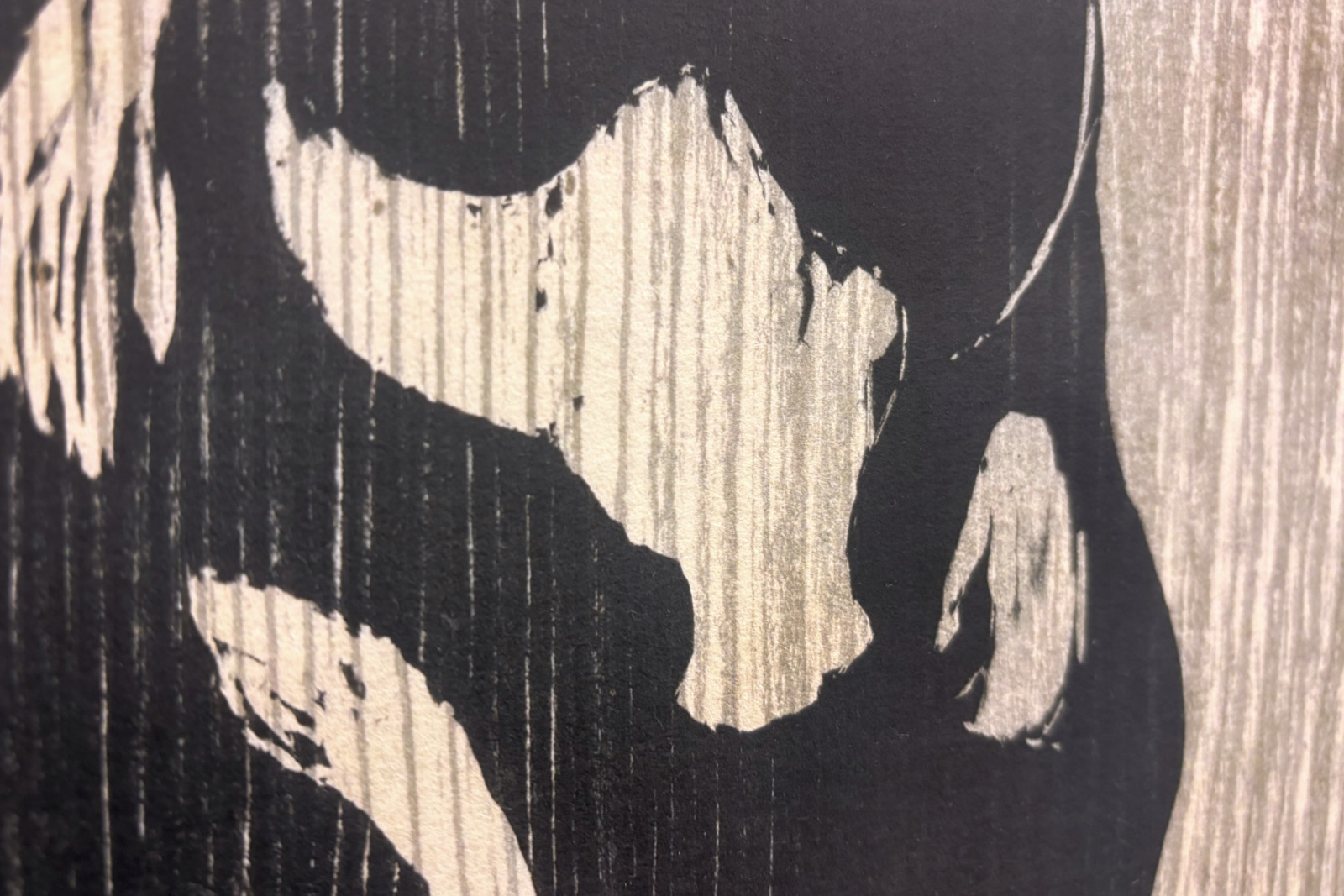
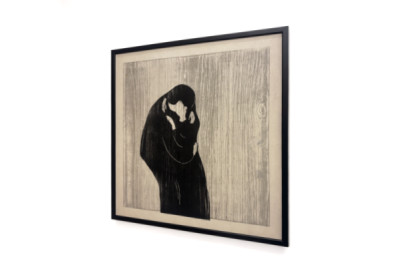
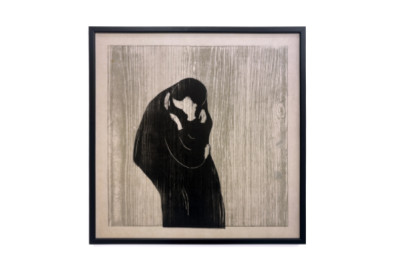
In the midst of a field of vertical lines, two figures merge into a dark, almost undivided form. Their heads lean towards one another, yet Edvard Munch leaves it open as to where one face ends and the other begins: lighter areas mark the forehead, cheek and hands, whilst the kiss itself is lost in black. Even the arms relinquish their individuality and shrink to a pair of arcs within the shared silhouette. All around, grey lines descend like a wall; on the right, only a small oval grain pattern interrupts their uniform course. The scene therefore speaks less of two specific people than of that moment in which closeness dissolves the boundaries of the individual. Intimate, yes, but also a little unsettling - very much in the spirit of Munch, who, as a pioneer of Expressionism, does not paint feelings in detail but condenses them into simple forms and stark contrasts. In the 1902 version, the kiss no longer has anything anecdotal about it. What remains is a human experience, expressed succinctly and almost physically.
In this production, Kozo Natural, at 110 g, makes all the difference, and you can tell this the moment you touch it. This Japanese paper, made from the long fibres of the paper mulberry tree, feels dry, soft and slightly fibrous; not smooth like modern printing paper, but rather like a thin sheet with a surprising amount of substance beneath your fingertips. Anyone expecting photographic paper will need a moment to adjust. This is particularly evident in the unprinted margins and in the light areas of the faces: The warm, natural tone replaces pure white, whilst tiny fibres and gentle irregularities rob the surfaces of any sterile uniformity. And this suits Munch’s lines better than we might previously have thought. They do not merely rest on the background, but seem to merge with it, so that the faces, which blend into one another, look even less like distinct portraits. Without a passe-partout, the sheet sits close to the black border; without glass, its matt surface remains exposed. On the wall, the almost square piece has enough presence to appear as a compact form from a distance, yet becomes approachable as soon as one stands close enough to see the paper fibres. One finds oneself drawn into this interplay between the effect from a distance and close-up.
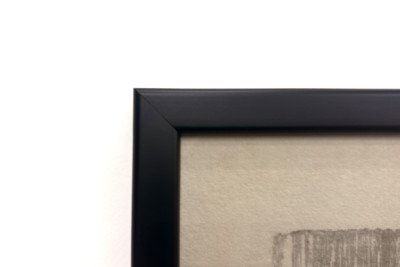
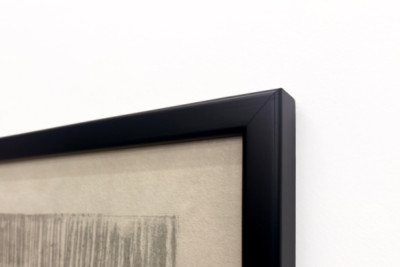
Dacey therefore uses only a narrow black border, leaving the sheet itself to take centre stage. When light falls on Kozo Natural from the side, no harsh reflection travels across the subject; instead, individual fibres brighten subtly, and it is precisely this gentle flicker that suits Munch’s fused faces so well.
 ×





 +43 4257 29415
 support@meisterdrucke.com
 Mo-Do: 7:00 - 16:00 | Fr: 7:00 - 13:00