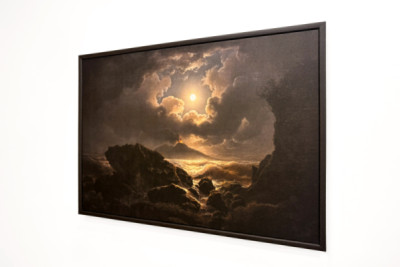
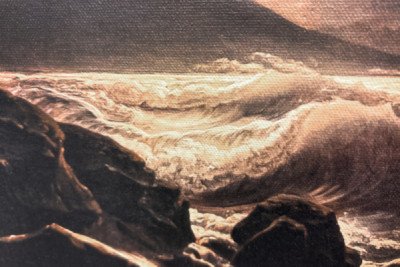
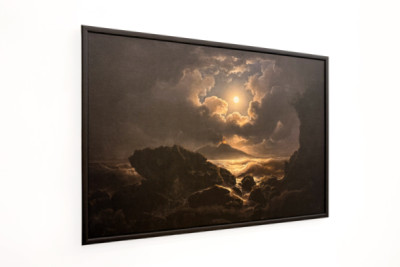
Through a gap in the cloud cover, the moonlight falls vertically onto the sea. The moon itself is merely a small, bright disc, but the edges of the clouds glow around it, and beneath it a streak of light stretches across the surf until it breaks into white foam amongst the rocks in the foreground. To the left in the background stands Vesuvius with a red flame at its summit; to the right, a bare tree marks the edge of the picture, and the boulders in front of it remain almost black. Everything else is darkness in shades of brown. On Leonardo’s canvas, this light does not remain entirely still: anyone standing in front of the painting and moving their head slightly will see the wave crests cast a faint glimmer, whilst the sky remains dull. During the final inspection in the studio, it was precisely this moment that made someone pause briefly - for a moment, the water actually seemed to glisten, and it took a second to realise that it was the canvas and not the lamp. Joseph Rebell, born in Vienna in 1787 and died there in 1828, lived for several years in Naples and Rome, where he painted time and again this southern light over the sea: moonlit nights, stretches of coastline, surf crashing against volcanic rock. The painting was created in 1822; the original now hangs in the Galleria Nazionale in Parma. Rebell straddles the line between classical order and Romantic enthusiasm for the elements, and both are evident here: the moon precisely in the centre of the picture, beneath it a storm, fire and a foaming sea.
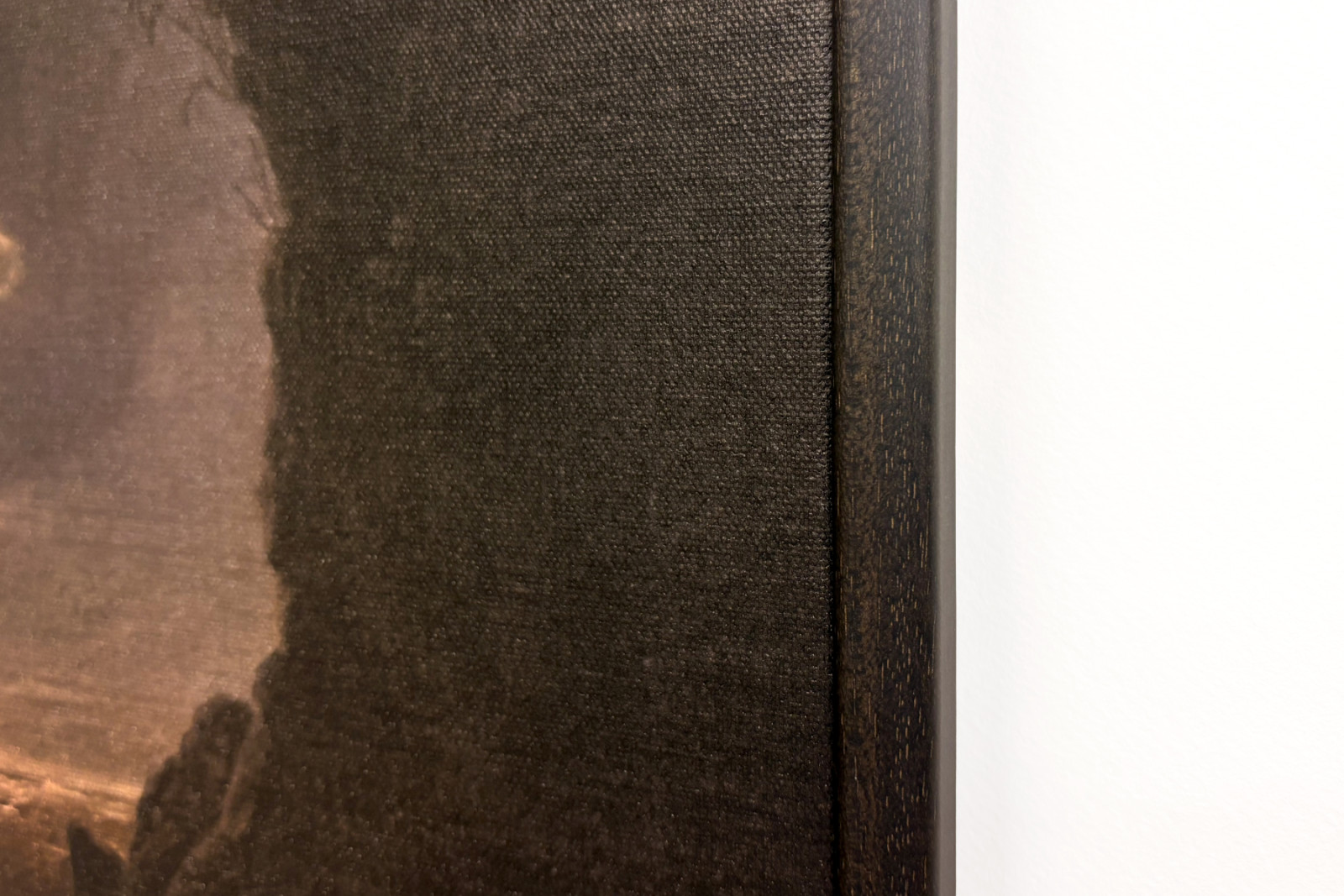
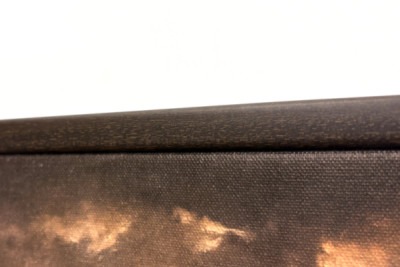
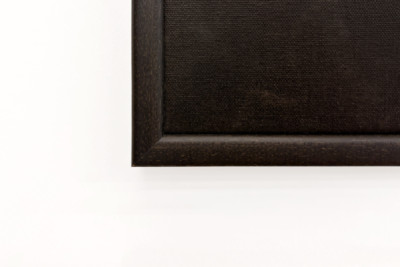
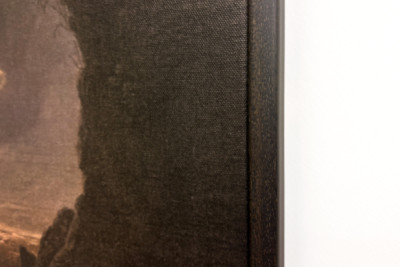
This reproduction is mounted without glass or a passe-partout in ‘Anima’, a narrow wooden frame in dark brown. Its surface displays an open-pored grain with fine, lighter lines running across the wood; the edge is slightly rounded, and the canvas abuts the profile directly. However, it is Leonardo’s weave that defines the overall impression. In the dark areas - the sky above, the rocks below - it emerges as a uniform grain pattern, with every intersection of warp and weft threads individually discernible; the ink lies over it as a thin layer, following the raised areas more closely than the recesses. This lends the night a velvety roughness. This changes at the crests of the waves: there, the light colour largely covers the weave, the surface appears smoother, and the spray stands out as a solid relief against the darker water. If one’s gaze follows the path from the rock on the left into the surf, the surface shifts noticeably from a grainy texture to a smooth one - a contrast in texture that corresponds quite precisely to the interplay of light and dark in the painting. Not every detail reflects this; the small Vesuvius fire almost disappears into the grain before one even looks for it - one really has to know that it is burning there. The dark frame, in turn, extends the blackish-brown tone of the rocks beyond the edge of the picture, so that the picture’s border is barely noticeable in the dark areasand only the bright patch of light in the centre stands out on its own - a frame that gives the painting less a boundary than an additional shadow.
 ×





 +43 4257 29415
 support@meisterdrucke.com
 Mo-Do: 7:00 - 16:00 | Fr: 7:00 - 13:00