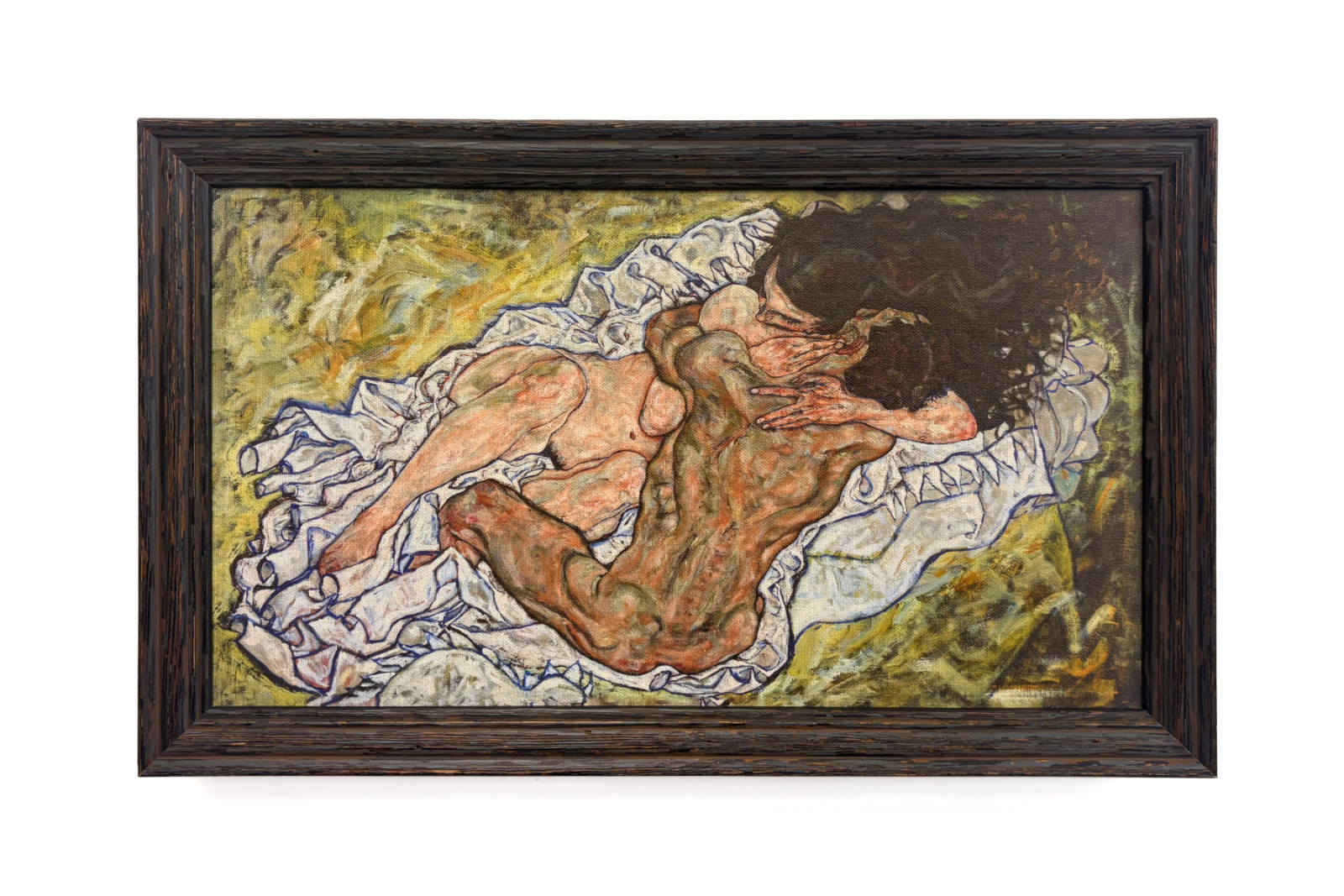
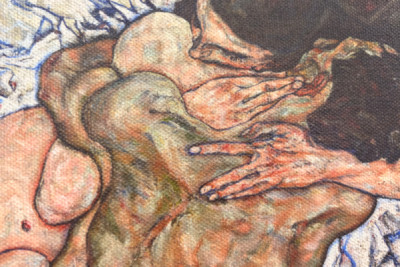
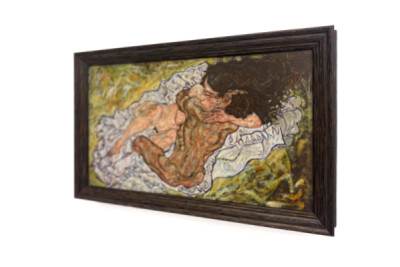
Two bodies lie intertwined on a rumpled sheet spread over a yellowish-green blanket - and there is almost nothing of their faces to be seen. The man has his back to the viewer, a back of rust-red, ochre and olive green that fills the entire centre of the picture. The woman disappears beneath him; all that remains visible is a leg, an arm, a hand pressed against his shoulder, and her dark hair, which flows to the right across the pillow. Blue contour lines outline the folds of the sheet, as if someone had traced them with a pen, and set the white against the restlessly painted background. Egon Schiele painted this picture in 1917, a year before his death, and it is one of the works in which his art took a new direction: The early nudes, with their painfully contorted limbs, give way to an intimacy that no longer needs to prove anything. Instead of exposing themselves to the gaze, the couple take refuge in one another. The original, also known as ‘Lovers II’, hangs in the Belvedere in Vienna, measuring around 100 by 170 centimetres - a life-size embracethat stands out with unusual tranquillity amongst the works of Viennese Modernism.
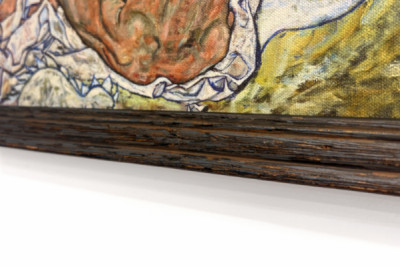
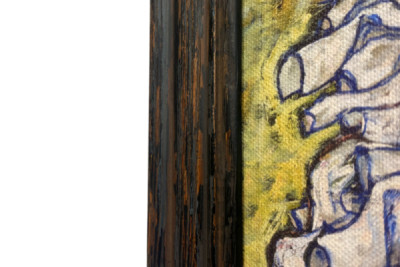
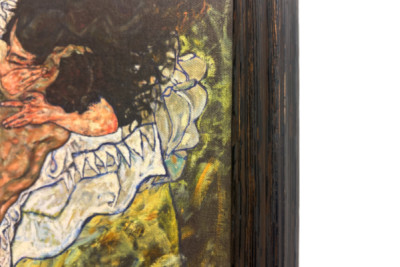
Here, this embrace is scaled down to 40 by 23 centimetres, becoming an object one can carry in both hands - those familiar with the Viennese wall will briefly miss the larger format, but that is precisely where the piece’s impact lies. Erminia, a black-grey wooden profile with deep grooves and a rough-hewn surface, wraps so broadly around the Leonardo canvas that the frame and the picture are almost equal in area; viewed from an angle, the moulding protrudes clearly from the wall and casts a narrow shadow downwards. Hanging against a light-coloured wall, the whole composition appears as a dark rectangle in landscape format, within which the yellow ceiling opens up like a window - from a distance, one first sees the splash of colour, then the couple. The blue outlines of the sheet and the individual fingers of the hand resting on the back remain distinguishable despite the reduction in size; the satin-finished surface does not obscure anything. What the weathered grooves in the wood have to do with this gentle scene is a legitimate question, and the answer lies before you: The rough wood strips the motif of all its sweetness and makes the tenderness appear as something hard-won, not as something pretty. A truly well-conceived commission.
 ×





 +43 4257 29415
 support@meisterdrucke.com
 Mo-Do: 7:00 - 16:00 | Fr: 7:00 - 13:00