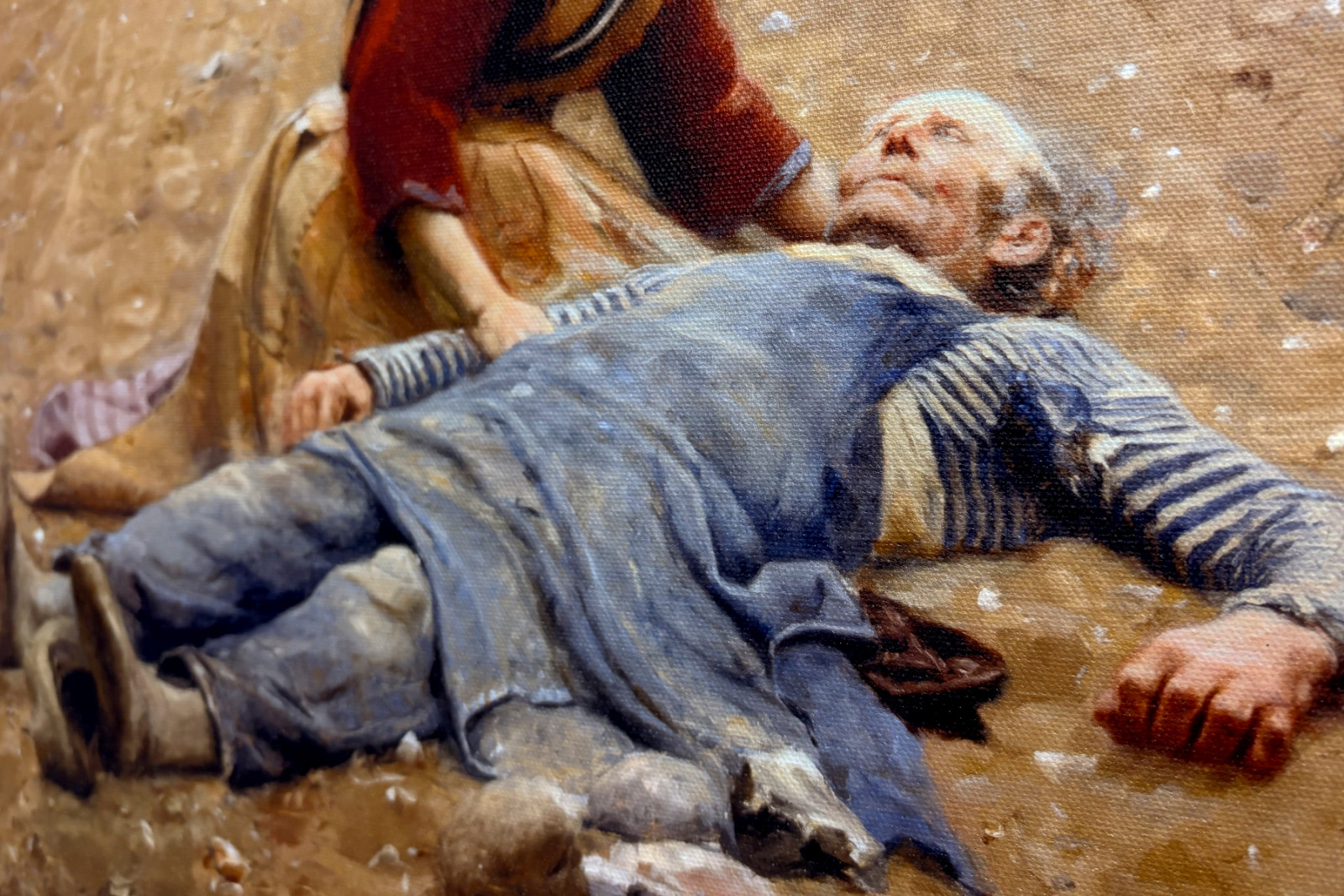
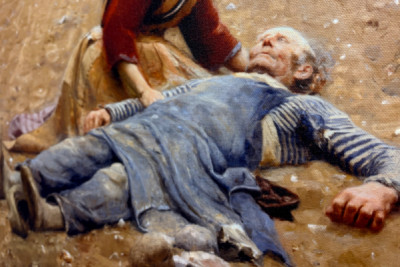
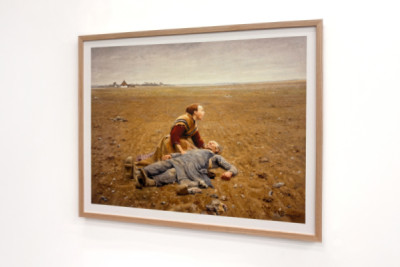
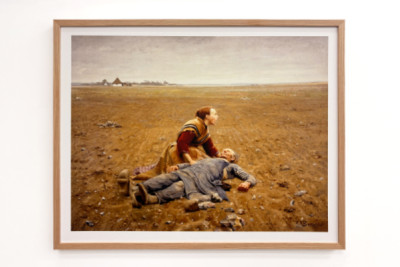
Just within the white border, the last few stones disappear into a field that seems to stretch endlessly towards the low horizon. In the midst of this barren expanse, an elderly farm labourer lies stretched out on the ground; his soiled clothes, heavy boots and limp, sagging arm speak of physical labour even before the title names it. A woman kneels behind him, supporting his upper body and calling for help with her mouth agape. Yet the nearest farmhouse appears merely as a tiny speck in the distance. In 1889, Hans Andersen Brendekilde distilled this scene into a depiction of social hardship: whether the man is exhausted, unconscious or already dead remains unclear. The second title, ‘The Martyr’, reinforces the message. Here, it is not a saint suffering at an altar, but a farm labourer on stony ground, literally knocked to the ground by his labour. The diffuse light of the overcast sky offers no comforting ray of sunshine; brown, grey and dull blue dominate the composition, whilst the red on the woman’s sleeve acts as a brief cry of alarm.
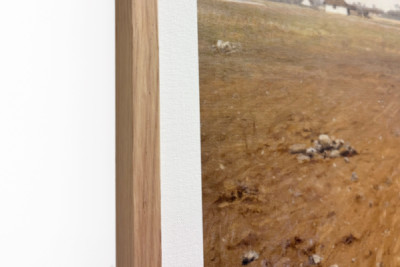
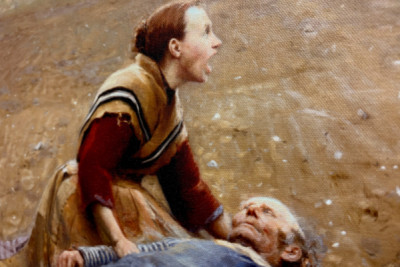
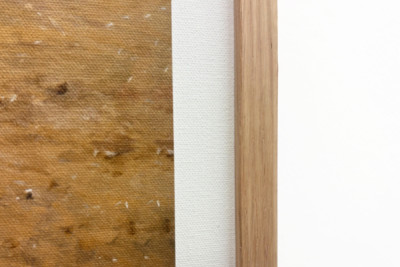
With this print on Leonardo’s satin-finished canvas, it is worth pausing a little longer to look at the two figures in particular. The print renders the narrow stripes of the shirt just as clearly as the traces of dirt on the blue apron. One’s gaze lingers longest on the man’s face: his half-open eyes do not focus on any fixed point; small reddish marks are visible on his forehead and cheek; and his grey beard still stands out against the brown field. The woman’s clenched hand, too, remains clearly discernible, even though her movement and his heavy body are tightly intertwined. A three-centimetre-wide white border is a visible part of the composition and separates the harrowing scene from the frame without appearing like a passe-partout - this distance does the scene a world of good. Sinead frames the 63 x 48-centimetre piece with a narrow oak veneer. Near the right-hand edge of the picture, the mown brown ends precisely at the white border.
 ×
× 





 +43 4257 29415
 support@meisterdrucke.com
 Mo-Do: 7:00 - 16:00 | Fr: 7:00 - 13:00