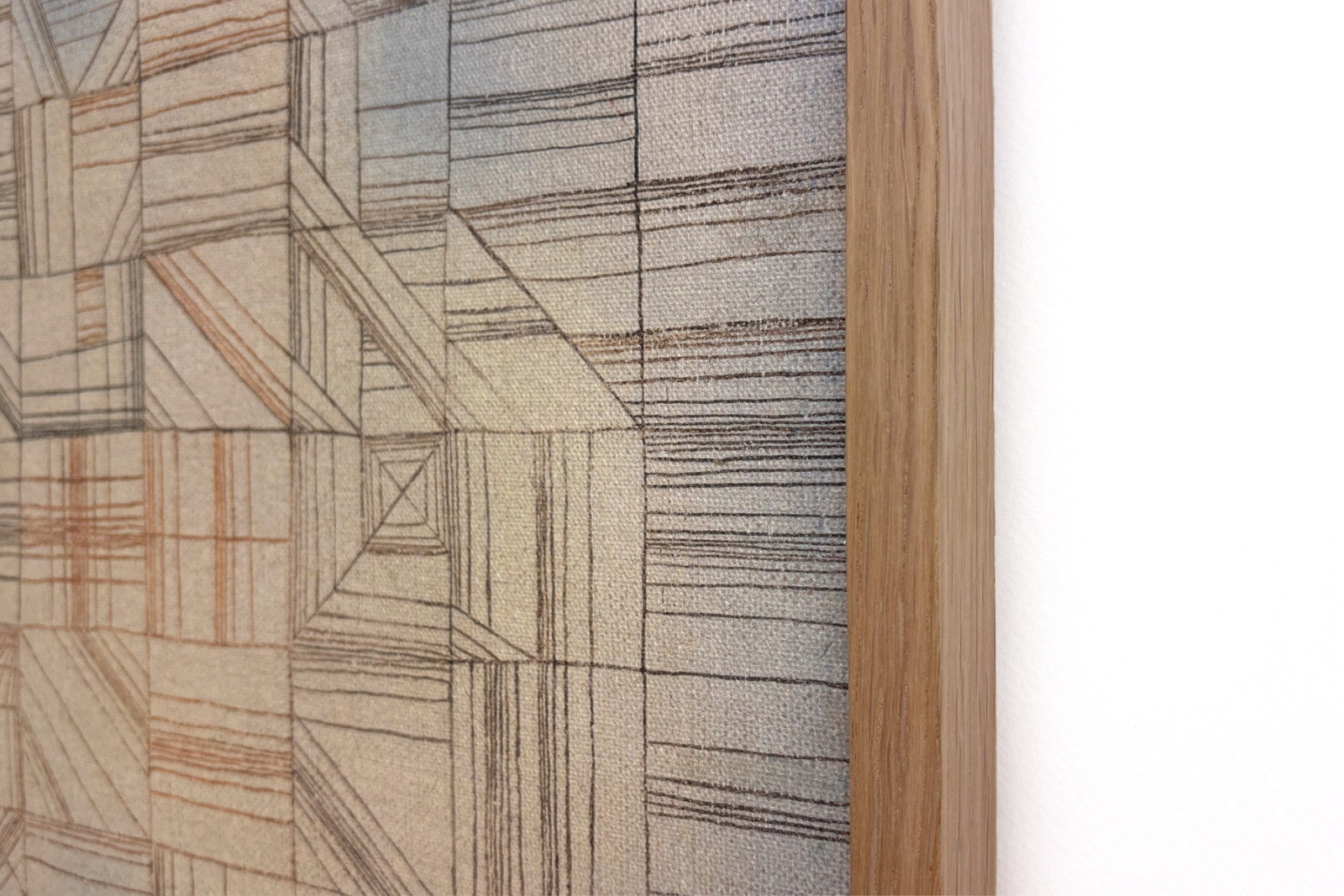
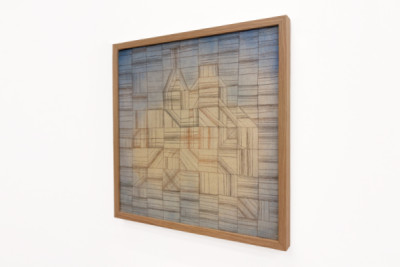
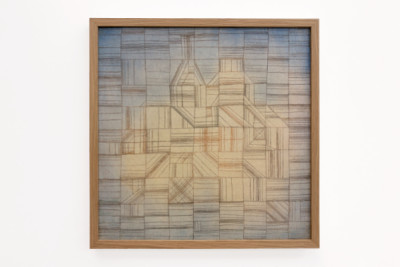
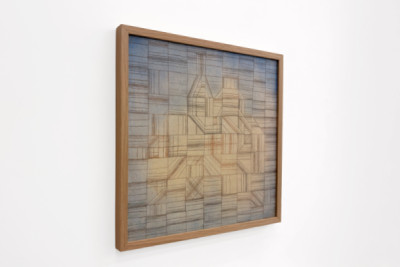
Klee was a trained violinist before he became a painter, and this is evident in this work from 1927: What unfolds across the surface here reads less like a scene than a musical score, in which a motif is introduced, repeated, shifted and played out in ever-changing arrangements. Nothing is being narrated - instead, a fundamental idea develops from delicate parallel lines, panel by panel, sometimes layered horizontally, sometimes tilted diagonally, sometimes condensed into small gables and intersecting squares, until, in the centre, something almost like an architecture composed entirely of variations takes shape, surrounded by a blue that grows darker towards the top, like an evening sky behind scaffolding. The square format of 42 x 42 cm encapsulates this order once more and lends it a sense of cohesion, almost meditative in nature. I find it interesting that, despite the many repetitions and variations, the picture never appears restless - Klee, who at the time was teaching at the Bauhaus about rhythm, structure and the inner laws of form, keeps everything within a controlled, almost musical rhythm, in which every deviation sounds like a deliberate modulation.
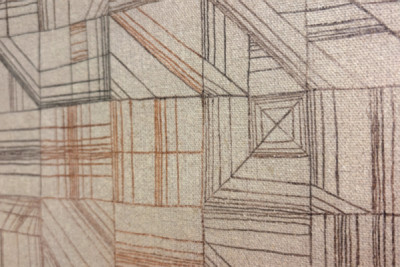
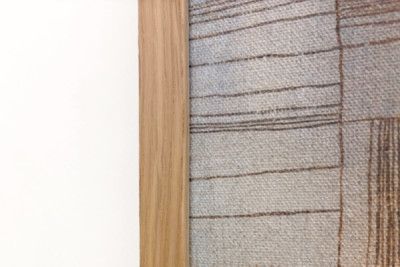
Sinead, a simple strip of oak veneer, frames this piece without any ornamentation and, with its visible wood grain, provides a calm counterpoint to the abstract order of the motif. The real highlight of this piece, however, is the surface itself: The Leonardo canvas, with its satin-finished, grainy weave, plays a significant part in making the printed lines appear as thoughas if drawn directly onto a coarse painting surface - anyone looking closely can see how every single line follows the small ridges of the weave, breaking off slightly and thereby retaining precisely that hand-drawn irregularity which characterises Klee’s drawing. Particularly in the rust-red sections at the centre of the picture, the print and the relief interlock in such a way that the structure of the fabric becomes part of the motif rather than merely a support. Stretched onto the stretcher frame and mirrored at the edges, the picture runs flush right up to the oak moulding. The result is a piece in which one can almost watch a single thought develop in several variations - and which seems to move a little further with every glance.
 ×





 +43 4257 29415
 support@meisterdrucke.com
 Mo-Do: 7:00 - 16:00 | Fr: 7:00 - 13:00