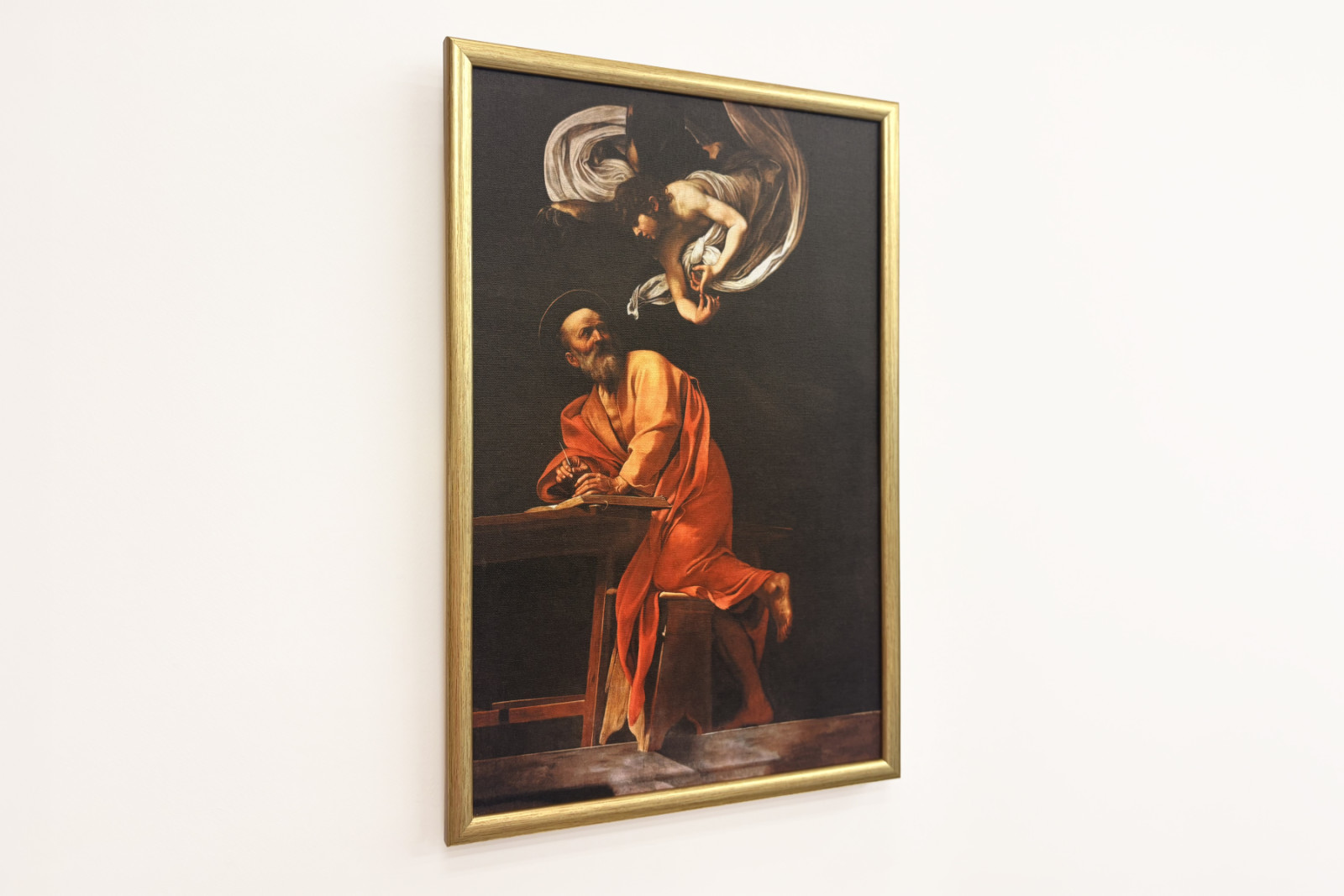
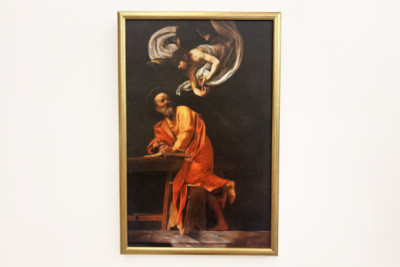
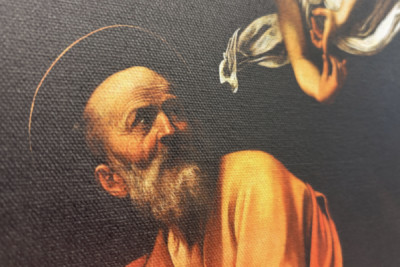
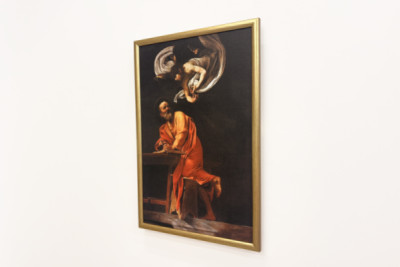
The light defines the scene. It falls from the darkness onto Matthew and the angel, with a direct line of sight running between them. The evangelist sits at the table, holding his quill over the open book. His head looks up, whilst his body remains bent over his writing. Above him hovers the angel; his hands and robe are in motion - his fingers seem to be counting out his thoughts. Below, the saint’s orange robe forms a warm block against the black space. The table, stool and foot form an angular base, above which the figure of the angel almost dissolves into light and fabric. Thus the inspiration does not seem distant or otherworldly. It happens suddenly, and Matthew reacts physically, with visible tension. Caravaggio painted the picture in 1602. His chiaroscuro is one of the defining visual devices of the early Baroque, yet here it serves not merely to create drama - it structures the narrative. I am struck by how little he needs to achieve this: two figures, a dark room, nothing more. It is precisely this restraint that makes the encounter so immediate. The narrow portrait format further heightens the sense of closeness between the writer and his heavenly counterpart.
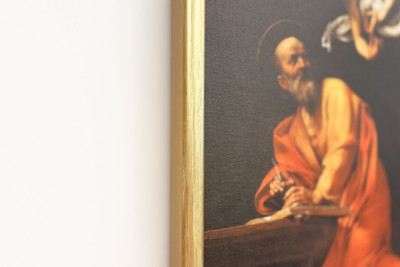
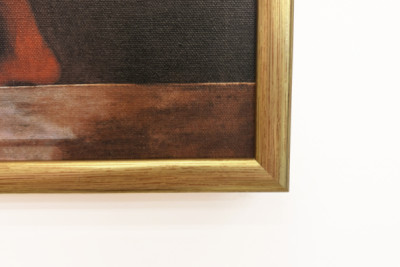
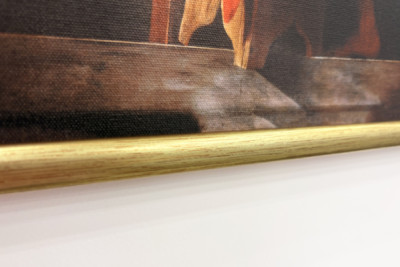
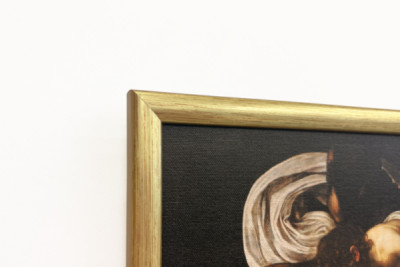
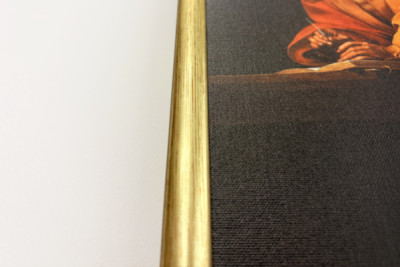
Measuring 30 by 47 centimetres, the reproduction hangs compactly on the light-coloured wall yet still possesses a remarkable sense of height. The composition draws the eye from the lower stone edge, across Matthew, to the angel; there is hardly any space left at the sides. This makes the scene seem more intimate and urgent than a wider format could achieve. Even from a few steps away, the red robe and the pale figure above it remain clearly visible. Closer to the wall, one notices how cohesive the piece appears: Without a passe-partout, the picture surface extends right up to the narrow gold border, which defines a minimal outline and adds hardly any visual bulk to the work. It works well. A wide frame would lend too much weight to the dark area, when it is the vertical movement that takes centre stage. The canvas, stretched over a stretcher frame, gives the picture a slight depth away from the wall - viewed from the side, it therefore appears as a small three-dimensional object rather than a flat sheet. The mirrored edges disappear neatly behind the frame, and without glass, the viewer’s gaze remains fixed directly on the printed surface. The drawing is what matters most anyway: fingers, pen strokes, facial features and folds in the garment remain clearly distinct from one another. What really captures my attention is the subtle gradation of light that Matthäus draws out of the darkness, making the creative process comprehensible as a visible phenomenon.
 ×
× 





 +43 4257 29415
 support@meisterdrucke.com
 Mo-Do: 7:00 - 16:00 | Fr: 7:00 - 13:00