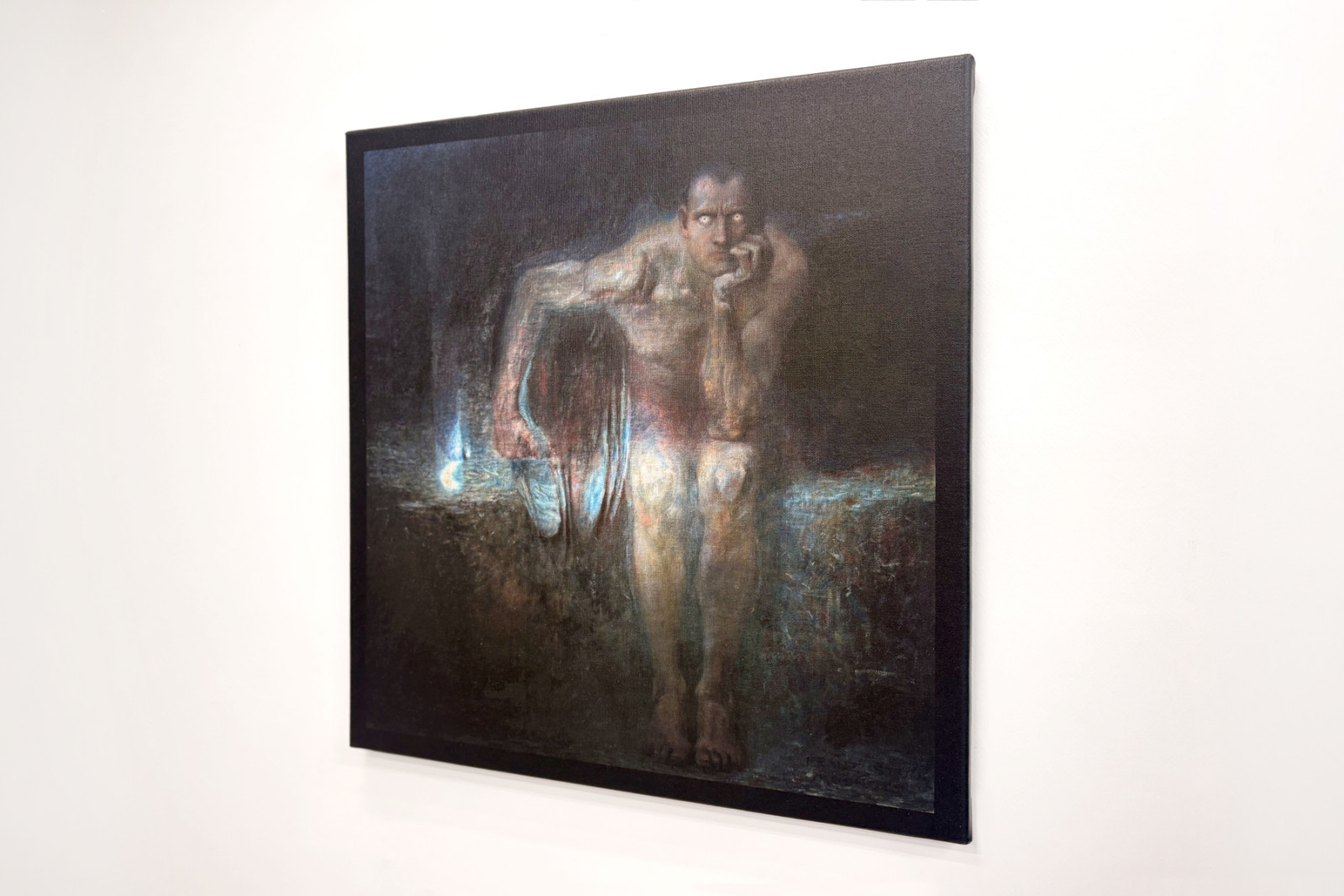
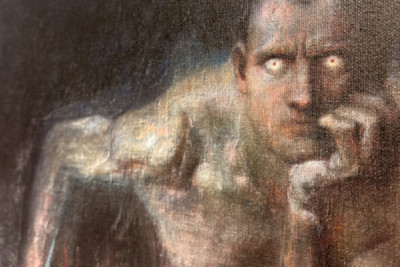
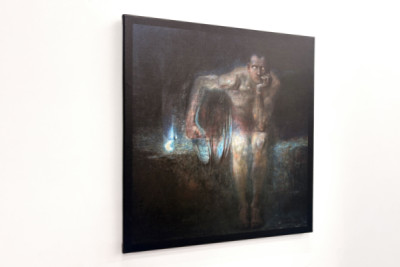
The fine weave of the canvas is visible against the dark areas, even on the face and above the light-coloured eyes. Franz von Stuck’s “Lucifer” from 1890 depicts a male demon sitting facing the viewer, almost motionless. One arm rests on his bent leg, his hand supporting his face; this pensive posture stands in stark contrast to his fixed gaze. The body emerges from the darkness in pale grey, brown and muted red. To the left, a blue flame glows, its cold light sweeping across the floor and the figure. Nothing distracts from the figure. It is precisely this conciseness that gives the painting its monumental impact: Lucifer appears not as a raging monster, but as an alert, introspective adversary. The painting belongs to Stuck’s dark creative phase and encapsulates that preoccupation with mythical figures which characterised the German artist.
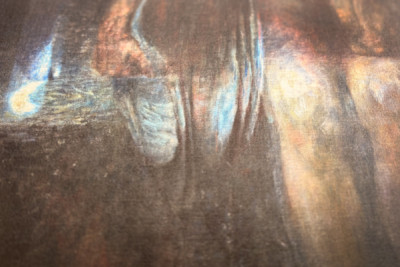
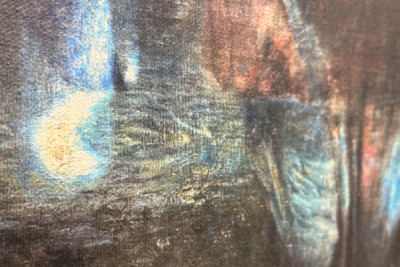
Leonardo, the satin-finished canvas used for this reproduction, features the motif in the format 48 x 51 cm. Viewed up close, its weave remains clearly visible: small raised areas run through the light sections of the body, whilst the dark layers of ink cause the fabric to almost disappear in places. The eye is drawn to the blue flame and the vertical lines beside the leg - there, the impression of overlapping brushstrokes arises, even though the surface retains its uniform textile order. Without glass or a passe-partout, this materiality can be experienced directly. The stretcher frame pulls the canvas taut; the black border runs around the picture and extends the already tight composition, rather than interrupting it decoratively. This piece really needs nothing more: its tactile depth arises from the interplay between the grainy weave and dense layers of paint, and the black border makes this interplay between the picture surface and physicality visible.
 ×
× 





 +43 4257 29415
 support@meisterdrucke.com
 Mo-Do: 7:00 - 16:00 | Fr: 7:00 - 13:00