support@meisterdrucke.com  ·  0043 4257 29415

Deutsch English Italiano Español Français Nederlands Português Svenska Polski Dansk
Search by artist, work title or style – e.g. Monet, Starry Night, Impressionism, Hokusai wave, nude. Describe the scene – e.g. green meadow, abstract with lots of red, dark oil painting, standing nude next to a tree.

Geometry: The Art of Shapes and Lines

Find peace and order in the clear lines and shapes that define each artwork.


Discover Geometry now!
Österreichische Kunstmanufaktur Erfahrungen & Bewertungen zu Meisterdrucke auf ProvenExpert.com

Geometry: The Art of Shapes and Lines

Find peace and order in the clear lines and shapes that define each artwork.

Discover Geometry now!
Geometry
Passionate Customer Service
Museum Quality Art Prints
Individual Customization Options
Österreichische Kunstmanufaktur Passionate Customer Service
Museum Quality Art Prints
Individual Customization Options


The Harmony of Shape and Function

The Harmony of Shape and Function

Geometry: 0 artworks found
Sort by

Filter settings

Display settings
0 artworks found


Page 1 / 0


Geometry

Beginning with the "golden section" and the development of the perspective representation of space in antiquity and the Renaissance, artists took geometric laws into account in order to set proportions in uniform relationships. Geometry at the same time opened up to them the possibility of giving their works a new dimension of spatial depth.

When modern art turned away from the task of mimetically imitating objects of the external world and instead set itself the task of depicting their essence in sensory experience, geometry retained its importance.

At the beginning of the 20th century, Cubism dissolved the conventions of form and space. The creative means of structuring the two dimensions of the canvas were deliberately reduced to highly simplified geometric forms such as nested planes, grid structures or lines of varying thickness.

Piet Mondrian (1872-1944) developed his own abstract geometric language from 1915 with his "Compositions". Black lines divide his works into areas, which are only weighted differently by the use of the primary colors yellow, red and blue. Theo van Doesburg (1883-1931) and the members of the de Stijl group assumed that geometry was a kind of universal language underlying every experience and every object. All sensory experience could thus find its counterpart in purely geometric forms.

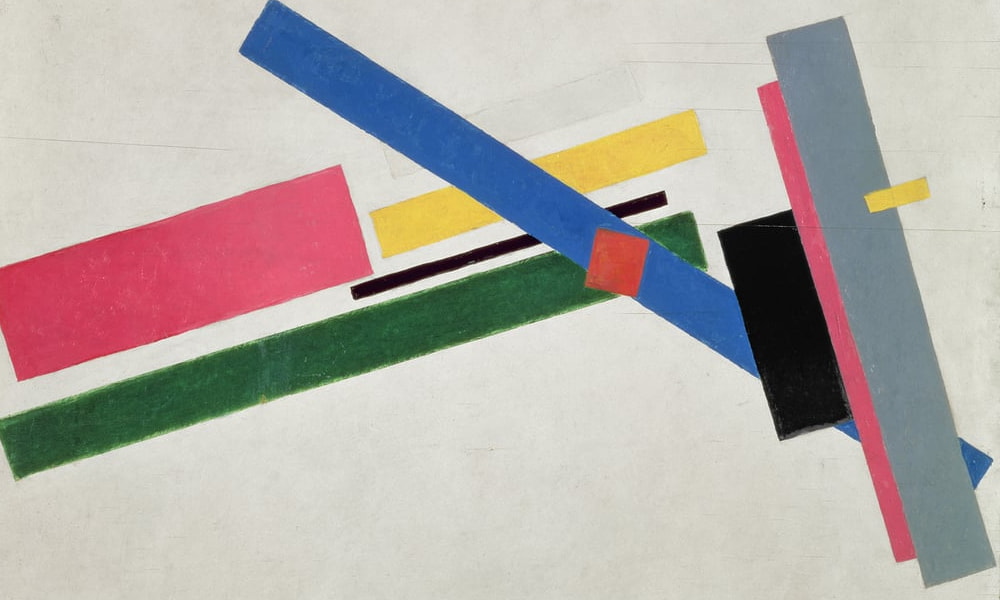
The Russian avant-garde artist Kazimir Malevich (1878-1935) reduced his works such as "Black Square" or "Black Cross" to elementary geometric forms in order to be able to show the absolute of a "fourth dimension".

British artist Peter McClure expresses his fascination with geometry as the ordering force of the universe in works such as "Overlay"(1982) and "Linkage"(2008). Contemporary, digitized art based on geometric principles is created by Russian artist Alex Caminker.

Geometry

Beginning with the "golden section" and the development of the perspective representation of space in antiquity and the Renaissance, artists took geometric laws into account in order to set proportions in uniform relationships. Geometry at the same time opened up to them the possibility of giving their works a new dimension of spatial depth.

When modern art turned away from the task of mimetically imitating objects of the external world and instead set itself the task of depicting their essence in sensory experience, geometry retained its importance.

At the beginning of the 20th century, Cubism dissolved the conventions of form and space. The creative means of structuring the two dimensions of the canvas were deliberately reduced to highly simplified geometric forms such as nested planes, grid structures or lines of varying thickness.

Piet Mondrian (1872-1944) developed his own abstract geometric language from 1915 with his "Compositions". Black lines divide his works into areas, which are only weighted differently by the use of the primary colors yellow, red and blue. Theo van Doesburg (1883-1931) and the members of the de Stijl group assumed that geometry was a kind of universal language underlying every experience and every object. All sensory experience could thus find its counterpart in purely geometric forms.

The Russian avant-garde artist Kazimir Malevich (1878-1935) reduced his works such as "Black Square" or "Black Cross" to elementary geometric forms in order to be able to show the absolute of a "fourth dimension".

British artist Peter McClure expresses his fascination with geometry as the ordering force of the universe in works such as "Overlay"(1982) and "Linkage"(2008). Contemporary, digitized art based on geometric principles is created by Russian artist Alex Caminker.


What our customers think about us


Frequently Asked Questions about Meisterdrucke


Personalizing your art print at Meisterdrucke is simple and intuitive: Choose a frame, set the image size, pick a printing medium, and add suitable glazing or a stretcher frame. We also offer additional customization options like mats, fillets, and spacers. If you have any questions, our customer service team is ready to help you create your perfect artwork.

At Meisterdrucke, you can visualize your configured artwork directly in your own room. Simply upload a photo of your space and see how the artwork looks in it. If you're visiting us on a mobile device — phone or tablet — our augmented reality feature brings the picture to life and projects it right into your room. A unique experience that combines art and technology.

Choosing the right medium is often a matter of personal taste. To give you a better idea, we've provided some images for each medium. We also offer a sample set of all paper variants, so you can decide not just visually but by touch as well. You can order the sample set free of charge — only shipping costs apply.

Don't worry! At Meisterdrucke, we don't just process orders mechanically. Every order is manually reviewed by our team. If we spot any inconsistencies or issues with your configuration, we'll get in touch with you right away. And of course, our friendly and patient support team is always here to help you with your configuration. We'll work with you by phone or email to adjust your image so the final result is exactly what you had in mind.


Still have questions?

Are you interested in an art print from our manufactory but still unsure? Do you need advice on choosing the medium or help with the order?

Our experts are happy to assist you.

+43 4257 29415
support@meisterdrucke.com
Mo-Do: 7:00 - 16:00 | Fr: 7:00 - 13:00

Still have questions?

Are you interested in an art print from our manufactory but still unsure? Do you need advice on choosing the medium or help with the order?

Our experts are happy to assist you.

+43 4257 29415
support@meisterdrucke.com
Mo-Do: 7:00 - 16:00 | Fr: 7:00 - 13:00


Meisterdrucke

   Kärntner Strasse 46
        9586 Finkenstein am Faaker See
        Austria
        +43 4257 29415
        support@meisterdrucke.com
Other languages

                   
Erfahrungen & Bewertungen zu Meisterdrucke
Post.at DHL Express Quehenberger Cargoboard
Kaiser Franz Joseph

Meisterdrucke
Kärntner Strasse 46
9586 Finkenstein am Faaker See · Austria
+43 4257 29415 · office@meisterdrucke.com
Post.at DHL Express Quehenberger Cargoboard


(c) 2026 meisterdrucke.us