The date of Paul Sandby's birth has not been handed down, the only certainty is that he was baptised in Nottingham in 1731. 1745 he moved to London and followed his brother Thomas (1721 - 1798) into the military drawing department in the Tower of London. After the rebellion of the Jacobites (followers of the Stuart royal line) in 1745, Sandby assisted in the military surveying of the new road to Fort George and the north and west of the Highlands. He was even promoted to chief draughtsman of the undertaking. During the six years he worked on the survey, Sandby also began to paint his first pictures with watercolours of bridges, fortifications and the Scottish landscape.
After leaving his post with the survey team, Sandby spent time with his brother, who had been appointed Deputy Ranger of Windsor Great Park. Sandby painted pictures of Windsor - castle, town, landscape. The works of that time made him a much sought-after artist, who was praised by Thomas Gainsborough (1727 - 1788) as the best landscape painter of his time.
Sandby also made numerous etchings of his own works and those of other artists. The immense range of Sandby's work also includes caricatures, which he published anonymously in 1753/54 and sporadically under his own name from 1762 onwards. In 1760 Sandby also exhibited for the first time at the Society of Artists, which he repeated regularly over the next eight years until 1768, when the Royal Academy was founded by Sandby and 27 other artists. In the years that followed, Sandby repeatedly made excursions to Wales and produced further paintings of the country and its people.
 ×
×







 Passionate Customer Service

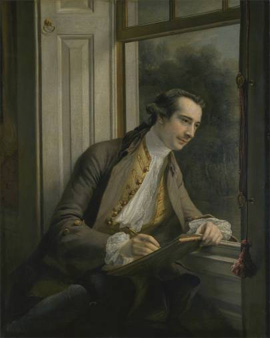
.jpg "Windsor Castle - The Round Tower, Royal Court and Devils Tower from the Black Rod by Paul Sandby")
.jpg)
.jpg "The Westgate, Canterbury by Paul Sandby")
.jpg)
.jpg "Windsor Forest with Oxen Drawing Timber, 1798 by Paul Sandby")
.jpg)
.jpg "A Distant View of Maidstone by Paul Sandby")
.jpg)
.jpg "London Cries: \"Black Heart Cherries...\" by Paul Sandby")
.jpg)
.jpg "London Cries - Black Heart Cherries... by Paul Sandby")
.jpg)
.jpg "Brook End, Essex by Paul Sandby")
.jpg)
.jpg "North West View of Wakefield Lodge in Whittlebury Forest, Northamptonshire by Paul Sandby")
.jpg)
.jpg "Windsor Castle from Datchet Lane on a Rejoicing Night, 1768 by Paul Sandby")
.jpg)
.jpg "The Duke of Cumberland with a Gentleman and a Groom, All Mounted, and Dogs by Paul Sandby")
.jpg)
.jpg "London Cries - A Man with a Bundle, Old Clothes by Paul Sandby")
.jpg)
![The Analyst Besh-n in His Own Taste Pr.1s[hilling], 1753 by Paul Sandby](/kunstwerke/300px/Paul Sandby - The Analyst Besh-n in his own Taste Pr1shilling 1753 - (MeisterDrucke-142095).jpg "The Analyst Besh-n in His Own Taste Pr.1s[hilling], 1753 by Paul Sandby")
![The Analyst Besh-n in His Own Taste Pr.1s[hilling], 1753 by Paul Sandby](/kunstwerke/400w/Paul Sandby - The Analyst Besh-n in his own Taste Pr1shilling 1753 - (MeisterDrucke-142095).jpg)
.jpg "Oxford. Shepherd herding sheep on road toward Oxford, which is visible on the horizon lit by the glow of sunset. by Paul Sandby")
.jpg)
.jpg "Iron Forge on the River Kent, Westmorland by Paul Sandby")
.jpg)
.jpg "St. George")
.jpg)
.jpg "St. George")
.jpg)
.jpg "Landscape with a Lake by Paul Sandby")
.jpg)
 - (MeisterDrucke-86740).jpg "Whatman Turkey Mill in Kent by Paul Sandby")
 - (MeisterDrucke-86740).jpg)
.jpg "A View of Vinters at Boxley, Kent, with Mr. Whatmans Turkey Paper Mills by Paul Sandby")
.jpg)
.jpg "Askeaton Abbey near Limerick, Ireland on the River Deel by Paul Sandby")
.jpg)
.jpg "Windsor Great Park, 1790-99 by Paul Sandby")
.jpg)
_-_(MeisterDrucke-899619).jpg "Hackwood Park, Hampshire by Paul Sandby")
_-_(MeisterDrucke-899619).jpg)
_-_(MeisterDrucke-902327).jpg "A Distant View of Maidstone, from Lower Bell Inn, Boxley Hill by Paul Sandby")
_-_(MeisterDrucke-902327).jpg)
.jpg "Portrait of Thomas Sandby, R.A., the Artist")
.jpg)
.jpg "The Burning of the Temple at Ephesus by Paul Sandby")
.jpg)
.jpg "Conway Castle by Paul Sandby")
.jpg)
_-_(MeisterDrucke-173393).jpg "Part of Holyrood Abbey with a View of the Canongate by Paul Sandby")
_-_(MeisterDrucke-173393).jpg)
.jpg "Group of Figures: A Dogfight by Paul Sandby")
.jpg)
.jpg "Wynnstay, Seat of Sir Watkin Williams Wynn Bart from a Cottage above the New Bridge over the River Dee, Denbigh Shire by Paul Sandby")
.jpg)
 - (MeisterDrucke-19390).jpg "London Cries: A Girl with a Basket on Her Head (Lights for the Cats, Liver for the Dogs) by Paul Sandby")
 - (MeisterDrucke-19390).jpg)
.jpg "Halfway House, Sadler")
.jpg)
.jpg "The Deputy Ranger")
.jpg)
.jpg "The Itinerant Pedlar by Paul Sandby")
.jpg)
.jpg "Pont-Aber-Glassin, plate seven from Twelve Views in Wales by Paul Sandby")
.jpg)
.jpg "The Garden of Thomas Sandby")
.jpg)
.jpg "Landscape by Paul Sandby")
.jpg)
.jpg "Two Laden Hay Carts with Horses by Paul Sandby")
.jpg)
.jpg "Conway Castle by Paul Sandby")
.jpg)
.jpg "The Author Run Mad by Paul Sandby")
.jpg)
.jpg "Colonnade with Vaulted Roof by Paul Sandby")
.jpg)
.jpg "Ruins of Newark Castle by Paul Sandby")
.jpg)
.jpg "Woman and Child Holding a Doll by Paul Sandby")
.jpg)
.jpg "Horse Fair on Bruntsfield Links, Edinburgh by Paul Sandby")
.jpg)
.jpg "Carew Castle, plate eight from Twelve Views in Wales by Paul Sandby")
.jpg)
.jpg "Overton Bridge/Over the River Dee, on the Confines of Denbigh and Flintshire by Paul Sandby")
.jpg)
.jpg "Pont-y-Pier near Llanroost, Denbighshire by Paul Sandby")
.jpg)
.jpg "Llangollin in the County of Denbigh, from the Turnpike Road Above the River Dee by Paul Sandby")
.jpg)
_-_(MeisterDrucke-902322).jpg "The Westgate, Canterbury by Paul Sandby")
_-_(MeisterDrucke-902322).jpg)
.jpg "Study of Mrs Mercier seated in a Chair, and her youngest son, Henry Mercier standing behind her by Paul Sandby")
.jpg)
.jpg "London Cries: Small Coal or Brushes by Paul Sandby")
.jpg)
.jpg "A Public House by Paul Sandby")
.jpg)
.jpg "Windsor, 1785 by Paul Sandby")
.jpg)
.jpg "Views of Warwick Castle: Part of Warwick Castle from the South East by Paul Sandby")
.jpg)
.jpg "St George")
.jpg)
.jpg "Approaching Rochester and the Medway by Paul Sandby")
.jpg)
.jpg "Dolbardarn Castle and Llanberris Lake by Paul Sandby")
.jpg)
.jpg "A Castle on a River by Paul Sandby")
.jpg)
_-_(MeisterDrucke-1499477).jpg "Windsor Great Park, c.1790-99 by Paul Sandby")
_-_(MeisterDrucke-1499477).jpg)
.jpg "Bothwell Castle, from the South by Paul Sandby")
.jpg)
.jpg "A Group of Men on Westminster Pier by Paul Sandby")
.jpg)
.jpg "River Ferry with Many Passengers and Animals by Paul Sandby")
.jpg)
.jpg "Romantic Landscape by Paul Sandby")
.jpg)
_-_(MeisterDrucke-901901).jpg "Roche Abbey, Yorkshire by Paul Sandby")
_-_(MeisterDrucke-901901).jpg)
.jpg "The Itinerant Pedlar by Paul Sandby")
.jpg)
.jpg "River Landscape by Paul Sandby")
.jpg)
.jpg "Bayswater by Paul Sandby")
.jpg)
.jpg "Lady Maynard by Paul Sandby")
.jpg)
.jpg "London Cries: \"Turn your Copper into Silver Now before Your Eyes\" (Title Page Design) by Paul Sandby")
.jpg)
.jpg "Roslin Castle by Paul Sandby")
.jpg)
.jpg "Dartmouth Castle by Paul Sandby")
.jpg)
.jpg "A Family in Hyde Park by Paul Sandby")
.jpg)
 - (MeisterDrucke-115671).jpg "View of the Old Welsh Bridge, Shrewsbury by Paul Sandby")
 - (MeisterDrucke-115671).jpg)
.jpg "Tea at Englefield Green by Paul Sandby")
.jpg)
.jpg "View at Charlton, Kent by Paul Sandby")
.jpg)
.jpg "Rochester by Paul Sandby")
.jpg)
.jpg "A Moonlight Effect by Paul Sandby")
.jpg)
.jpg "Englefield Green by Paul Sandby")
.jpg)
.jpg "Ancient Beech in Windsor Forest, Nature in Britain by Paul Sandby")
.jpg)
.jpg "Lady in a Bonnet by Paul Sandby")
.jpg)
_-_(MeisterDrucke-385084).jpg "Landscape with Horseman by Paul Sandby")
_-_(MeisterDrucke-385084).jpg)
.jpg "Landscape with a Lake by Paul Sandby")
.jpg)
.jpg "Pont-y-Pair over the River Conway above Llanrwst in the County of Denbigh by Paul Sandby")
.jpg)
.jpg "London Cries: All Fire and No Smoke by Paul Sandby")
.jpg)
.jpg "London Cries: A Man with a Bottle by Paul Sandby")
.jpg)
.jpg "The Toilet by Paul Sandby")
.jpg)
.jpg "Couple Playing Shuttlecock and Battledore by Paul Sandby")
.jpg)
) - (MeisterDrucke-262465).jpg "Penllyn Castle by Paul Sandby")
) - (MeisterDrucke-262465).jpg)
.jpg "The Garden of Thomas Sandby")
.jpg)
.jpg "Caernarvon Castle by Paul Sandby")
.jpg)
.jpg "A Military Camp in St. James")
.jpg)
_-_(MeisterDrucke-293827).jpg "The South Front of Strawberry Hill by Paul Sandby")
_-_(MeisterDrucke-293827).jpg)
 - (MeisterDrucke-147394).jpg "Chepstow Castle by Paul Sandby")
 - (MeisterDrucke-147394).jpg)
.jpg "My Pretty Little Ginny Tarters for a Ha")
.jpg)
.jpg "London Cries: A Muffin Man by Paul Sandby")
.jpg)
.jpg "A View of Bethlem the Great Moravian Settlement in the Province of Pennsylvania from")
.jpg)
.jpg "Windsor Terrace Looking Westward by Paul Sandby")
.jpg)
.jpg "Landscape with a Castle by Paul Sandby")
.jpg)
.jpg "Edinburgh from the West, in the Time of David Hume by Paul Sandby")
.jpg)
.jpg "A View of Arundel Castle with Country Folk Merrymaking by a Farmhouse by Paul Sandby")
.jpg)
.jpg "Twelve Views in South Wales: St. Quintin")
.jpg)

 +43 4257 29415
 support@meisterdrucke.com
 Mo-Do: 7:00 - 16:00 | Fr: 7:00 - 13:00