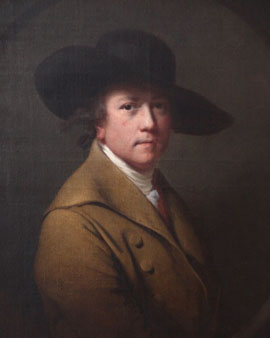
Joseph Wright of Derby was born into the age of the beginning industrial revolution. Closely associated with his hometown of Derby, he developed an early interest in the natural sciences. Wright took his first steps as a painter during his apprenticeship with a portrait painter. He adopted the style of his teacher with moderate success. Profitable commissions failed to materialize.
Joseph Wright of Derby changed his style and incorporated his love of the scientific discoveries of his time into the paintings. Wright created the first painting of the Industrial Revolution, The Experiment with the Bird in the Air Pump. At the same time, he created a series of depictions of candle-lit people at the center of the painting. This way of depicting people was new and the artist received the long awaited attention. Derby went one step further with the positioning of scientific apparatus as the centre of his work.
He took up the style of chiaroscuro painting, which had already found its way into Dutch painting, and experimented with artificial light sources. Joseph Wright demonstrated his ability to depict landscapes in a realistic way in the play of light with Cave in the Evening. Repeated attempts at portraiture failed because of his realistic way of depiction, which was often not desired by the client.
 ×
×







 Passionate Customer Service

.jpg "An Experiment on a Bird in an Air Pump by Joseph Wright of Derby")
.jpg)
.jpg "A Lake by Moonlight, c. 1780-82 by Joseph Wright of Derby")
.jpg)
.jpg "The Corinthian Maid, 1782-84 by Joseph Wright of Derby")
.jpg)
.jpg "Snowdown by Moonlight, 1792 by Joseph Wright of Derby")
.jpg)
.jpg "Mrs Frances Hesketh by Joseph Wright of Derby")
.jpg)
.jpg "The Eruption of Vesuvius with Islands in the Bay of Naples, 1776, Private Collection by Joseph Wright of Derby")
.jpg)
.jpg "Untitled, known as A Philosopher Giving that Lecture on the Orrery, in which a Lamp is put in place of the Sun or The Orrery by Joseph Wright of Derby")
.jpg)
.jpg "A Cottage on Fire at Night, c. 1785-93 by Joseph Wright of Derby")
.jpg)
 scientist inventor - (MeisterDrucke-292785).jpg "Portrait of Dr Erasmus Darwin (1731-1802), scientist, inventor and poet, grandfather of Charles Darwin, c. 1770 by Joseph Wright of Derby")
 scientist inventor - (MeisterDrucke-292785).jpg)
.jpg "Matlock Tor by Moonlight, c. 1778 by Joseph Wright of Derby")
.jpg)
.jpg "An Experiment on a Bird in the Air Pump by Joseph Wright of Derby")
.jpg)
.jpg "Dovedale by Moonlight, c.1784-85 by Joseph Wright of Derby")
.jpg)
.jpg "A Girl Reading a Letter by Candlelight, with a Young Man Peering over Her Shoulder, c. 1760-2 by Joseph Wright of Derby")
.jpg)
.jpg "The Iron Forge, 1772 by Joseph Wright of Derby")
.jpg)
.jpg "An Eruption of Vesuvius, seen from Portici, c.1774-6 by Joseph Wright of Derby")
.jpg)
_British_navigator_around_1766_-_1768Paintin_-_(MeisterDrucke-993673).jpg "Portrait of James Cook (1728 - 1779), British navigator around 1766 - 1768 by Joseph Wright of Derby")
_British_navigator_around_1766_-_1768Paintin_-_(MeisterDrucke-993673).jpg)
.jpg "Vesuvius in Eruption, with a View over the Islands in the Bay of Naples by Joseph Wright of Derby")
.jpg)
 1777 - (MeisterDrucke-59439).jpg "Portrait of Dorothy Beridge, née Gladwin by Joseph Wright of Derby")
 1777 - (MeisterDrucke-59439).jpg)
.jpg "A Lighthouse on Fire at Night by Joseph Wright of Derby")
.jpg)
.jpg "A view of Vesuvius from Posillipo, Naples by Joseph Wright of Derby")
.jpg)
.jpg "View in Matlock Dale, Looking Towards Black Rock Escarpment by Joseph Wright of Derby")
.jpg)
.jpg "The Storm, Antigonus Pursued by the Bear from \"The Winter")
.jpg)
.jpg "Derwent Water with Skiddaw in the Distance, ca. 1795-6 by Joseph Wright of Derby")
.jpg)
 1771 (mezzotint) - (MeisterDrucke-116775).jpg "The Blacksmith")
 1771 (mezzotint) - (MeisterDrucke-116775).jpg)
.jpg "Lake Albano, c.1790-92 by Joseph Wright of Derby")
.jpg)
.jpg "Derwent Water, with Skiddaw in the distance by Joseph Wright of Derby")
.jpg)
_-_(MeisterDrucke-898836).jpg "Portrait of a man, known as the")
_-_(MeisterDrucke-898836).jpg)
_17_-_(MeisterDrucke-632660).jpg "Antigonus in the Storm (Act III, Scene III, from Shakespeare")
_17_-_(MeisterDrucke-632660).jpg)
.jpg "Benjamin Franklin, 1782 by Joseph Wright of Derby")
.jpg)
.jpg "Portrait of a Man, Known as the")
.jpg)
_-_(MeisterDrucke-1538295).jpg "Portrait of a Lady, c.1760 by Joseph Wright of Derby")
_-_(MeisterDrucke-1538295).jpg)
_-_(MeisterDrucke-896647).jpg "Portrait of a Man (c.1768) by Joseph Wright of Derby")
_-_(MeisterDrucke-896647).jpg)
.jpg "The Blacksmith")
.jpg)
.jpg "William and Margaret from Percy")
.jpg)
.jpg "Two boys by candlelight, blowing a bladder, c.1767-73 by Joseph Wright of Derby")
.jpg)
.jpg "Portrait of a Man, Known as the")
.jpg)
.jpg "William and Margaret from the")
.jpg)
.jpg "Matlock Dale, Looking Toward Black Rock Escarpment by Joseph Wright of Derby")
.jpg)
.jpg "The Iron Forge Viewed from Without by Joseph Wright of Derby")
.jpg)
.jpg "Virgil")
.jpg)
.jpg "Edwin, from")
.jpg)
.jpg "Portrait of Edward Abney, seated three-quarter-length, in a Green Coat, Holding a Letter against a Red Curtain by Joseph Wright of Derby")
.jpg)
_-_(MeisterDrucke-1457759).jpg "Reverend Seward, Canon of Lichfield by Joseph Wright of Derby")
_-_(MeisterDrucke-1457759).jpg)
.jpg "Lake Nemi, Sunset by Joseph Wright of Derby")
.jpg)
_and_Miss_Catherine_Macaulay_(1731-91)_(oil_on_canvas_-_(MeisterDrucke-1016871).jpg "Rev. Thomas Wilson and Miss Catherine Macaulay by Joseph Wright of Derby")
_and_Miss_Catherine_Macaulay_(1731-91)_(oil_on_canvas_-_(MeisterDrucke-1016871).jpg)
.jpg "Portrait of Mr. William Chase, Sr. by Joseph Wright of Derby")
.jpg)
.jpg "Matlock Dale, Looking Toward Black Rock Escarpment by Joseph Wright of Derby")
.jpg)
 1777 - (MeisterDrucke-98969).jpg "Maria,")
 1777 - (MeisterDrucke-98969).jpg)
.jpg "Self Portrait at the age of about Forty, c.1772-3 by Joseph Wright of Derby")
.jpg)
.jpg "The Colosseum, c.1774-75 by Joseph Wright of Derby")
.jpg)
 - (MeisterDrucke-99677).jpg "The Indian Widow by Joseph Wright of Derby")
 - (MeisterDrucke-99677).jpg)
.jpg "The Alchemist in Search of the Philosopher")
.jpg)
.jpg "Dovedale by Moonlight by Joseph Wright of Derby")
.jpg)
_c1783_(oil_on_canvas)_-_(MeisterDrucke-1518142).jpg "Elizabeth Balguy (nee Gould), c.1783 by Joseph Wright of Derby")
_c1783_(oil_on_canvas)_-_(MeisterDrucke-1518142).jpg)
.jpg "Virgil")
.jpg)
.jpg "William and Margaret from Percy")
.jpg)
_-_(MeisterDrucke-898957).jpg "Matlock Tor by Moonlight by Joseph Wright of Derby")
_-_(MeisterDrucke-898957).jpg)
 c1771-72 - (MeisterDrucke-81275).jpg "Portrait of John Milnes, 12th Duke of St. Albans (d.1810) by Joseph Wright of Derby")
 c1771-72 - (MeisterDrucke-81275).jpg)
.jpg "Portrait of Miss Bentley, Seated Full Length, Wearing a White Dress, Holding a Rabbit in a Landscape by Joseph Wright of Derby")
.jpg)
.jpg "Thomas and Joseph Pickford as Children by Joseph Wright of Derby")
.jpg)
.jpg "Eruption of the Vesuvius with the head of Saint January door in procession by Joseph Wright of Derby")
.jpg)
.jpg "An Iron Forge by Joseph Wright of Derby")
.jpg)
.jpg "Sunset on the Coast near Naples, c.1785-90 by Joseph Wright of Derby")
.jpg)
.jpg "An Old Man, Half-Length, in a Brown Fur-Lined Coat by Joseph Wright of Derby")
.jpg)
.jpg "Matlock Dale, Looking Toward Black Rock Escarpment by Joseph Wright of Derby")
.jpg)
.jpg "Portrait of the Rev. Thomas Wilson D.D. and His Adopted Daughter, Miss Catherine Macauley by Joseph Wright of Derby")
.jpg)
_-_(MeisterDrucke-901898).jpg "Portrait of Samuel Oldknow by Joseph Wright of Derby")
_-_(MeisterDrucke-901898).jpg)
.jpg "The Eruption of Mount Vesuvius by Joseph Wright of Derby")
.jpg)
.jpg "Elizabeth, Mrs. John Bostock by Joseph Wright of Derby")
.jpg)
.jpg "The widow of an Indian chief watching over her husband")
.jpg)
.jpg "Derwent Water, with Skiddaw in the Distance by Joseph Wright of Derby")
.jpg)
.jpg "A Class in a Painters")
.jpg)
.jpg "Boy Blowing a Bladder in Candlelight by Joseph Wright of Derby")
.jpg)
.jpg "A Grotto in the Gulf of Salerno, Evening, c.1800 by Joseph Wright of Derby")
.jpg)
.jpg "Portrait of John Milnes by Joseph Wright of Derby")
.jpg)
.jpg "The Experiment with the Bird in the Air Pump by Joseph Wright of Derby")
.jpg)
_1773_-_(MeisterDrucke-971906).jpg "A forge in the 18th century by Joseph Wright of Derby (1773) by Joseph Wright of Derby")
_1773_-_(MeisterDrucke-971906).jpg)
_-_(MeisterDrucke-1466843).jpg "Thomas Day by Joseph Wright of Derby")
_-_(MeisterDrucke-1466843).jpg)
.jpg "The Blacksmith")
.jpg)
.jpg "The Prisoner, c.1787-90 by Joseph Wright of Derby")
.jpg)
.jpg "A Grotto in the Gulf of Salerno, Sunset by Joseph Wright of Derby")
.jpg)
.jpg "Lake Scene by Joseph Wright of Derby")
.jpg)
_(oil_on_canvas)_-_(MeisterDrucke-1126096).jpg "Portrait of Elizabeth Copestake by Joseph Wright of Derby")
_(oil_on_canvas)_-_(MeisterDrucke-1126096).jpg)
_-_(MeisterDrucke-900250).jpg "Miss Frances Warren, early 1760s by Joseph Wright of Derby")
_-_(MeisterDrucke-900250).jpg)
.jpg "Dovedale, the Peak District by Joseph Wright of Derby")
.jpg)
_(SantAngelo)_a_Rome_la_Girando_-_(MeisterDrucke-1324995).jpg "Firework Display at the Castel Sant")
_(SantAngelo)_a_Rome_la_Girando_-_(MeisterDrucke-1324995).jpg)
.jpg "Matlock Tor, c.1778-80 by Joseph Wright of Derby")
.jpg)
_c1769_(oil_on_canvas)_-_(MeisterDrucke-1425396).jpg "Portrait of Charles Goore by Joseph Wright of Derby")
_c1769_(oil_on_canvas)_-_(MeisterDrucke-1425396).jpg)
.jpg "Portrait of Thomas Hanway, Half Length, in a Beige Coat with Blue and Silver Facings, and a Blue and Silver Waistcoat, Holding a Hat Under His Arm, in a Landscape by Joseph Wright of Derby")
.jpg)
.jpg "The Gulf of Salerno by Joseph Wright of Derby")
.jpg)
.jpg "Portrait of a Gentleman, c. 1760 by Joseph Wright of Derby")
.jpg)
.jpg "Cavern, Near Naples, 1774 by Joseph Wright of Derby")
.jpg)
.jpg "Anne Bateman, later Mrs. John Gisbourne by Joseph Wright of Derby")
.jpg)
 1779-1780 - (MeisterDrucke-135452).jpg "Portrait of John Whetham of Kirklington by Joseph Wright of Derby")
 1779-1780 - (MeisterDrucke-135452).jpg)
.jpg "Cottage on Fire at Night by Joseph Wright of Derby")
.jpg)
.jpg "Portrait of Erasmus Darwin, Half Length, in a Buff Coat and White Shirt by Joseph Wright of Derby")
.jpg)
.jpg "The Lake of Albano by Joseph Wright of Derby")
.jpg)
.jpg "A Conversation between Girls, or Two Girls with their Black Servant, 1770 by Joseph Wright of Derby")
.jpg)
.jpg "Virgil")
.jpg)
.jpg "Lake Nemi, Sunset by Joseph Wright of Derby")
.jpg)

 +43 4257 29415
 support@meisterdrucke.com
 Mo-Do: 7:00 - 16:00 | Fr: 7:00 - 13:00