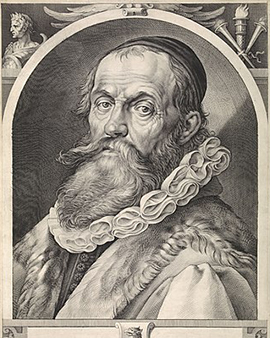
Hendrick Goltzius, born in the frosty winter days of 1558 in Bracht, was not only a master of art, but also a pioneer for the art of copperplate engraving. In a country known for its scientific and artistic revolution, Goltzius set a monument to himself.
Shaped under the watchful eye of Dirck Volkertszoon Coornhert and Philipp Galle, Goltzius developed an affinity for the technique of engraving. With a tireless curiosity, he traveled Italy and Germany, making "treffliche Studien". Despite a malformed right hand - a childhood scar from a painful burn - he perfected his art with such brilliance that he depicted himself in a special self-portrait showing the hand as ideal for his profession. A legend says that he stabbed with his right hand and painted with his left, which was also confirmed by his biographer Karel van Mander.
In his forties, Goltzius found a new passion: painting. Although he was already at the peak of his art as an engraver, he allowed himself to be carried away by the Mannerist current of the time. From erotic allegories to dramatic motifs of violence; his works are a kaleidoscope of emotions and techniques. And yet it was not only his own art that shone. As a teacher, he shaped the elite of his time, including Jacob de Gheyn II and Jan Saenredam. They all carried on his influence and shaped the art world for generations. An art print by Goltzius is not only a representation of his talent, but also a testament to the depth and diversity of art history that is continually brought to life in our collection.
 ×
×







 Passionate Customer Service

.jpg "The four Disgracers - Ixion by Hendrick Goltzius")
.jpg)
.jpg "Whale stranded near Berckhey, 1598 by Jacob Matham")
.jpg)
.jpg "Anger by Jacob Matham")
.jpg)
.jpg "The Four Disgracers - Tantalus by Hendrick Goltzius")
.jpg)
_-_(MeisterDrucke-1361794).jpg "Icarus - The Four Fallers (series title) by Hendrick Goltzius")
_-_(MeisterDrucke-1361794).jpg)
.jpg "The Four Disgracers - Phaeton by Hendrick Goltzius")
.jpg)
_-_Rechtvaardigheid_(Justitia)Iustitia_(title_on_object)_-_(MeisterDrucke-1333758).jpg "Justice by Jacob Matham (attributed to)")
_-_Rechtvaardigheid_(Justitia)Iustitia_(title_on_object)_-_(MeisterDrucke-1333758).jpg)
.jpg "The Creation of the Four Elements by Hendrick Goltzius")
.jpg)
.jpg "The Annunciation by Hendrick Goltzius")
.jpg)
_-_Cadmus_vraagt_het_orakel_van_Delphi_wat_hem_te_doen_staat_nu_hij_zijn_zuster_Eur_-_(MeisterDrucke-1376141).jpg "Cadmus Asks the Oracle of Delphi What to Do Since He Could Not Find His Sister Europa by Hendrick Goltzius (workshop of)")
_-_Cadmus_vraagt_het_orakel_van_Delphi_wat_hem_te_doen_staat_nu_hij_zijn_zuster_Eur_-_(MeisterDrucke-1376141).jpg)
_-_(MeisterDrucke-1266460).jpg "Allegory of the Transience of Life (")
_-_(MeisterDrucke-1266460).jpg)
.jpg "The Flagellation of Christ, Plate 6 from the series \"The Passion\" by Hendrick Goltzius")
.jpg)
.jpg "Venus and Cupid, Plate 2 from the series \"Bacchus, Venus and Ceres\" by Hendrick Goltzius")
.jpg)
.jpg "Crucifixion, Plate 10 from the series \"The Passion\" by Hendrick Goltzius")
.jpg)
.jpg "Thalia, Plate 2 of the Series \"Nine Muses\" by Hendrick Goltzius")
.jpg)
_-_(MeisterDrucke-1281767).jpg "Allegory of the Transience of Life (\"Quis Evadet?\") by Hendrick Goltzius")
_-_(MeisterDrucke-1281767).jpg)
.jpg "Adoration of the Magi, plate 5 from the series “The Life of the Virgin Mary” by Hendrick Goltzius")
.jpg)
_Jongen_met_h_-_(MeisterDrucke-1706721).jpg "Two Men, Possibly Jan Matthijs Ban and Philips van Winghe (recto). Boy with Hat, Half-Length. Holding a Dead Old Man (verso) by Hendrick Goltzius")
_Jongen_met_h_-_(MeisterDrucke-1706721).jpg)
.jpg "Building upon the Rock, Plate 6 from the Series \"Allegories of the Christian Faith\" by Hendrick Goltzius")
.jpg)
.jpg "Euterpe, from the series \"Muses\" by Hendrick Goltzius")
.jpg)
.jpg "Ascent of the Righteous into Heaven, Sheet 3 from the Series")
.jpg)
_-_(MeisterDrucke-1330503).jpg "The Crowning with Thorns The Passion (series title) by Ludovicus Siceram")
_-_(MeisterDrucke-1330503).jpg)
.jpg "Bacchus by Hendrick Goltzius")
.jpg)
_-_(MeisterDrucke-1756267).jpg "Mars (Half-Length) by Hendrick Goltzius")
_-_(MeisterDrucke-1756267).jpg)
.jpg "Christ on the Cross, from \"The Passion of Christ\" by Hendrick Goltzius")
.jpg)
_-_Apollo_doodt_de_reuzenslang_PythonOvidius_Metamorfosen_(series_title)_-_(MeisterDrucke-1330467).jpg "Apollo kills the giant serpent Python. Ovid")
_-_Apollo_doodt_de_reuzenslang_PythonOvidius_Metamorfosen_(series_title)_-_(MeisterDrucke-1330467).jpg)
_-_KolonelOfficieren_en_soldaten_(series_title)_-_(MeisterDrucke-1330867).jpg "Colonel (Officers and Soldiers series) by Jacob de Gheyn (II)")
_-_KolonelOfficieren_en_soldaten_(series_title)_-_(MeisterDrucke-1330867).jpg)
_-_Val_van_PhathonOvidius_Metamorfosen_(series_title)_-_(MeisterDrucke-1334117).jpg "Fall of Phaethon (Ovid")
_-_Val_van_PhathonOvidius_Metamorfosen_(series_title)_-_(MeisterDrucke-1334117).jpg)
_-_(MeisterDrucke-1709058).jpg "Portrait of Pieter Dircksz. Hasselaer (?) by Hendrick Goltzius")
_-_(MeisterDrucke-1709058).jpg)
.jpg "Adoration of the Shepherds, Sheet 2 from the Series \"The Life of the Virgin Mary\" by Hendrick Goltzius")
.jpg)
.jpg "Paul, Plate 14 from the Series")
.jpg)
_-_(MeisterDrucke-1271855).jpg "Fire (Ignis) by Hendrick Goltzius")
_-_(MeisterDrucke-1271855).jpg)
.jpg "The Holy Family Seated in a Landscape with Elizabeth, Zechariah, and John the Baptist as a Child by Jacob Matham")
.jpg)
_-_(MeisterDrucke-1273371).jpg "The Alliance between Athena and Mercury (Hermathena) by Jacob Matham")
_-_(MeisterDrucke-1273371).jpg)
_-_(MeisterDrucke-1745432).jpg "Marcus Valerius Corvus (Roman Heroes, Plate 6) by Hendrick Goltzius")
_-_(MeisterDrucke-1745432).jpg)
.jpg "Melpomene, Plate 3 of the Series")
.jpg)
_-_(MeisterDrucke-1710028).jpg "Art and Practice (Ars, Usus) by Hendrick Goltzius")
_-_(MeisterDrucke-1710028).jpg)
_-_Orde_in_de_chaosSchepping_van_de_vier_elementenOvidius_Metamorfosen_(series_titl_-_(MeisterDrucke-1332411).jpg "Order in Chaos - Creation of the Four Elements - Ovid")
_-_Orde_in_de_chaosSchepping_van_de_vier_elementenOvidius_Metamorfosen_(series_titl_-_(MeisterDrucke-1332411).jpg)
.jpg "Mocking of Christ, Plate 7 from the Series \"The Passion\" by Hendrick Goltzius")
.jpg)
.jpg "An Ambush Against Giovanni de")
.jpg)
_-_(MeisterDrucke-1709570).jpg "Bust of an Old Lady (Agatha Scholiers?) by Hendrick Goltzius")
_-_(MeisterDrucke-1709570).jpg)
_-_De_IJzeren_EeuwMetamorfosen_van_Ovidius_(series_title)_-_(MeisterDrucke-1341498).jpg "The Iron Age (Metamorphoses of Ovid) by Hendrick Goltzius (workshop of)")
_-_De_IJzeren_EeuwMetamorfosen_van_Ovidius_(series_title)_-_(MeisterDrucke-1341498).jpg)
_-_Gouden_eeuwOvidius_Metamorfosen_(series_title)Herscheppingen_van_P_Ovidius_Naso_-_(MeisterDrucke-1328526).jpg "Golden Age by Hendrick Goltzius (workshop of)")
_-_Gouden_eeuwOvidius_Metamorfosen_(series_title)Herscheppingen_van_P_Ovidius_Naso_-_(MeisterDrucke-1328526).jpg)
_-_(MeisterDrucke-1369809).jpg "The Adulterous Woman (series title: Famous Women from the New Testament) by Jan Saenredam")
_-_(MeisterDrucke-1369809).jpg)
.jpg "Fall of Ixion, Page 4 of the Series")
.jpg)
.jpg "The Nine Muses: Clio, #4 in a series of 9 by Hendrick Goltzius")
.jpg)
_de_apostelen_(_-_(MeisterDrucke-1333823).jpg "The Martyrdom of Paul The Martyrdom of (Christ and?) the Apostles (series title) by Hendrick Goltzius")
_de_apostelen_(_-_(MeisterDrucke-1333823).jpg)
.jpg "Christ, from \"Christ, the Apostles and St. Paul with the Creed\" by Hendrick Goltzius")
.jpg)
.jpg "Andrew, Plate 2 from the series \"Christ, the Twelve Apostles and Paul\" by Hendrick Goltzius")
.jpg)
.jpg "Separation of the Righteous from the Unrighteous, Plate 2 from the Series")
.jpg)
.jpg "Horatius Cocles, Plate 2 from the series \"Roman Heroes\" by Hendrick Goltzius")
.jpg)
.jpg "Matthias, Plate 13 from the Series")
.jpg)
.jpg "Venus and Amor, from Three Pagan Gods or Goddesses by Hendrick Goltzius")
.jpg)
_-_(MeisterDrucke-1755582).jpg "Persephone (Proserpine) by Hendrick Goltzius")
_-_(MeisterDrucke-1755582).jpg)
.jpg "Pluto by Hendrick Goltzius")
.jpg)
.jpg "The Nine Muses: Terpsichore, #5 in a Series of 9 by Hendrick Goltzius")
.jpg)
_-_(MeisterDrucke-1706273).jpg "Johannes Zurenus (1517-1591) by Hendrick Goltzius")
_-_(MeisterDrucke-1706273).jpg)
.jpg "Helios by Hendrick Goltzius")
.jpg)
Drie_antieke_beelden_te_Rome_naa_-_(MeisterDrucke-1331029).jpg "Apollo Belvedere (Three Antique Statues in Rome after Goltzius) by Nicolaes de Bruyn")
Drie_antieke_beelden_te_Rome_naa_-_(MeisterDrucke-1331029).jpg)
_-_DavidProfeten_van_het_Oude_Testament_(series_title)_-_(MeisterDrucke-1330640).jpg "David by Jacob Matham (attributed to)")
_-_DavidProfeten_van_het_Oude_Testament_(series_title)_-_(MeisterDrucke-1330640).jpg)
.jpg "Terpsichore, Plate 5 from the Series The Nine Muses by Hendrick Goltzius")
.jpg)
_-_Het_koninkrijk_van_Neptunus_-_(MeisterDrucke-1370568).jpg "The Kingdom of Neptune by Jacob de Gheyn (II)")
_-_Het_koninkrijk_van_Neptunus_-_(MeisterDrucke-1370568).jpg)
.jpg "Ceres, from Three Pagan Gods or Goddesses by Hendrick Goltzius")
.jpg)
_-_(MeisterDrucke-1365534).jpg "Frieze with the Punishment of Niobe (Plate 2) by Jan Saenredam")
_-_(MeisterDrucke-1365534).jpg)
.jpg "The Crowning with Thorns, plate seven from The Passion of Christ by Hendrick Goltzius")
.jpg)
_-_Apollo_doodt_CoronisOvidius_Metamorfosen_(series_title)_-_(MeisterDrucke-1332836).jpg "Apollo Kills Coronis, Ovid")
_-_Apollo_doodt_CoronisOvidius_Metamorfosen_(series_title)_-_(MeisterDrucke-1332836).jpg)
.jpg "Flagellation of Christ, from The Passion, #6 in a Series of 12 Engravings by Hendrick Goltzius")
.jpg)
.jpg "The Passion: The Crowning with Thorns by Hendrick Goltzius")
.jpg)
.jpg "Mercury, Plate 8 from the Series")
.jpg)
_-_(MeisterDrucke-1330562).jpg "Hercules and Deianira (Loves of the Gods) by Jacob Matham")
_-_(MeisterDrucke-1330562).jpg)
_-_(MeisterDrucke-1332380).jpg "Flagellation of Christ (The Passion series) by Ludovicus Siceram")
_-_(MeisterDrucke-1332380).jpg)
.jpg "Urania, Plate 9 of the Series \"Nine Muses\" by Hendrick Goltzius")
.jpg)
_-_SchatmeesterOfficieren_en_soldaten_(series_title)_-_(MeisterDrucke-1355963).jpg "Treasurer by Jacob de Gheyn (II)")
_-_SchatmeesterOfficieren_en_soldaten_(series_title)_-_(MeisterDrucke-1355963).jpg)
_-_Phathon_vraagt_Apollo_of_hij_in_diens_wagen_mag_rijdenMetamorfosen_van_Ovidius_(_-_(MeisterDrucke-1341911).jpg "Phaëthon Asks Apollo to Drive His Chariot by Hendrick Goltzius (workshop of)")
_-_Phathon_vraagt_Apollo_of_hij_in_diens_wagen_mag_rijdenMetamorfosen_van_Ovidius_(_-_(MeisterDrucke-1341911).jpg)
_-_De_Gouden_EeuwMetamorfosen_van_Ovidius_(series_title)_-_(MeisterDrucke-1342225).jpg "The Golden Age by Hendrick Goltzius (workshop of)")
_-_De_Gouden_EeuwMetamorfosen_van_Ovidius_(series_title)_-_(MeisterDrucke-1342225).jpg)
.jpg "The Nine Muses: Polyhymnia, #8 in a Series of 9 by Hendrick Goltzius")
.jpg)
_-_PiekenierOfficieren_en_soldaten_(series_title)_-_(MeisterDrucke-1355480).jpg "Pikeman Officers and Soldiers (series title) by Jacob de Gheyn (II)")
_-_PiekenierOfficieren_en_soldaten_(series_title)_-_(MeisterDrucke-1355480).jpg)
.jpg "Philip, Plate 5 from the Series \"Christ, the Twelve Apostles and Paul\" by Hendrick Goltzius")
.jpg)
.jpg "Annunciation, Plate 1 from the Series \"The Life of the Virgin Mary\" by Hendrick Goltzius")
.jpg)
.jpg "Bacchus by Hendrick Goltzius")
.jpg)
.jpg "Terpsichore by Hendrick Goltzius")
.jpg)
_-_Prometheus_schept_de_eerste_mensMetamorfosen_van_Ovidius_(series_title)_-_(MeisterDrucke-1341328).jpg "Prometheus Creates the First Man by Hendrick Goltzius (workshop of)")
_-_Prometheus_schept_de_eerste_mensMetamorfosen_van_Ovidius_(series_title)_-_(MeisterDrucke-1341328).jpg)
_-_KolonelOfficieren_en_soldaten_(series_title)_-_(MeisterDrucke-1355302).jpg "Colonel (Officers and Soldiers) by Jacob de Gheyn (II)")
_-_KolonelOfficieren_en_soldaten_(series_title)_-_(MeisterDrucke-1355302).jpg)
_-_(MeisterDrucke-1361425).jpg "Frieze with the Punishment of Niobe (Plate 7) by Jan Saenredam")
_-_(MeisterDrucke-1361425).jpg)
_-_Venus_moedigt_Cupido_aan_een_pijl_naar_Pluto_te_schieten_-_(MeisterDrucke-1374716).jpg "Venus Encourages Cupid to Shoot an Arrow at Pluto by Jacob Matham (attributed to)")
_-_Venus_moedigt_Cupido_aan_een_pijl_naar_Pluto_te_schieten_-_(MeisterDrucke-1374716).jpg)
_-_Juno_beklaagt_zich_bij_Thetis_en_OceanusOvidius_Metamorfosen_(series_title)Hersc_-_(MeisterDrucke-1328814).jpg "Juno Complains to Thetis and Oceanus by Hendrick Goltzius (workshop of)")
_-_Juno_beklaagt_zich_bij_Thetis_en_OceanusOvidius_Metamorfosen_(series_title)Hersc_-_(MeisterDrucke-1328814).jpg)
_-_(MeisterDrucke-1709200).jpg "Johannes Zurenus (1517-1591) by Hendrick Goltzius")
_-_(MeisterDrucke-1709200).jpg)
_-_Evangelist_MattheuesDe_vier_evangelisten_(series_title)_-_(MeisterDrucke-1355237).jpg "Evangelist Matthew (The Four Evangelists series) by Jacob de Gheyn (II)")
_-_Evangelist_MattheuesDe_vier_evangelisten_(series_title)_-_(MeisterDrucke-1355237).jpg)
.jpg "The Nine Muses: Thalia, #2 in a Series of 9 by Hendrick Goltzius")
.jpg)
De_verenigde_deugden_(s_-_(MeisterDrucke-1364199).jpg "Justice and Prudence by Hendrick Goltzius")
De_verenigde_deugden_(s_-_(MeisterDrucke-1364199).jpg)
.jpg "Bacchus, #7 in a Series of Eight Antique Gods by Hendrick Goltzius")
.jpg)
_-_Peneus_door_andere_riviergoden_bezochtOvidius_Metamorfosen_(series_title)_-_(MeisterDrucke-1332356).jpg "Peneus Visited by Other River Gods by Hendrick Goltzius (workshop of)")
_-_Peneus_door_andere_riviergoden_bezochtOvidius_Metamorfosen_(series_title)_-_(MeisterDrucke-1332356).jpg)
.jpg "Hercules and Telephos by Hendrick Goltzius")
.jpg)
.jpg "Hercules Farnese, Back View by Hendrick Goltzius")
.jpg)
![Portrait of Jan [Johann] van Duvenvoorde by Hendrick Goltzius](/kunstwerke/300px/Hendrick_Goltzius_-_Portraet_von_Jan_Johann_van_Duvenvoorde_-_(MeisterDrucke-1706081).jpg "Portrait of Jan [Johann] van Duvenvoorde by Hendrick Goltzius")
![Portrait of Jan [Johann] van Duvenvoorde by Hendrick Goltzius](/kunstwerke/400w/Hendrick_Goltzius_-_Portraet_von_Jan_Johann_van_Duvenvoorde_-_(MeisterDrucke-1706081).jpg)
_-_Daphne_verandert_in_een_laurierboomOvidius_Metamorfosen_(series_title)Herscheppi_-_(MeisterDrucke-1328706).jpg "Daphne Turning into a Laurel Tree by Hendrick Goltzius (workshop of)")
_-_Daphne_verandert_in_een_laurierboomOvidius_Metamorfosen_(series_title)Herscheppi_-_(MeisterDrucke-1328706).jpg)
_-_Deucalion_en_Pyrrha_scheppen_een_nieuw_mensenrasOvidius_Metamorfosen_(series_tit_-_(MeisterDrucke-1330860).jpg "Deucalion and Pyrrha Creating a New Human Race (Ovid")
_-_Deucalion_en_Pyrrha_scheppen_een_nieuw_mensenrasOvidius_Metamorfosen_(series_tit_-_(MeisterDrucke-1330860).jpg)
.jpg "Proserpina by Hendrick Goltzius")
.jpg)
.jpg "The Nine Muses: Euterpe, #6 in a series of 9 by Hendrick Goltzius")
.jpg)
.jpg "Mucius Scaevola, Plate 3 from the Series \"Roman Heroes\" by Hendrick Goltzius")
.jpg)

 +43 4257 29415
 support@meisterdrucke.com
 Mo-Do: 7:00 - 16:00 | Fr: 7:00 - 13:00