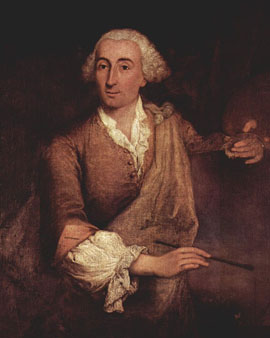
In 1712 the Italian Francescco Guardi was born into a family of artists. His father was the famous baroque painter Domenico Guardi. It was through him that the young Francesco first came into contact with painting. He himself became one of the most famous Italian rococo artists.
He was trained in the workshop not only by his father, but especially by his older brother Giovanni Antonio Guardi. His cats as a painter began for the young Francesco with the completion of various altarpieces. During this time, however, he was also inspired by the work of other Italian artists, such as Michele Marieschi. Later he became a student of Bernardo Bellottos.
Both he and Marieschi are known for their detailed pictures of various cities such as Dresden, Venice or Warsaw. Guardi later followed in the footsteps of his teacher Bellotto and devoted himself to his city - Venice - in an artistic way. Unlike his predecessors, however, Guardi not only included real buildings in his works, but also imaginary buildings. The rococo artist produced his vedute on commission from the Venetian Republic or rich patrons.
Among his most famous works are the Piazza San Marco with a view to the Basilica or the gate to the Arsenal in Venice. Today his paintings are exhibited in the Louvre in Paris, the Alte Pinakothek in Munich, the Staatliche Gemäldegalerie in Berlin and of course in Venice.
 ×
×







 Passionate Customer Service

.jpg "The Doge")
.jpg)
.jpg "The Doge of Venice attends the feasts of Thursday Gras on Piazzetta di San Marco, the Doge is on the left, under the central arcade of the Doge")
.jpg)
_-_(MeisterDrucke-1462507).jpg "Ducal Palace in Venice, by Francesco Guardi (1712-1793) by Francesco Guardi")
_-_(MeisterDrucke-1462507).jpg)
 - (MeisterDrucke-11941).jpg "Gondolas on the Lagoon (Grey Lagoon) by Francesco Guardi")
 - (MeisterDrucke-11941).jpg)
.jpg "The Island of San Michele, Venice, 1770s by Francesco Guardi")
.jpg)
.jpg "View of the Palazzo Loredan dell")
.jpg)
.jpg "Punta della Dogana with Santa Maria della Salute. Around 1770 by Francesco Guardi")
.jpg)
.jpg "Isola del Lazzaretto Vecchio by Francesco Guardi")
.jpg)
.jpg "Rio dei Mendicanti by Francesco Guardi")
.jpg)
.jpg "Audience Granted by the Doge of Venice in the College Room of Doge")
.jpg)
.jpg "Roman Ruins Near the Lagoon, c. 1765-1775 by Francesco Guardi")
.jpg)
.jpg "The Departure of the")
.jpg)
.jpg "Figure Studies by Francesco Guardi")
.jpg)
.jpg "Venice, The Punta della Dogana with Santa Maria della Salute, c. 1770 by Francesco Guardi")
.jpg)
.jpg "The Coronation of the Doge of Venice on the Scala dei Giganti of the Palazzo Ducale by Francesco Guardi")
.jpg)
.jpg "The Story of Tobias, detail of the Archangel Raphael")
.jpg)
.jpg "The Doge on the Bucentaur in front of San Nicolò del Lido, on Ascension Day, c.1766-70 by Francesco Guardi")
.jpg)
.jpg "Easter Procession of the Doge of Venice at the Church of San Zaccaria, c.1766-70 by Francesco Guardi")
.jpg)
.jpg "Little St Mark")
.jpg)
.jpg "The Rialto Bridge in Venice in the 18th century. Painting by Francesco Guardi (1712-1793). 18th century. Sun. 0.62 x 0.93 m. Toulouse, Musée des Augustins by Francesco Guardi")
.jpg)
.jpg "The Doge in the Shrove Tuesday Festival on the Piazzetta, Venice, detail of the acrobats by Francesco Guardi")
.jpg)
.jpg "Capriccio with Roman Ruins, a Pyramid and Figures, 1760-70 by Francesco Guardi")
.jpg)
.jpg "Venice, a View towards the Giudecca and the Church of Le Zitelle by Francesco Guardi")
.jpg)
.jpg "View on the Cannaregio Canal, Venice by Francesco Guardi")
.jpg)
.jpg "The Story of Tobias, the departure of the Archangel Raphael, c. 1750 by Francesco Guardi")
.jpg)
.jpg "Gala Concert given in January 1782 in Venice for the Tsarevich Paul of Russia and his wife, Maria Feodorovna by Francesco Guardi")
.jpg)
.jpg "View of the courtyard of the Palazzo Ducale and the Giant")
.jpg)
.jpg "The Villa Loredan, near Treviso by Francesco Guardi")
.jpg)
.jpg "The coronation of the Doge of Venice on the Giants")
.jpg)
_in_Venice_-_Guardi_Francesco_(1712-1793)_-_Oil_on_canvas_-_7_-_(MeisterDrucke-1014824).jpg "Casino (Il ridotto) in Venice by Francesco Guardi")
_in_Venice_-_Guardi_Francesco_(1712-1793)_-_Oil_on_canvas_-_7_-_(MeisterDrucke-1014824).jpg)
 - (MeisterDrucke-200179).jpg "The Grand Canal with the Ca")
 - (MeisterDrucke-200179).jpg)
.jpg "Campo dei Santi Giovanni e Paolo and the Scuola Grande di San Marco, Venice by Francesco Guardi")
.jpg)
.jpg "The Island of San Michele, Venice by Francesco Guardi")
.jpg)
.jpg "Regatta on the Canale della Giudecca by Francesco Guardi")
.jpg)
.jpg "View of an Italian City by Francesco Guardi")
.jpg)
.jpg "Casino Il Ridotto in Venice by Francesco Guardi")
.jpg)
.jpg "The Sacrifice of Isaac, Tobias and the Angel, The Angels Appearing to Abraham, Abraham Welcoming the Three Angels (painting series) by Francesco Guardi")
.jpg)
_-_(MeisterDrucke-1636680).jpg "Rialto Bridge (detail) by Francesco Guardi")
_-_(MeisterDrucke-1636680).jpg)
_-_(MeisterDrucke-1457607).jpg "The Church of Santa Lucia on the Grand Canal, Venice by Francesco Guardi")
_-_(MeisterDrucke-1457607).jpg)
.jpg "Santa Maria delle Salute and the Entrance to the Grand Canal, Venice, Looking East by Francesco Guardi")
.jpg)
_-_(MeisterDrucke-1659490).jpg "San Marco, Venice, with Clock Tower by Francesco Guardi")
_-_(MeisterDrucke-1659490).jpg)
.jpg "The Doge of Venice goes to the Church of Santa Maria della Salute on November 21, the day of the commemoration of the end of the plague of 1630 by Francesco Guardi")
.jpg)
.jpg "Architectural Capriccio: Vaulted Passageway Leading to a Square by Francesco Guardi")
.jpg)
.jpg "Fire in the Oil Warehouses at San Marcuola by Francesco Guardi")
.jpg)
.jpg "The Doge of Venice Carried by the Gondoliers After His Election by Francesco Guardi")
.jpg)
 - (MeisterDrucke-199858).jpg "The Foyer by Francesco Guardi")
 - (MeisterDrucke-199858).jpg)
_oi_-_(MeisterDrucke-1463439).jpg "Piazza San Marco Towards San Giorgio Maggiore by Francesco Guardi")
_oi_-_(MeisterDrucke-1463439).jpg)
.jpg "View of the Giudecca Canal looking northwest with the Zattere by Francesco Guardi")
.jpg)
.jpg "Venetian Courtyard by Francesco Guardi")
.jpg)
.jpg "The Bucintoro Festival of Venice. The Bacino di S. Marco with the")
.jpg)
.jpg "Three Sketches of Arches, 1782 by Francesco Guardi")
.jpg)
_Three_Sketches_Buildings_by_Canal_with_Boats_-_(MeisterDrucke-1618715).jpg "Adoration of the Shepherds (recto); Three Sketches: Buildings by Canal with Boats, Landscape with Buildings on Hillside, Buildings with Portico (verso) by Francesco Guardi")
_Three_Sketches_Buildings_by_Canal_with_Boats_-_(MeisterDrucke-1618715).jpg)
_-_(MeisterDrucke-1120826).jpg "The Clock Tower, Venice by Francesco Guardi")
_-_(MeisterDrucke-1120826).jpg)
.jpg "Venetian Gala Concert by Francesco Guardi")
.jpg)
.jpg "Gala Concert in Honour of Princess Maria Fedorowna in Venice, Italy by Francesco Guardi")
.jpg)
.jpg "Imaginary View of a Venetian Square or Campo by Francesco Guardi")
.jpg)
.jpg "Fantastic Landscape by Francesco Guardi")
.jpg)
 Duke of Polignac to the Baroness Idalia of Neukirchen at Villa Gradenigo Carpenedo 1790 (wc over graphite with pen ink on pape - (MeisterDrucke-61878).jpg "Festive Dinner Given to Celebrate the Marriage of Armand Duke of Polignac to the Baroness Idalia of Neukirchen at Villa Gradenigo, Carpenedo by Francesco Guardi")
 Duke of Polignac to the Baroness Idalia of Neukirchen at Villa Gradenigo Carpenedo 1790 (wc over graphite with pen ink on pape - (MeisterDrucke-61878).jpg)
_by_Francesco_Guardi_(1712-1793)_oil_on_canvas_-_(MeisterDrucke-1080032).jpg "Ridotto (Foyer) by Francesco Guardi")
_by_Francesco_Guardi_(1712-1793)_oil_on_canvas_-_(MeisterDrucke-1080032).jpg)
_in_San_Nicolo_from_Lido_to_Venice_Ascens_-_(MeisterDrucke-947011).jpg "The Doge on the Bucentaurus in San Nicolo from Lido to Venice, Ascension Day by Francesco Guardi")
_in_San_Nicolo_from_Lido_to_Venice_Ascens_-_(MeisterDrucke-947011).jpg)
_-_(MeisterDrucke-1457521).jpg "The Church of San Simeone Piccolo on the Grand Canal, Venice by Francesco Guardi")
_-_(MeisterDrucke-1457521).jpg)
.jpg "The Piazza San Marco, on the Doge")
.jpg)
_A_Priest_Celebrating_Mass_and_Saint_Vin_-_(MeisterDrucke-1752173).jpg "The Grand Canal above the Rialto (recto); A Priest Celebrating Mass and Saint Vincent Ferrer Preaching (verso) by Francesco Guardi")
_A_Priest_Celebrating_Mass_and_Saint_Vin_-_(MeisterDrucke-1752173).jpg)
_-_(MeisterDrucke-1635853).jpg "View on the Cannaregio Canal, Venice by Francesco Guardi")
_-_(MeisterDrucke-1635853).jpg)
.jpg "Capriccio: A Palace Courtyard by Francesco Guardi")
.jpg)
_-_(MeisterDrucke-1454109).jpg "Italy, Venice, The Friars")
_-_(MeisterDrucke-1454109).jpg)
_-_(MeisterDrucke-977442).jpg "View of the arsenal in Venice by Francesco Guardi")
_-_(MeisterDrucke-977442).jpg)
.jpg "Architectural Capriccio: Vaulted Colonnade of a Palace by Francesco Guardi")
.jpg)
.jpg "The Grand Canal in Venice with Palazzo Bembo by Francesco Guardi")
.jpg)
.jpg "The Doge of Venice attends the Shrove Tuesday celebrations on Piazzetta di San Marco by Francesco Guardi")
.jpg)
.jpg "Venice: San Giorgio Maggiore with the Giudecca and the Zitelle by Francesco Guardi")
.jpg)
_-_(MeisterDrucke-1659506).jpg "Il Ridotto by Francesco Guardi")
_-_(MeisterDrucke-1659506).jpg)
.jpg "The Grand Canal, Venice by Francesco Guardi")
.jpg)
 Giving a Banquet for the Ambassadors 1776-78 - (MeisterDrucke-63633).jpg "Doge Alvise Mocenigo IV Giving a Banquet for the Ambassadors, 1776-78 by Francesco Guardi")
 Giving a Banquet for the Ambassadors 1776-78 - (MeisterDrucke-63633).jpg)
.jpg "Regatta in Venice by Francesco Guardi")
.jpg)
.jpg "Venice, Il Rio dei Mendicanti by Francesco Guardi")
.jpg)
.jpg "Venice, The Grand Canal with San Geremia, Palazzo Labia, and the Entrance to the Cannaregio by Francesco Guardi")
.jpg)
.jpg "View of the Rialto Bridge, Venice by Francesco Guardi")
.jpg)
.jpg "View of the Santa Maria della Salute Church, 18th century by Francesco Guardi")
.jpg)
_-_(MeisterDrucke-1659491).jpg "Piazza San Marco, Venice, Italy by Francesco Guardi")
_-_(MeisterDrucke-1659491).jpg)
_-_(MeisterDrucke-1470854).jpg "View of San Giorgio Maggiore, c.1760 by Francesco Guardi")
_-_(MeisterDrucke-1470854).jpg)
_-_(MeisterDrucke-1304998).jpg "Three Sketches of Arches (verso) by Francesco Guardi")
_-_(MeisterDrucke-1304998).jpg)
.jpg "Portico by Francesco Guardi")
.jpg)
_18th_century_Paris_-_(MeisterDrucke-1000431).jpg "A Portico in Venice by Francesco Guardi")
_18th_century_Paris_-_(MeisterDrucke-1000431).jpg)
.jpg "View of Santa Maria della Salute and the Dogana by Francesco Guardi")
.jpg)
.jpg "The Staircase of the Giants, Ducal Palace, Venice by Francesco Guardi")
.jpg)
.jpg "The Doge on the Bucintoro near the Riva di Sant")
.jpg)
.jpg "Piazza San Marco by Francesco Guardi")
.jpg)
.jpg "Ruined Archway by Francesco Guardi")
.jpg)
.jpg "Two Vessels in a Storm, 18th century by Francesco Guardi")
.jpg)
.jpg "Venetian Capriccio: View of a Square and a Palace by Francesco Guardi")
.jpg)
.jpg "The Grand Canal, Venice by Francesco Guardi")
.jpg)
.jpg "Pope Pius VI Descending the Throne to Take Leave of the Doge in the Hall of SS. Giovanni e Paolo and Pontifical Ceremony in SS. Giovanni e Paolo, Venice by Francesco Guardi")
.jpg)
.jpg "San Giorgio Maggiore, Venice, with the Giudecca and Zitelle by Francesco Guardi")
.jpg)
.jpg "The Bucintoro Festival of Venice. The Bacino di S. Marco with the Bucintoro, the Doge")
.jpg)
.jpg "Gala Concert at the Casino dei Filodrammatici in Venice by Francesco Guardi")
.jpg)
.jpg "Regatta on the Giudecca Canal by Francesco Guardi")
.jpg)
.jpg "Santa Maria della Salute by Francesco Guardi")
.jpg)
_-_(MeisterDrucke-1089079).jpg "View of the Dogana and Santa Maria della Salute, Venice by Francesco Guardi")
_-_(MeisterDrucke-1089079).jpg)
 - (MeisterDrucke-85685).jpg "The Rialto Bridge, Venice by Francesco Guardi")
 - (MeisterDrucke-85685).jpg)

 +43 4257 29415
 support@meisterdrucke.com
 Mo-Do: 7:00 - 16:00 | Fr: 7:00 - 13:00