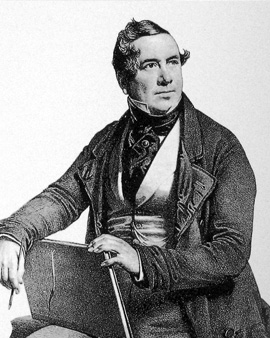
Born into difficult economic circumstances, David Roberts began painting surfaces at the age of eight. By imitating wood and marble, David contributed to the Roberts family's household income. Roberts began an apprenticeship with a decoration painter, left his Scottish homeland and made a name for himself as a painter of stage decorations. David had already made it into the best theatre houses in London when he exhibited his first oil painting in 1824.
Roberts first attracted great attention with the painting "The Interior of Rouen Cathedral". The talent David revealed with this painting induced him to dedicate himself to studio painting. Private commissions enabled David Roberts to pursue his second passion, travelling. He was regularly drawn back to Scotland, but he also visited Germany, the Netherlands and France on his way to the Orient.
Roberts processes the impressions of his travels in his most important works. "The Temple of Isis on the Island of Philes" shows the impressive architecture of the building and is a testimony to Egyptian culture. David Roberts regularly presented his travel sketches not only as illustrations, he also wrote a text about what he had experienced and thus became the author of a series of impressive travel guides. A crowning conclusion of his journey was a trip on the Nile. Robert's talent for landscape painting is clearly shown in the painting "Approaching Sandstorm in Giza".
 ×
×







 Passionate Customer Service

.jpg "View under the Grand Portico, Philae, from Egypt and Nubia, Vol. 1 by David Roberts")
.jpg)
.jpg "Petra, March 7th 1839, plate 92 from Volume III of „The Holy Land“, engraved by Louis Haghe (1806-85), published 1849 by David Roberts")
.jpg)
.jpg "Hall of Columns, Karnak, Egypt, 19th century by David Roberts")
.jpg)
.jpg "Grand Portico of the Temple of Philae, Nubia, from “Egypt and Nubia”, engraved by Louis Haghe (1806-85), published in London, 1838 by David Roberts")
.jpg)
.jpg "El Deir, Petra, March 8th 1839, plate 90 from Volume III of “The Holy Land”, engraved by Louis Haghe (1806-85), published 1849 by David Roberts")
.jpg)
.jpg "Front Elevation of the Great Temple of Abu Simbel, Nubia, from")
.jpg)
.jpg "Convent of St. Catherine with Mount Horeb, February 19th 1839, plate 118 from Volume III of “The Holy Land”, engraved by Louis Haghe (1806-85), published 1849 by David Roberts")
.jpg)
.jpg "Excavated Temple of Abu Simbel, from Egypt and Nubia, Vol. 1 by David Roberts")
.jpg)
.jpg "Jerusalem, April 9th 1839, plate 16 from Volume I of “The Holy Land”, engraved by Louis Haghe (1806-85), published 1842 by David Roberts")
.jpg)
.jpg "Mosque of Omar showing the Site of the Temple, plate 8 from Volume I of")
.jpg)
.jpg "The Sphinx at Giza by David Roberts")
.jpg)
.jpg "Entrance to Petra, March 10th 1839, plate 98 from Volume III of “The Holy Land”, engraved by Louis Haghe (1806-85), published 1849 by David Roberts")
.jpg)
.jpg "The Damascus Gate, Jerusalem by David Roberts")
.jpg)
_publ_-_(MeisterDrucke-87770).jpg "Temple of Horus, Edfu, from")
_publ_-_(MeisterDrucke-87770).jpg)
.jpg "The Citadel of Cairo, Residence of Mehmet Ali, from Egypt and Nubia, Vol. 3, 1838 by David Roberts")
.jpg)
.jpg "The Pyramids of Giza, from Egypt and Nubia, Vol. 1 by David Roberts")
.jpg)
.jpg "Giant limestone statues of Rameses II, Temple of Rameses, Abu Simbel, Egypt, 1836 by David Roberts")
.jpg)
.jpg "Excavated Temple of Gyrshe, Nubia by David Roberts")
.jpg)
.jpg "The Hypaethral Temple at Philae, Called the Bed of Pharaoh, Egypt by David Roberts")
.jpg)
.jpg "Shrine of the Holy Sepulchre, April 10th 1839, plate 14 from Volume I of")
.jpg)
.jpg "Baalbek Gate in Lebanon, drawing made on 07/05/1839 in")
.jpg)
.jpg "The Hypaethral Temple at Philae, Called the Bed of Pharaoh, Engraved by Louis Haghe, Published in 1843 by David Roberts")
.jpg)
.jpg "Excavated Temple of Abu Simbel, Nubia, Egypt, c1845 by David Roberts")
.jpg)
.jpg "Bethlehem, 1839 by David Roberts")
.jpg)
.jpg "The Hypostyle Hall of the Great Temple at Abu Simbel, Egypt by David Roberts")
.jpg)
.jpg "Triumphal Arch crossing the Ravine leading to Petra, plate 95 from Volume III of")
.jpg)
.jpg "Pyramids of Gizeh - in")
.jpg)
.jpg "El Deir, Petra, 1839 by David Roberts")
.jpg)
.jpg "The Great Temple of Amon Karnak, The Hypostyle Hall by David Roberts")
.jpg)
.jpg "Jaffa, ancient Joppa, 16 April 1839, plate 61 from Volume II of ‘The Holy Land’, engraved by Louis Haghe (1806-85), published 1843 by David Roberts")
.jpg)
.jpg "Convent of the Terra Santa, Nazareth, April 21st 1839, plate 30 from Volume I of")
.jpg)
.jpg "Interior of the Temple of Abu Simbel, from")
.jpg)
.jpg "Rome, twilight, view from the Convent of San Onofrio on Mount Janiculum, c.1853-55 by David Roberts")
.jpg)
.jpg "Obelisk at Alexandria, commonly called Cleopatra")
.jpg)
.jpg "Ascent of the Lower Range of Sinai, February 18th 1839, Plate 114 from Volume III of")
.jpg)
.jpg "From under the Portico of the Temple of Edfu, Upper Egypt by David Roberts")
.jpg)
.jpg "Karnac, 27th November 1838 by David Roberts")
.jpg)
.jpg "Shrine of the Annunciation, Nazareth, April 20th 1839, plate 31 from Volume I of")
.jpg)
.jpg "Entrance to Petra, Jordan by David Roberts")
.jpg)
_-_(MeisterDrucke-1019802).jpg "Interior of the Temple of Abu Simbel, from")
_-_(MeisterDrucke-1019802).jpg)
.jpg "Obelisk at Temple at Luxor, engraving by David Roberts")
.jpg)
_-_(MeisterDrucke-102073).jpg "Frontispiece to")
_-_(MeisterDrucke-102073).jpg)
.jpg "The Temple of Edfu, engraving by David Roberts")
.jpg)
.jpg "The Hypaethral Temple at Philae, called the Bed of Pharaoh - in")
.jpg)
.jpg "The Giralda, Seville, from")
.jpg)
.jpg "Facade of the Temple of Hathor, Dendarah, from")
.jpg)
.jpg "Jerusalem from the South, 1839 by David Roberts")
.jpg)
_-_(MeisterDrucke-1111372).jpg "View on the Nile, ferry to Giza, from")
_-_(MeisterDrucke-1111372).jpg)
.jpg "Citadel of Jerusalem, Without the Walls, Tower of David by David Roberts")
.jpg)
.jpg "View from under the Portico of the Temple of Edfu, Upper Egypt, plate 32 from Volume I of Egypt and Nubia, engraved by Louis Haghe (1806-85), published 1846 by David Roberts")
.jpg)
.jpg "Alcazar, Segovia, Spain, 1836 by David Roberts")
.jpg)
.jpg "Interior of the Temple of Abu Simbel, Nubia, Egypt by David Roberts")
.jpg)
.jpg "Temple of Edfu, ancient Apollinopolis, Upper Egypt, from Egypt and Nubia, Vol. 1 by David Roberts")
.jpg)
.jpg "The Pool of Bethesda, Jerusalem by David Roberts")
.jpg)
.jpg "The Giralda, Seville by David Roberts")
.jpg)
.jpg "In the Alhambra Palace, Granada by David Roberts")
.jpg)
.jpg "The Hypaethral Temple at Philae, called the Bed of Pharaoh, plate 65 from volume II of")
.jpg)
.jpg "The Colossi of Memnon, at Thebes, during the Inundation, from Egypt and Nubia, Vol. 1 by David Roberts")
.jpg)
.jpg "Jerusalem from the Mount of Olives, 1839 by David Roberts")
.jpg)
.jpg "Church of the Holy Sepulchre, Jerusalem by David Roberts")
.jpg)
.jpg "The Minaret of the Mosque of El Rhamree, Cairo, from")
.jpg)
.jpg "Burgos Cathedral, 1838 by David Roberts")
.jpg)
.jpg "City of Tiberias on the Sea of Galilee, April 22nd 1839, plate 38 from Volume I of")
.jpg)
.jpg "Absalom")
.jpg)
.jpg "Jerusalem from the North by David Roberts")
.jpg)
_-_(MeisterDrucke-569419).jpg "West Porch of Roslyn Chapel by David Roberts")
_-_(MeisterDrucke-569419).jpg)
.jpg "General View of the Ruins of Luxor from the Nile, from Egypt and Nubia, Vol. 1 by David Roberts")
.jpg)
.jpg "Malaga by David Roberts")
.jpg)
.jpg "Greek Church of the Holy Sepulchre, Jerusalem, April 11th 1839, plate 4 from Volume I of")
.jpg)
.jpg "View of the ruins of Petra, Jordan by David Roberts")
.jpg)
.jpg "Grand Approach to the Temple of Philae, Nubia, 19th century by David Roberts")
.jpg)
.jpg "Procession in Seville Cathedral, 1833 by David Roberts")
.jpg)
.jpg "View on the Nile looking towards the Pyramids of Dahshur and Saqqarah, from Egypt and Nubia, Vol. 1 by David Roberts")
.jpg)
.jpg "Mosque of the Sultan Hasan from the Great Square of Rumeyleh, Cairo, from Egypt and Nubia, Vol. 3 by David Roberts")
.jpg)
.jpg "Interior of the Temple at Esna, Upper Egypt, from “Egypt and Nubia”, engraved by Louis Haghe, published in London, 1838 by David Roberts")
.jpg)
.jpg "Mosque El Mooristan, Cairo, from Egypt and Nubia, Vol. 3 by David Roberts")
.jpg)
.jpg "Grand Entrance to the Temple of Luxor, from Egypt and Nubia, Vol. 1 by David Roberts")
.jpg)
.jpg "North Gate at Dendarah, from Egypt and Nubia, Vol. 1 by David Roberts")
.jpg)
.jpg "Fragments of the Great Colossus, at the Memnonium, Thebes, 1937 BC by David Roberts")
.jpg)
.jpg "Portico of the Temple of Edfu, Upper Egypt, from Egypt and Nubia, Vol. 1 by David Roberts")
.jpg)
.jpg "Cairo from the Gate of Citizenib, looking towards the Desert of Suez, from Egypt and Nubia, Vol. 3 by David Roberts")
.jpg)
.jpg "The Citadel of Cairo, Residence of Mehmet Ali, 1842-49 by David Roberts")
.jpg)
.jpg "The ancient city of Tyre, taken from the isthmus by David Roberts")
.jpg)
_drawing_made_on_10031839_in_The_Holy_Land_London_-_(MeisterDrucke-974112).jpg "The Theatre (entrance to Petra), drawing made on 10/03/1839 in")
_drawing_made_on_10031839_in_The_Holy_Land_London_-_(MeisterDrucke-974112).jpg)
.jpg "The Coronation Procession of Anne Boleyn to Westminster Abbey, illustration from ‘The History of Protestantism’ by James Aitken Wylie (1808-1890), published 1878 by David Roberts")
.jpg)
.jpg "Temple of Sobek and Haroeris at Kom Ombo, from")
.jpg)
_-_(MeisterDrucke-1656359).jpg "In the Holy Land: Jerusalem, from the Road to Bethany by David Roberts")
_-_(MeisterDrucke-1656359).jpg)
.jpg "Jerusalem, April 1839, plate 22 from Volume I of")
.jpg)
.jpg "Interior of a Cathedral, 1822 or 1829 by David Roberts")
.jpg)
_drawing_made_on_091118_-_(MeisterDrucke-952002).jpg "Interior of the Temple of Aboo Simbel, drawing made on 09/11/1836 in")
_drawing_made_on_091118_-_(MeisterDrucke-952002).jpg)
_-_(MeisterDrucke-278077).jpg "The Necropolis, Petra by David Roberts")
_-_(MeisterDrucke-278077).jpg)
_publish_-_(MeisterDrucke-44292).jpg "Encedi, from Volume II of")
_publish_-_(MeisterDrucke-44292).jpg)
.jpg "Ruins of the Eastern Portico of the Temple of Baalbec, May 6th 1839, Plate 83 from Volume II of")
.jpg)
.jpg "Ruins, Temple on the Island of Biggeh, Nubia by David Roberts")
.jpg)
_Thebes_(Thebes)_-_in_The_Holy_Land_London_1849_-_(MeisterDrucke-952005).jpg "Medinet Abu, Thebes - in")
_Thebes_(Thebes)_-_in_The_Holy_Land_London_1849_-_(MeisterDrucke-952005).jpg)
.jpg "The Dromos or Central Hall of the Great Temple of Amun, Karnak, from Egypt and Nubia, Vol. 2 by David Roberts")
.jpg)
_-_(MeisterDrucke-1127937).jpg "Interior of a Mosque, c.1835 by David Roberts")
_-_(MeisterDrucke-1127937).jpg)
.jpg "El Deir, Petra, drawing made on 08/03/1839 in")
.jpg)
.jpg "The Pool of Siloam, from Volume II of")
.jpg)
_Scottish_artist_-_(MeisterDrucke-1641118).jpg "View of a Pyramid by David Roberts")
_Scottish_artist_-_(MeisterDrucke-1641118).jpg)

 +43 4257 29415
 support@meisterdrucke.com
 Mo-Do: 7:00 - 16:00 | Fr: 7:00 - 13:00