Once, when I - Vladimir Veličković - was strolling through the streets of Belgrade on a rainy afternoon, my gaze fell on a scene that has stayed with me to this day: An old man standing under a dripping canopy, holding a crumpled sketchpad in his hands. His fingers, marked by time, glided across the paper as if he were recreating the city itself with just a few lines. At that moment, I realised how much Serbia tells its stories not only in monuments, but above all in images, colours and lines. Serbian art lives from these quiet, often overlooked moments - from the poetry of everyday life, captured in watercolours, drawings and photographs that make the invisible visible.
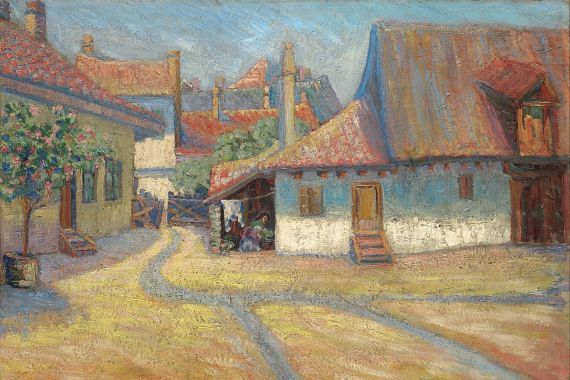
What many people don't realise: Serbian painting is a kaleidoscope of East and West, of tradition and new beginnings. In the smoky cafés of Skadarlija, where bohemians and intellectuals once clashed, not only heated debates but also sketches on napkins, spontaneous portraits and first sketches for works that would later adorn the walls of the National Gallery were created. The artists of my homeland - from Paja Jovanović, whose oil paintings capture the light of the Balkan landscapes like a precious secret, to Nadežda Petrović, whose expressive brushstrokes make the suffering and hope of an entire generation tangible - they have all given Serbia an unmistakable signature. Their works are not mere images, but emotional maps on which history, pain and longing are superimposed.
But Serbia would not be Serbia if it did not constantly explore the boundaries of its own art anew. In the 1960s, when the world was in upheaval, artists such as Dušan Džamonja and Marina Abramović took up the camera, photographic paper and screen printing - and transformed the Serbian art scene into a laboratory for experimentation. Photography became a mirror of a changing society, printmaking a protest against oblivion. Even today, when I walk through the studios of young artists, I sense this irrepressible desire for new beginnings: old family photos are painted over with vibrant gouache colours, collages are created from newspaper clippings and charcoal drawings that celebrate life between the Danube and the Sava in all its contradictions.
Serbia is a country that does not hide its art in gold-framed still lifes, but takes it out onto the streets, into the cafés and into people's hearts. If you look closely, you will discover a piece of this untamed soul in every picture, every drawing, every print - and perhaps, as I did in the rain, a moment that will stay with you.
Once, when I - Vladimir Veličković - was strolling through the streets of Belgrade on a rainy afternoon, my gaze fell on a scene that has stayed with me to this day: An old man standing under a dripping canopy, holding a crumpled sketchpad in his hands. His fingers, marked by time, glided across the paper as if he were recreating the city itself with just a few lines. At that moment, I realised how much Serbia tells its stories not only in monuments, but above all in images, colours and lines. Serbian art lives from these quiet, often overlooked moments - from the poetry of everyday life, captured in watercolours, drawings and photographs that make the invisible visible.
What many people don't realise: Serbian painting is a kaleidoscope of East and West, of tradition and new beginnings. In the smoky cafés of Skadarlija, where bohemians and intellectuals once clashed, not only heated debates but also sketches on napkins, spontaneous portraits and first sketches for works that would later adorn the walls of the National Gallery were created. The artists of my homeland - from Paja Jovanović, whose oil paintings capture the light of the Balkan landscapes like a precious secret, to Nadežda Petrović, whose expressive brushstrokes make the suffering and hope of an entire generation tangible - they have all given Serbia an unmistakable signature. Their works are not mere images, but emotional maps on which history, pain and longing are superimposed.
But Serbia would not be Serbia if it did not constantly explore the boundaries of its own art anew. In the 1960s, when the world was in upheaval, artists such as Dušan Džamonja and Marina Abramović took up the camera, photographic paper and screen printing - and transformed the Serbian art scene into a laboratory for experimentation. Photography became a mirror of a changing society, printmaking a protest against oblivion. Even today, when I walk through the studios of young artists, I sense this irrepressible desire for new beginnings: old family photos are painted over with vibrant gouache colours, collages are created from newspaper clippings and charcoal drawings that celebrate life between the Danube and the Sava in all its contradictions.
Serbia is a country that does not hide its art in gold-framed still lifes, but takes it out onto the streets, into the cafés and into people's hearts. If you look closely, you will discover a piece of this untamed soul in every picture, every drawing, every print - and perhaps, as I did in the rain, a moment that will stay with you.
 ×
×






 Passionate Customer Service

 +43 4257 29415
 support@meisterdrucke.com
 Mo-Do: 7:00 - 16:00 | Fr: 7:00 - 13:00