Romanian Artists
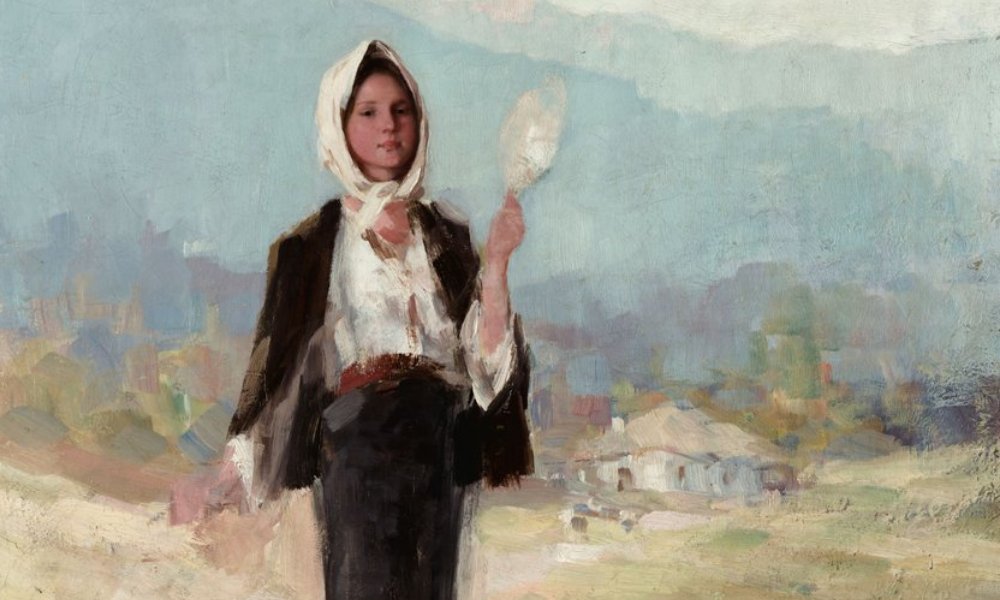
A luminous watercolour that captures the morning mist over the rolling hills of Maramureș: Delicate shades of blue merge with the lush green of the meadows, while a village with red roofs awakens in the background. An old woman stands in the centre of the picture, her headscarf like a splash of colour in the mist, and her hands rest on a basket full of apples. This picture, created by the Romanian artist Elena Popea, is more than just a landscape - it is a window into the soul of a country that oscillates between East and West, tradition and modernity, melancholy and joie de vivre.
Romania, the land of the Carpathians, endless forests and mysterious villages, is a place where art has always echoed the landscape and the people. Travelling through the narrow streets of Sibiu or the wide fields of the Vltava, you can feel how the light refracts on the facades, how colours and shadows tell stories. In the studios of Bucharest, where the scent of oil paint and coffee fills the air, works have been created that capture a nation's attitude to life: The expressive paintings of Nicolae Grigorescu, whose brushstrokes capture rural life with an almost impressionistic lightness, or the mysterious, almost dreamlike compositions of Victor Brauner, who was one of the few Romanians to inspire the Parisian surrealists. Romanian art is full of contrasts - it can be wild and impetuous like the storms over the Danube delta, but also tender and thoughtful like a quiet portrait by Theodor Pallady, in which the light dances on a white tablecloth.
What many people don't realise: Romania was a melting pot of styles and influences early on. While Impressionism was celebrated in Western Europe, Romanian artists experimented with Symbolism, Art Nouveau and later with the avant-garde. Photography found enthusiastic supporters here surprisingly early on - Carol Popp de Szathmari, one of the world's first war photographers, documented the life and conflicts of his homeland as early as the 19th century. And when modernism arrived, artists such as Corneliu Baba ventured into expressive portraits that explored the inner lives of their figures with an almost psychological depth. In the turmoil of the 20th century, between dictatorship and upheaval, art became a mirror of society: sometimes as a quiet protest, sometimes as a poetic escape, sometimes as a courageous search for identity. Today, in the galleries of Cluj or Timișoara, we encounter a young generation that uses photography, printmaking and mixed media to question traditions in a new way - and, in doing so, repeatedly flashes the unmistakable, the Romanian, in bright colours and surprising forms.
Romanian art history is thus a kaleidoscope of light and shadow, of longing and new beginnings. It invites you to take a closer look, to let yourself be carried away by colours and lines - and perhaps to discover in an art print the echo of a landscape, a moment, an attitude to life that radiates far beyond the country's borders.
Romanian Artists
A luminous watercolour that captures the morning mist over the rolling hills of Maramureș: Delicate shades of blue merge with the lush green of the meadows, while a village with red roofs awakens in the background. An old woman stands in the centre of the picture, her headscarf like a splash of colour in the mist, and her hands rest on a basket full of apples. This picture, created by the Romanian artist Elena Popea, is more than just a landscape - it is a window into the soul of a country that oscillates between East and West, tradition and modernity, melancholy and joie de vivre.
Romania, the land of the Carpathians, endless forests and mysterious villages, is a place where art has always echoed the landscape and the people. Travelling through the narrow streets of Sibiu or the wide fields of the Vltava, you can feel how the light refracts on the facades, how colours and shadows tell stories. In the studios of Bucharest, where the scent of oil paint and coffee fills the air, works have been created that capture a nation's attitude to life: The expressive paintings of Nicolae Grigorescu, whose brushstrokes capture rural life with an almost impressionistic lightness, or the mysterious, almost dreamlike compositions of Victor Brauner, who was one of the few Romanians to inspire the Parisian surrealists. Romanian art is full of contrasts - it can be wild and impetuous like the storms over the Danube delta, but also tender and thoughtful like a quiet portrait by Theodor Pallady, in which the light dances on a white tablecloth.
What many people don't realise: Romania was a melting pot of styles and influences early on. While Impressionism was celebrated in Western Europe, Romanian artists experimented with Symbolism, Art Nouveau and later with the avant-garde. Photography found enthusiastic supporters here surprisingly early on - Carol Popp de Szathmari, one of the world's first war photographers, documented the life and conflicts of his homeland as early as the 19th century. And when modernism arrived, artists such as Corneliu Baba ventured into expressive portraits that explored the inner lives of their figures with an almost psychological depth. In the turmoil of the 20th century, between dictatorship and upheaval, art became a mirror of society: sometimes as a quiet protest, sometimes as a poetic escape, sometimes as a courageous search for identity. Today, in the galleries of Cluj or Timișoara, we encounter a young generation that uses photography, printmaking and mixed media to question traditions in a new way - and, in doing so, repeatedly flashes the unmistakable, the Romanian, in bright colours and surprising forms.
Romanian art history is thus a kaleidoscope of light and shadow, of longing and new beginnings. It invites you to take a closer look, to let yourself be carried away by colours and lines - and perhaps to discover in an art print the echo of a landscape, a moment, an attitude to life that radiates far beyond the country's borders.
 ×
× 





 Passionate Customer Service

 +43 4257 29415
 support@meisterdrucke.com
 Mo-Do: 7:00 - 16:00 | Fr: 7:00 - 13:00