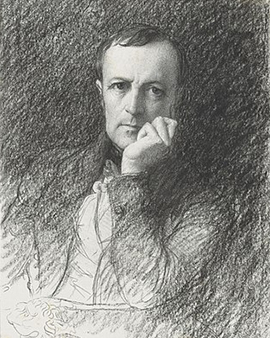
A dazzling personality of the art world, who left his mark on academic realism, is the French history painter Paul Delaroche, whose works take us on a journey through time. In the heart of Paris, on July 17, 1797, Delaroche opened his eyes to the world before finally bidding farewell to it on November 4, 1856. In the annals of art, he is also known as Hippolyte Delaroche, a rare name that does justice to his complexity and uniqueness. Delaroche, affectionately known in the family as "Paul," was the second son of Grégoire-Hippolyte de la Roche and Marie-Catherine Bégat, a family deeply rooted in the Paris art scene for generations. They lived in a house on Rue de la Vrillière in the 1st arrondissement, a street that was considered the epicenter of the art scene. Delaroche began his training in painting in 1816 at Louis Etienne Watelet before moving to Antoine Jean Gros's studio two years later. Gros, a renowned artist of his time, was instrumental in shaping Delaroche's style and expression. His talent was quickly recognized and in 1822 he made his debut at the Salon de Paris. Here he met Theodore Gericault and Eugène Delacroix, two other emerging painters of his time, and together they formed the heart of Parisian history painting.
Delaroche's work exuded a fascinating blend of classicism and romanticism, a style that made him distinctive on the art scene. His paintings, carefully staged and executed down to the smallest detail, mostly depicted dramatic historical events that emotionally captured the viewer. Delaroche drew inspiration from the social and political turmoil of his time and wove these themes into his art, often depicting high nobles at crucial moments. These motifs were considered emblematic of the political uncertainty of the day and resonated with his audience. Delaroche's artwork left a lasting impression of rare intensity and deep feeling.
Among Delaroche's masterpieces, Execution of Jane Grey stands out, a powerful, ahistorical portrait that took place outdoors. With each brushstroke, Delaroche painted a story that extended beyond the frame of the painting and captured the emotions of the viewer. He also referenced contemporary developments in photography, recognizing that the daguerreotype, an early form of photography, had the potential to revolutionize painting. Today, we honor Paul Delaroche as one of the most important history painters of his time and value his art as an irreplaceable contribution to our cultural heritage. Our company is proud to keep his works alive through high quality art prints that do justice to the finest nuances of his art. Each art print is a tribute to Delaroche's masterful skill and his extraordinary ability to convey the complexity of history through the language of art. We invite you to embark on a journey of discovery and explore the fascinating world of Paul Delaroche through our exquisite art prints.
 ×
×







 Passionate Customer Service

.jpg "The Execution of Lady Jane Grey, 1833 by Paul Delaroche")
.jpg)
.jpg "The Young Martyr, 1855 by Paul Delaroche")
.jpg)
.jpg "Offering to the God Pan, 1855 by Paul Delaroche")
.jpg)
.jpg "The assassination of the Duke of Guise at the Château de Blois in 1588, 1834. by Paul Delaroche")
.jpg)
.jpg "The assassination of the Duke of Guise at the Château de Blois in 1588 by Paul Delaroche")
.jpg)
.jpg "Napoleon at Fontainebleau, March 31, 1814 by Paul Delaroche")
.jpg)
.jpg "The Execution of Lady Jane Grey, 1833 by Paul Delaroche")
.jpg)
.jpg "Portrait of Henriette Sontag, 1806-1854 by Paul Delaroche")
.jpg)
.jpg "Seated Jewish Woman from Gaza, with Her Child and Two Large Jugs by Paul Delaroche")
.jpg)
.jpg "The Death of Elizabeth I, Queen of England by Paul Delaroche")
.jpg)
.jpg "The Members of the Academy of Beaux-Arts Assembled to Jury the Rome Prize by Paul Delaroche")
.jpg)
.jpg "Jane Jarvis, 1830-1831 by Paul Delaroche")
.jpg)
.jpg "Napoleon at Fontainebleau During the First Abdication - April 1814 by Paul Delaroche")
.jpg)
.jpg "Joan of Arc in Prison, 1825 by Paul Delaroche")
.jpg)
.jpg "Portrait of Mme. de Therville by Paul Delaroche")
.jpg)
.jpg "Jane Jarvis by Paul Delaroche")
.jpg)
.jpg "Offering to the God Pan by Paul Delaroche")
.jpg)
.jpg "Napoleon Crossing the Alps by Paul Delaroche")
.jpg)
.jpg "Young Girl in a Water Basin by Paul Delaroche")
.jpg)
.jpg "Christian Martyr Drowned in the Tiber During the Reign of Diocletian, 1853 by Paul Delaroche")
.jpg)
.jpg "Herodias by Paul Delaroche")
.jpg)
.jpg "Portrait of Pope Gregory XVI by Paul Delaroche")
.jpg)
.jpg "Bonaparte Crossing the Alps by Paul Delaroche")
.jpg)
.jpg "Herodias with the Head of St. John the Baptist by Paul Delaroche")
.jpg)
.jpg "Charles de Rémusat by Paul Delaroche")
.jpg)
.jpg "The Members of the Academy of Beaux-Arts Assembled to Jury the Rome Prize by Paul Delaroche")
.jpg)
.jpg "Women in an Interior by Paul Delaroche")
.jpg)
.jpg "Portrait of Emperor Peter I the Great by Paul Delaroche")
.jpg)
.jpg "The Execution of Lady Jane Grey in the Tower of London in the Year 1554 by Paul Delaroche")
.jpg)
.jpg "The Execution of Lady Jane Grey by Paul Delaroche")
.jpg)
.jpg "Guillotine. The Carmelites of Compiègne, first half of the 19th century. by Paul Delaroche")
.jpg)
.jpg "Saint Vincent de Paul Preaching to the Court of Louis XIII on Behalf of the Abandoned Children by Paul Delaroche")
.jpg)
.jpg "Bonaparte Crossing the Alps by Paul Delaroche")
.jpg)
.jpg "Portrait of Countess Sophie Shuvaloff by Paul Delaroche")
.jpg)
.jpg "Study for a Figure of Fame, from the Hémicycle des Beaux-Arts, École des Beaux-Arts by Paul Delaroche")
.jpg)
.jpg "Portrait of Mme. E. D. by Paul Delaroche")
.jpg)
.jpg "Napoleon Crossing the Alps by Paul Delaroche")
.jpg)
.jpg "The Children of King Edward IV of England, 1852 by Paul Delaroche")
.jpg)
.jpg "Oliver Cromwell by the Coffin of Charles I, King of England by Louis Pierre Henriquel-Dupont")
.jpg)
.jpg "Marquis de Pastoret by Paul Delaroche")
.jpg)
.jpg "The Execution of Lady Jane Grey by Paolo Mercuri")
.jpg)
.jpg "The Death of Queen Elizabeth I of England, 1828 by Paul Delaroche")
.jpg)
.jpg "Napoleon at Fontainebleau During the First Abdication - 31 March 1814, 1845. by Paul Delaroche")
.jpg)
.jpg "Napoleon Bonaparte, French general and Emperor. by Paul Delaroche")
.jpg)
.jpg "Napoleon at Fontainebleau During the First Abdication - 31 March 1814, 1845 by Paul Delaroche")
.jpg)
.jpg "Napoleon by Paul Delaroche")
.jpg)

 +43 4257 29415
 support@meisterdrucke.com
 Mo-Do: 7:00 - 16:00 | Fr: 7:00 - 13:00