Anyone who wants to learn how to paint a horse at full gallop would do best to study under the British painter and printmaker Henry Thomas Alken. A picture such as “Full Cry, c.1840” - named for the English hunting term “full cry” - demonstrates the task: a grey and a chestnut stretch out across the meadow, one rider sits deep in the saddle in a red coat, the other waves his hat as he leaps, the pack streams away to the right like a mottled chain, and at the edge of the picture a farm labourer pauses with his spade to watch. Everything is in motion, and yet every leg, every hoof, every fetlock is right - the slender joint above the hoof. The first lesson, then: speed comes from precision.
Second lesson: origins. Across four generations, the London Alken family produced eight documented artists. Henry Thomas, born in Soho on 12 October 1785, was the third son of Samuel Alken, who also painted hunting and sporting scenes and engraved them in aquatint, an etching technique used to create soft, even tones; two of his brothers painted as well, as did his own sons later. He first trained at home, then with the miniature painter John Thomas Barber Beaumont; two of his portrait miniatures were exhibited at the Royal Academy in 1801 and 1802, after which he abandoned the small format. Yet the miniaturist's training remained in his hand: it can be seen in the finger-sized hounds in his hunting pictures, each individually delineated, with its own markings and gait.
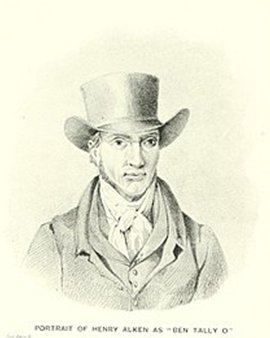
Third lesson: a name is a tool. His earliest sporting prints, beginning in 1813, bear the signature of an invented figure, “Ben Tally Ho” - named after the cry with which English hunters announce the fox, and well suited to gentle satire. From 1816 onward he signed his own name, and business flourished: the young father lived above the shop of the publisher Thomas McLean in the Haymarket and supplied drawings for 30 shillings a day, a very good income at the time. In 1821 McLean published his principal work, “The National Sports of Great Britain”, fifty hand-coloured aquatint plates covering everything England then considered sport, from horse racing and foxhunting to fishing, prizefighting and cockfighting - a clear-eyed inventory of the sporting culture of his time.
Fourth lesson, and the most important: the wit belongs to the people, never to the horses. Alken worked in both registers with the same hand, producing noble hunting series as readily as albums of caricatures, and the two meet most beautifully in his plates devoted to Mr Jorrocks - a fictional character created by the writer Robert Smith Surtees, a London grocer obsessed with hunting. In “Lift Me Up! Tie Me in My Chair! Fill My Glass!”, Jorrocks lounges blissfully askew in his armchair after a day's hunting, his legs stretched wide apart, while the company around the table raises its glasses; on the wall, as propriety demands, hang two hunting pictures in gold frames. The title is Jorrocks's own heartfelt sigh, and Alken laughs with his exhausted hero rather than at him.
Fifth lesson: a signature offers only limited protection against confusion. Because so many members of the Alken family painted and numerous works are signed simply “Alken”, the art trade has spent generations puzzling over which hand painted which picture; his son Samuel Henry sometimes used the deceptively similar signature “H. Alken”, and one rule of thumb among dealers holds that ladies riding sidesaddle are more likely to indicate the son. “The Start of the Derby” shows how customers recognised their Alken: a field of jockeys knee to knee, their silks green, red, blue and yellow, the horses fully extended, one second before the race breaks apart. And in “Hunting Scene”, red coats and the mottled pack sweep together across the green - the fever of a hunting morning condensed onto a small panel.
Sixth lesson: the material. Alken's scenes in oil thrive on dark horses' bodies, the single rich red of the coats and the changing light across the meadow; as an art print, this painting requires a support capable of carrying such contrasts. We therefore prefer to print them on lightly glossy canvas: the subtle sheen keeps the blacks deep and gives the red its luminosity.
Alken himself gave the final lesson. In 1849, long ill and impoverished - why the prosperity of his successful years had vanished is not recorded - he summarised in 58 pages what forty years in the workshop had taught him: “The Art and Practice of Etching”, a practical etching manual for beginners. The second edition appeared in 1851, and by then the master had little time left: he died in London on 7 April 1851. His grave is in London's Highgate Cemetery; his family paid for the funeral.
 ×
×







 Passionate Customer Service

.jpg "Lift Me Up! Tie Me in My Chair! Fill My Glass! by Henry Thomas Alken")
.jpg)
.jpg "The Start of the Derby by Henry Thomas Alken")
.jpg)
.jpg "Full Cry, c.1840 by Henry Thomas Alken")
.jpg)
_(see_349143_for_pair)_-_(MeisterDrucke-193510).jpg "Hunting Scene by Henry Thomas Alken")
_(see_349143_for_pair)_-_(MeisterDrucke-193510).jpg)
.jpg "A Cock-fight Watched by Four Men in an Out-House: The Death, Engraved as Plate 40 in \"The National Sports of Great Britain\" by Henry Thomas Alken")
.jpg)
.jpg "A Cock-Fight Watched by Four Men in an Out-House: The Fight, Engraved as Plate 39 in \"The National Sports of Great Britain\" by Henry Thomas Alken")
.jpg)
.jpg "Illustration to R. S. Surtees")
.jpg)
.jpg "Hunting Scene, Drawing the Cover by Henry Thomas Alken")
.jpg)
![[Fox-hunting] Some Do and Some Don](/kunstwerke/300px/Henry_Thomas_Alken_-_Fox-hunting_Some_Do_and_Some_Dont_It_is_All_a_Notion_Getting_into_a_Bog_-_(MeisterDrucke-1734228).jpg "[Fox-hunting] Some Do and Some Don")
![[Fox-hunting] Some Do and Some Don](/kunstwerke/400w/Henry_Thomas_Alken_-_Fox-hunting_Some_Do_and_Some_Dont_It_is_All_a_Notion_Getting_into_a_Bog_-_(MeisterDrucke-1734228).jpg)
.jpg "Steeplechasing: The Field Coming up to a Ditch by Henry Thomas Alken")
.jpg)
.jpg "Grouse Shooting, ca. 1825. by Henry Thomas Alken")
.jpg)
.jpg "Squire Cheatum")
.jpg)
.jpg "Head of a Foxhound, in Profile Right by Henry Thomas Alken")
.jpg)
.jpg "Cock Fighting, aquatinted by I. Clark, published by Thomas McLean by Henry Thomas Alken")
.jpg)
.jpg "Grouse Shooting by Henry Thomas Alken")
.jpg)
.jpg "The St. Leger, Doncaster: Preparing to Start by Henry Thomas Alken")
.jpg)
.jpg "Earth Stopper by Henry Thomas Alken")
.jpg)
.jpg "The Grand Leicestershire Steeplechase, March 12th, 1829: Dick Christian")
.jpg)
.jpg "A Whipper-In and a Couple of Hounds Running Hard in Open Country by Henry Thomas Alken")
.jpg)
_-_(MeisterDrucke-36315).jpg "Foxhunting: The Toast by Henry Thomas Alken")
_-_(MeisterDrucke-36315).jpg)
.jpg "Two Riders Taking a Double Fence by Henry Thomas Alken")
.jpg)
_-_(MeisterDrucke-911218).jpg "Madman, a Birchen Cock by Henry Thomas Alken")
_-_(MeisterDrucke-911218).jpg)
.jpg "Going at a Rank of Hurdles with Temper and Resolution by Henry Thomas Alken")
.jpg)
.jpg "The Liverpool Mail Near St. Albans, c19th century by Robert Havell")
.jpg)
.jpg "The Infant by Henry Thomas Alken")
.jpg)
.jpg "Hunting Scene, In Full Cry by Henry Thomas Alken")
.jpg)
.jpg "\"The National Sports of Great Britain,\" 1821: Owling by Henry Thomas Alken")
.jpg)
.jpg "A Steeplechase, Near the Finish by Henry Thomas Alken")
.jpg)
.jpg "The Grand Leicestershire Steeplechase, March 12, 1829: The Climax of Disaster by Henry Thomas Alken")
.jpg)
.jpg "Grouse Shooting by Henry Thomas Alken")
.jpg)
.jpg "Foxhunting: Drawing a Cover by Henry Thomas Alken")
.jpg)
.jpg "A Steeplechase: Crossing a Deep Ravine Dangerous to Pass by Henry Thomas Alken")
.jpg)
.jpg "Hunting Scene: In Full Cry by Henry Thomas Alken")
.jpg)
 - (MeisterDrucke-102949).jpg "Fox hunting by Henry Thomas Alken")
 - (MeisterDrucke-102949).jpg)
_-_(MeisterDrucke-1098049).jpg "The Meet by Henry Thomas Alken")
_-_(MeisterDrucke-1098049).jpg)
.jpg "A Steeplechase, Taking a Hedge and Ditch by Henry Thomas Alken")
.jpg)
.jpg "Cockerel, Hens and Chicks by Henry Thomas Alken")
.jpg)
_-_(MeisterDrucke-1425604).jpg "Treeing the Fox, c.1830 by Henry Thomas Alken")
_-_(MeisterDrucke-1425604).jpg)
_-_(MeisterDrucke-298680).jpg "Fox Hunting by Henry Thomas Alken")
_-_(MeisterDrucke-298680).jpg)
_19th_centur_-_(MeisterDrucke-1066911).jpg "Hunting: “The fox hunt”. English lithography by Henri Alken (1774-1850), 19th century, Paris, B.N. by Henry Thomas Alken")
_19th_centur_-_(MeisterDrucke-1066911).jpg)
.jpg "Manchester - London Coach in Winter by Henry Thomas Alken")
.jpg)
 - (MeisterDrucke-113974).jpg "Steeplechasing: Three Riders Galloping to Right, Mounted Spectators in Background by Henry Thomas Alken")
 - (MeisterDrucke-113974).jpg)
 - (MeisterDrucke-115386).jpg "Morning Ride, Original Drawing for Plate 12 of")
 - (MeisterDrucke-115386).jpg)
.jpg "Duck Shooting by Henry Thomas Alken")
.jpg)
_-_(MeisterDrucke-1172584).jpg "The Oakley Hunt by Henry Thomas Alken")
_-_(MeisterDrucke-1172584).jpg)
.jpg "The Dover to London Coach: In Summer by Henry Thomas Alken")
.jpg)
.jpg "The Dover Coach Going Downhill by Henry Thomas Alken")
.jpg)
.jpg "A View in Regent")
.jpg)
.jpg "Scenes from a steeplechase: Taking a Hedge, ca. 1845 by Henry Thomas Alken")
.jpg)
.jpg "Mr. Jorrocks Declares His Inability to Subscribe to the Surrey Stag-Hounds, 1838 by Henry Thomas Alken")
.jpg)
.jpg "The Appearance of Swell Astonishes the Surrey Hunt by Henry Thomas Alken")
.jpg)
_-_(MeisterDrucke-573619).jpg "Steeplechasing: Three Riders Taking a Brook by Henry Thomas Alken")
_-_(MeisterDrucke-573619).jpg)
.jpg "Taking a Tumble, from")
.jpg)
.jpg "Mr. Jorrocks makes a Faux Pas at the Countess de Jackson")
.jpg)
.jpg "Duck Shooting by Henry Thomas Alken")
.jpg)
_-_(MeisterDrucke-1105161).jpg "The Dover Mail by Henry Thomas Alken")
_-_(MeisterDrucke-1105161).jpg)
_-_(MeisterDrucke-1425819).jpg "The Chase by Henry Thomas Alken")
_-_(MeisterDrucke-1425819).jpg)
_-_(MeisterDrucke-36968).jpg "Johnson")
_-_(MeisterDrucke-36968).jpg)
_-_(MeisterDrucke-1098402).jpg "Going to the Meet, Breaking Cover Full Cry and The Death by Henry Thomas Alken")
_-_(MeisterDrucke-1098402).jpg)
.jpg "Swell and the Surrey. The Hounds in Full Cry by Henry Thomas Alken")
.jpg)
.jpg "Hunting Scene by Henry Thomas Alken")
.jpg)
.jpg "Stag Hunting by Henry Thomas Alken")
.jpg)
.jpg "“Sporting Discoveries, or the Miseries of Driving”: ... Up and Down, or the Endeavor to Discover Which Way Your Horse is Inclined to Come Down, Backwards or Forwards by Henry Thomas Alken")
.jpg)
.jpg "The St. Leger, Doncaster: The Finish by Henry Thomas Alken")
.jpg)
.jpg "The Hull Mail on the Open Road by Henry Thomas Alken")
.jpg)
.jpg "Scenes from a Steeplechase: The Winner by Henry Thomas Alken")
.jpg)
.jpg "Fox Hunting: Leaping the Brook, 1906 by Henry Thomas Alken")
.jpg)
.jpg "The Hunt - The Meet, 1820, 1890 by Henry Thomas Alken")
.jpg)
.jpg "Hunting Scenes: Tally-Ho by Henry Thomas Alken")
.jpg)
.jpg "A Hunt Going Through A Gate by Henry Thomas Alken")
.jpg)
.jpg "Unknown Image by Henry Thomas Alken")
.jpg)
.jpg "Scenes From a Steeplechase: Another Hedge by Henry Thomas Alken")
.jpg)
.jpg "“Doing the Thing: and the Thing Done:” Afternoon. Returning Home in Fine Trim. Doing the Most You Can by Henry Thomas Alken")
.jpg)
.jpg "Victorian Gentlemen on Horseback Gathering for a Stag Hunt by Henry Thomas Alken")
.jpg)
.jpg "A Coach and Four on an Autumn Road by Henry Thomas Alken")
.jpg)
 - (MeisterDrucke-105449).jpg "Two Pointers, facing left by Henry Thomas Alken")
 - (MeisterDrucke-105449).jpg)
.jpg "The First Step to the Coach-Box, from Nimrod")
.jpg)
.jpg "Coaching Scene by Henry Thomas Alken")
.jpg)
.jpg "Hunting Scene, The Kill by Henry Thomas Alken")
.jpg)
_-_(MeisterDrucke-1097655).jpg "Breaking Cover by Henry Thomas Alken")
_-_(MeisterDrucke-1097655).jpg)
.jpg "Stopping at Water, from")
.jpg)
.jpg "The Lover by Henry Thomas Alken")
.jpg)
.jpg "The Finish, c.1840 by Henry Thomas Alken")
.jpg)
.jpg "Grouse Shooting by Henry Thomas Alken")
.jpg)
.jpg "Foxhunting: Full Cry by Henry Thomas Alken")
.jpg)
.jpg "Raiding the Rook")
.jpg)
.jpg "Mr. Jorrocks Makes His Entrée into the Newmarket Betting-Ring, 1838 by Henry Thomas Alken")
.jpg)
.jpg "Scenes from a Steeplechase: Near the Finish by Henry Thomas Alken")
.jpg)
_-_(MeisterDrucke-1130707).jpg "Returning Home by Henry Thomas Alken")
_-_(MeisterDrucke-1130707).jpg)
.jpg "Chase of the Roebuck: Full Cry, c1800, 1922 by Henry Thomas Alken")
.jpg)
.jpg "Hunting Scene: Drawing the Cover by Henry Thomas Alken")
.jpg)
.jpg "Hunting Scene: The Kill by Henry Thomas Alken")
.jpg)
_(see_349142_for_pair)_-_(MeisterDrucke-595713).jpg "Hunting Scene by Henry Thomas Alken")
_(see_349142_for_pair)_-_(MeisterDrucke-595713).jpg)
.jpg "Hunting Scene: In Full Cry by Henry Thomas Alken")
.jpg)
.jpg "Scenes From a Steeplechase: Another Hedge by Henry Thomas Alken")
.jpg)
.jpg "Full Cry by Henry Thomas Alken")
.jpg)
.jpg "Self-Portrait, Full Face Looking Downwards to Right, Wearing a Top Hat by Henry Thomas Alken")
.jpg)
_-_(MeisterDrucke-313803).jpg "A Prize Fight, aquatinted by I. Clark, pub. by Thomas McLean by Henry Thomas Alken")
_-_(MeisterDrucke-313803).jpg)
.jpg "Partridge Shooting by Henry Thomas Alken")
.jpg)
.jpg "Scenes from a Steeplechase: Taking a Hedge by Henry Thomas Alken")
.jpg)

 +43 4257 29415
 support@meisterdrucke.com
 Mo-Do: 7:00 - 16:00 | Fr: 7:00 - 13:00