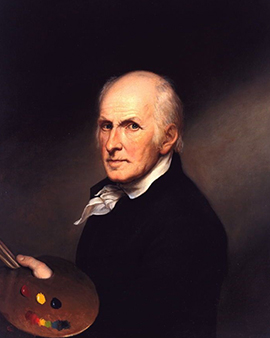
Charles Willson Peale had actually always intended to practice a trade. In 18th century North America, for example, he tried his hand at making saddles and repairing watches. But neither of these was his thing. When he started painting, he still considered it a pure craft and wanted to make his third attempt. However, it soon turned out that Charles Willson Peale had a natural talent for portraits. It was more than just pure craft to draw famous people. He expressed his artistic sensibility. He first spent his early years as an apprentice at John Singleton-Copley. There he learned the basic techniques with which he would later give the people he would portray their most authentic and majestically dignified appearance.
The turbulent period of the 18th century American Revolution, which Charles Willson Peale followed with great interest, helped him to hold a series of meetings and sessions with famous commanders, politicians, and future presidents of the United States. But before he immortalized greats like Thomas Jefferson and Benjamin Franklin in paintings for future generations in the 1770s, he went to England to study under Benjamin West. Peale was very impressed by him, as he had taught himself to paint completely by himself. Through his creativity Benjamin West had become one of the first American painters to make a name for himself in England. West was of the opinion that portraiture was about allowing human beauty to be fully expressed in the painting. The way he was able to develop his raw talent in order to live up to this high standard led Peale to study under West.
Peal probably succeeded best in depicting the grace of true greatness with his portrait of George Washington, which is still famous today. In later years, after a fulfilling career as a portrait painter, he moved to Philadelphia, where he purchased a property. He christened it the Belfield Estate. There he dedicated himself to landscape painting at the end of his creative period. The house on it is now known as the Charles Willson Peale House and belongs to the National Historic Landmarks in the USA.
 ×
×







 Passionate Customer Service

.jpg "Portrait of George Washington, 1776 by Charles Willson Peale")
.jpg)
.jpg "George Washington at Princeton by Charles Willson Peale")
.jpg)
.jpg "John Philip de Haas by Charles Willson Peale")
.jpg)
.jpg "Mrs. John Nicholson Hannah Duncan and John Nicholson, Jr. by Charles Willson Peale")
.jpg)
 1772 - (MeisterDrucke-44895).jpg "Portrait of George Washington (1732-99) by Charles Willson Peale")
 1772 - (MeisterDrucke-44895).jpg)
_c_1785_(watercolour_-_(MeisterDrucke-904356).jpg "Portrait of General Henry")
_c_1785_(watercolour_-_(MeisterDrucke-904356).jpg)
.jpg "Portrait of a Young Boy by Charles Willson Peale")
.jpg)
_-_(MeisterDrucke-1430027).jpg "George Washington at the Battle of Princeton by Charles Willson Peale")
_-_(MeisterDrucke-1430027).jpg)
.jpg "Exhumation of the Mastodon, 1806 by Charles Willson Peale")
.jpg)
.jpg "Mrs. James Smith and Grandson by Charles Willson Peale")
.jpg)
_-_(MeisterDrucke-1482832).jpg "Portrait of Robert Hazlehurst by Charles Willson Peale")
_-_(MeisterDrucke-1482832).jpg)
.jpg "Self-Portrait with Angelica and Portrait of Rachel by Charles Willson Peale")
.jpg)
 - (MeisterDrucke-369812).jpg "John Beale Bordley by Charles Willson Peale")
 - (MeisterDrucke-369812).jpg)
.jpg "Self Portrait with Angelica Peale and Portrait of Rachel by Charles Willson Peale")
.jpg)
_-_(MeisterDrucke-579260).jpg "Henry Clay by Charles Willson Peale")
_-_(MeisterDrucke-579260).jpg)
_-_(MeisterDrucke-1490288).jpg "Portrait of William Harris Crawford by Charles Willson Peale")
_-_(MeisterDrucke-1490288).jpg)
_-_(MeisterDrucke-878401).jpg "Eleanor Miller (Mrs. Francis Bailey) by Charles Willson Peale")
_-_(MeisterDrucke-878401).jpg)
.jpg "Portrait of George Washington after the Battle of Princeton, January 3 by Charles Willson Peale")
.jpg)
.jpg "George Washington at the Battle of Princeton by Charles Willson Peale")
.jpg)
.jpg "George Washington, after 1779 by Charles Willson Peale")
.jpg)
 after a drawing of the original by Charles Fraser (1782-1860) - (MeisterDrucke-149038).jpg "David Ramsay, engraved by James Barton Longacre after a drawing of the original by Charles Fraser by Charles Willson Peale")
 after a drawing of the original by Charles Fraser (1782-1860) - (MeisterDrucke-149038).jpg)
.jpg "General William North by Charles Willson Peale")
.jpg)
.jpg "Mrs. James Smith and Grandson by Charles Willson Peale")
.jpg)
 - (MeisterDrucke-114292).jpg "Dr. John Witherspoon, Engraved by James Barton Longacre by Charles Willson Peale")
 - (MeisterDrucke-114292).jpg)
.jpg "John Philip de Haas, 1772 by Charles Willson Peale")
.jpg)
.jpg "Peggy Sanderson Hughes and Her Daughter, c.1788-89 by Charles Willson Peale")
.jpg)
_c1795-1805_(oil_on_canvas)_-_(MeisterDrucke-1641147).jpg "Richard Henry Lee (1732-1794) by Charles Willson Peale")
_c1795-1805_(oil_on_canvas)_-_(MeisterDrucke-1641147).jpg)
.jpg "The Long Room, Interior of Front Room in Peale")
.jpg)
_-_(MeisterDrucke-1083824).jpg "Portrait of Nathanael Greene by Charles Willson Peale")
_-_(MeisterDrucke-1083824).jpg)
.jpg "Mrs. Samuel Mifflin and Her Granddaughter Rebecca Mifflin Francis by Charles Willson Peale")
.jpg)
.jpg "John Laurens by Charles Willson Peale")
.jpg)
.jpg "Charles Willson Peale Self-Portrait by Charles Willson Peale")
.jpg)
.jpg "Anne Catharine Hoof Green by Charles Willson Peale")
.jpg)
 - (MeisterDrucke-5961).jpg "Eleanor Miller (Mrs. Francis Bailey) by Charles Willson Peale")
 - (MeisterDrucke-5961).jpg)
_-_(MeisterDrucke-1628114).jpg "The Peale Family, c.1771-73 by Charles Willson Peale")
_-_(MeisterDrucke-1628114).jpg)
.jpg "Portrait of Mrs. Arbuckle and Son by Charles Willson Peale")
.jpg)
.jpg "Benjamin and Eleanor Ridgely Laming, 1788 by Charles Willson Peale")
.jpg)
.jpg "Benjamin Harrison, Jr., 1783 by Charles Willson Peale")
.jpg)
.jpg "Portrait of John and Elizabeth Lloyd Cadwalader and their Daughter Anne by Charles Willson Peale")
.jpg)
_1775_or_1778_-_(MeisterDrucke-580091).jpg "Mrs Ann Borden Hopkinson (1746-1827) 1775 or 1778 by Charles Willson Peale")
_1775_or_1778_-_(MeisterDrucke-580091).jpg)
.jpg "Samuel Mifflin by Charles Willson Peale")
.jpg)
.jpg "Benjamin and Eleanor Ridgely Laming by Charles Willson Peale")
.jpg)
_-_(MeisterDrucke-1099584).jpg "Portrait of Mrs. David Forman and Child, c.1785 by Charles Willson Peale")
_-_(MeisterDrucke-1099584).jpg)
.jpg "Amerigo Vespucci by Charles Willson Peale")
.jpg)
_-_(MeisterDrucke-1641455).jpg "Portrait of Robert Fulton by Charles Willson Peale")
_-_(MeisterDrucke-1641455).jpg)
.jpg "Rachel Leeds Kerr by Charles Willson Peale")
.jpg)
.jpg "George Washington at the Battle of Princeton by Charles Willson Peale")
.jpg)
.jpg "Portrait of Benjamin Henry Latrobe by Charles Willson Peale by Charles Willson Peale")
.jpg)
 engraved by George P - (MeisterDrucke-221313).jpg "Major General Thomas Sumter engraved by George Parker after a drawing of the original by William G. Armstrong by Charles Willson Peale")
 engraved by George P - (MeisterDrucke-221313).jpg)
_-_(MeisterDrucke-1642098).jpg "Amerigo Vespucci (1454-1512) by Charles Willson Peale")
_-_(MeisterDrucke-1642098).jpg)
.jpg "George Washington at the Battle of Princeton, 1781 by Charles Willson Peale")
.jpg)
.jpg "George Washington (1732) by Charles Willson Peale")
.jpg)
.jpg "Self Portrait by Charles Willson Peale")
.jpg)
.jpg "Rev. Joseph Pillmore by Charles Willson Peale")
.jpg)
_-_(MeisterDrucke-1090226).jpg "Benjamin Henry Latrobe, c.1804 by Charles Willson Peale")
_-_(MeisterDrucke-1090226).jpg)
 engraved by James Barton Longacre - (MeisterDrucke-230138).jpg "John Paul Jones, engraved by James Barton Longacre by Charles Willson Peale")
 engraved by James Barton Longacre - (MeisterDrucke-230138).jpg)
_after_the_Battle_of_Princeton_January_-_(MeisterDrucke-1021709).jpg "Portrait of George Washington after the Battle of Princeton, January 3 by Charles Willson Peale")
_after_the_Battle_of_Princeton_January_-_(MeisterDrucke-1021709).jpg)
.jpg "Worthy of Liberty, Mr. Pitt Scorns to Invade the Liberties of Other People by Charles Willson Peale")
.jpg)
.jpg "George Washington at Princeton by Charles Willson Peale")
.jpg)
.jpg "East Coast of North America by Charles Willson Peale")
.jpg)
_and_John_Nicholson_Jr_-_(MeisterDrucke-1288723).jpg "Mrs. John Nicholson (Hannah Duncan) and John Nicholson, Jr. by Charles Willson Peale")
_and_John_Nicholson_Jr_-_(MeisterDrucke-1288723).jpg)
_-_(MeisterDrucke-1228391).jpg "Rebecca Bryan White (Mrs. John White) by Charles Willson Peale")
_-_(MeisterDrucke-1228391).jpg)
.jpg "Robert Morris by Charles Willson Peale")
.jpg)
_-_(MeisterDrucke-1348278).jpg "Walter Stewart (1756-1796) by Charles Willson Peale")
_-_(MeisterDrucke-1348278).jpg)
.jpg "Portrait of George Washington by Charles Willson Peale")
.jpg)
.jpg "Rev. Joseph Pilmore by Charles Willson Peale")
.jpg)
.jpg "Thomas Jefferson by Henry Wolf")
.jpg)
_and_John_Nicholson_Jr_-_(MeisterDrucke-1421436).jpg "Mrs. John Nicholson (Hannah Duncan) and John Nicholson, Jr. by Charles Willson Peale")
_and_John_Nicholson_Jr_-_(MeisterDrucke-1421436).jpg)
.jpg "George Washington After the Battle of Princeton on January 3, 1777 by Charles Willson Peale")
.jpg)
.jpg "Portrait of a Boy with a Toy Horse by Charles Willson Peale")
.jpg)
.jpg "John Quincy Adams by Charles Willson Peale")
.jpg)
.jpg "John Beale Bordley by Charles Willson Peale")
.jpg)
.jpg "William Moultrie by Charles Willson Peale")
.jpg)
.jpg "Portrait of William Clark by Charles Willson Peale")
.jpg)
.jpg "George Washington at the Battle of Princeton by Charles Willson Peale")
.jpg)
.jpg "The Staircase Group (Portrait of Raphaelle Peale and Titian Ramsay Peale) by Charles Willson Peale")
.jpg)
.jpg "Major General Arthur St. Clair, engraved by Edward Wellmore after a drawing of the original by James Barton Longacre by Charles Willson Peale")
.jpg)
.jpg "Richard Henry Lee by Charles Willson Peale")
.jpg)
_-_(MeisterDrucke-900540).jpg "Portrait of a Young Boy by Charles Willson Peale")
_-_(MeisterDrucke-900540).jpg)
.jpg "John Beale Bordley by Charles Willson Peale")
.jpg)
_-_(MeisterDrucke-1128264).jpg "Joseph Dean, c.1785 by Charles Willson Peale")
_-_(MeisterDrucke-1128264).jpg)
.jpg "Margaret Strachan Mrs. Thomas Harwood by Charles Willson Peale")
.jpg)
.jpg "John Dickinson by Charles Willson Peale")
.jpg)
.jpg "Francis Bailey by Charles Willson Peale")
.jpg)
.jpg "John Philip de Haas by Charles Willson Peale")
.jpg)
.jpg "Anne Catharine Hoof Green by Charles Willson Peale")
.jpg)
.jpg "Portrait of John and Elizabeth Lloyd Cadwalader and their Daughter Anne by Charles Willson Peale")
.jpg)
.jpg "Portrait of Mrs. William Strachan by Charles Willson Peale")
.jpg)
.jpg "Boy with Toy Horse by Charles Willson Peale")
.jpg)
.jpg "Mrs. James Smith and Grandson by Charles Willson Peale")
.jpg)
.jpg "Francis Bailey by Charles Willson Peale")
.jpg)
.jpg "Raphaelle Peale by Charles Willson Peale")
.jpg)
.jpg "George Washington by Charles Willson Peale")
.jpg)
.jpg "Anne Catharine Hoof Green by Charles Willson Peale")
.jpg)
.jpg "Walter Stewart by Charles Willson Peale")
.jpg)
.jpg "John Nicholson by Charles Willson Peale")
.jpg)
.jpg "Rebecca Bryan White Mrs. John White, 1788 by Charles Willson Peale")
.jpg)
 1783-84 - (MeisterDrucke-264762).jpg "Pieter Johan van Berckel (1725-1800) by Charles Willson Peale")
 1783-84 - (MeisterDrucke-264762).jpg)
.jpg "David Rittenhouse by Charles Willson Peale")
.jpg)
.jpg "David Ramsay by Charles Willson Peale")
.jpg)

 +43 4257 29415
 support@meisterdrucke.com
 Mo-Do: 7:00 - 16:00 | Fr: 7:00 - 13:00